Showing posts with label Cricket. Show all posts

Friday, 10 April 2026

Book Review - Boon: in the Firing Line by David Boon and A. Mark Thomas

 Boon: in the Firing Line an autobiography with A. Mark Thomas

Sydney: Sun Australia, 1993        ISBN 0725107243

I've read quite a few cricket books and it's fair to say the quality is variable, especially when it comes to cricketers writing about themselves. This "autobiography" falls more toward the disappointing side of the ledger, despite the fact that David Boon is one of the all-time-great Australian cricketers with, I am sure, a fund of excellent stories to tell.

The reasons why this book is not what it could be are several-fold. Firstly, it's a book written before Boon's career was over - much is made of his lost opportunity to score a century at Lord's in 1989, but of course he scored a magnificent 150 on his next visit, so time has healed that wound. There is nothing about his fielding to Warne (famously catching the hat-trick ball in Melbourne), or watching him bowl, because this is a halfway-house of a book.

The main reason why this book is less than it could be is the fact that despite being termed an autobiography, I'm sure David Boon didn't write a word of it. It's clearly a book written by Thomas, based on interviews with the man himself and other people considered significant to the story. Unfortunately, Thomas has a clunky formulaic style of writing, and spends a lot of the time discussing the matches in general, instead of Boon's part in them.

It is also a curiously constructed book - a brief chapter on formative years, and Boon's time playing for Tasmania, before sections on playing England, the West Indies, and New Zealand before a final section where various people (Geoff Marsh, Richard Hadlee, the commentator Neville Oliver, Boon's wife and his first coach) write their opinions of the man.

Boon is famously a shy man and one of few words, but by far the best parts of the book are when he relates a story about a particular match, with a comment that is simultaneously cutting and funny. The book shows him as a team man first and foremost - a firm friend, but someone who's wrong side you should avoid if possible.

As a cricket tragic of a certain age (the same generation, if slightly younger) than David Boon, the description of particular matches and players brings back some great personal memories of watching those series, through both painful and glorious times for the Australian cricket team.

It's just a shame that the book provides no real insights into Boon the man, or Boon the player. I picked this book up for two dollars in my local op-shop, and that's about the worth of it.


Cheers for now, from

A View Over the Be

Sunday, 5 October 2025

Book Review - Mystery Spinner by Gideon Haigh

 Mystery Spinner: the Story of Jack Iverson by Gideon Haigh

Melbourne: Text Publishing, 2000              ISBN 1876485515

"So here, perhaps, lies a little truth in the life and death of Jack Iverson. More than 2000 men have played cricket for their countries, and what have we really known about any of them? Even today, when we study and write about the players so exhaustively, the idea that we can obtain a measure of their character seems essentially a journalistic vanity. Those who watched or wrote about Jack Iverson can have had little conception of his frail sporting self-worth. No-one who played with him could have fathomed the depths of his disappointments and fears. By a man's sporting deeds, we can know only the merest fraction of him."

This, the second-last paragraph of this book, seems to me to explain why the previous 350-odd pages of this book are so fascinating, and why indeed a cricket biography of a man who only played 23 days of Test cricket in his 58 year life can be one of the better cricket books I've read - as C.L.R. James famously wrote "what do they know of cricket, who only cricket know?". Haigh has given us here the life of a complex man, who happened to be a very unusual cricketer.

The spark for this book came from Haigh's curiosity about Iverson - they both attended the same secondary school, but Haigh could not find Iverson's name on any cricket honour boards or in the record books, so he wondered how Iverson made it to the top.

Almost everything about Jack Iverson's cricket career was unconventional, whereas nearly everything about the rest of his life was completely conventionally middle-class. Son of a self-made father who became a successful real estate agent, Jack boarded at Geelong College, and spent time after school Jackarooing in country Victoria. He joined up at the start of World War II and served in an anti-aircraft battery in the Middle-East, Africa, and the Pacific. It was during the down-time during his service where his cricket career began. When he was young he was not interested in cricket, but rather golf (he was a fine golfer who won many tournaments). He had the habit in his youth of spinning table-tennis balls between his thumb and third finger as a bit of a party trick. While he was playing cricket in New Guinea, he made the decision to try this "trick" when bowling a cricket ball, and met with some success.

After the War he went down to his local club in Melbourne (Brighton) and immediately began to take wickets. His unusual method of spinning the ball (which batsmen found hard to decipher), his unerring accuracy, and the height and pace of release made him a dangerous adversary.

His rise through District and State ranks was meteoric, until he became the sensation of the 1950 Ashes Series. This height of his career was brief, mainly due to Iverson's character. Because Iverson had not come up through the ranks of cricket in the usual manner, he had not developed what Haigh calls a 'cricket brain'. Iverson's lack of experience manifested itself in a few ways. Iverson seemed unable to vary his mode of bowling - he essentially had two different types of deliveries and seemed unable to easily vary his line, length, or speed. Some of the better batsmen he bowled to worked this out and managed to survive and even make runs against him. His character and relative lack of experience meant that he was unable to cope with lack of success: if he failed, he felt it very personally. In fact as Haigh points out, it seems that Iverson felt that his "trick" as he put it, would be found out sooner or later, and that he would be exposed as some sort of fraud. After his final game for Victoria he explained that he was retiring from First-Class Cricket because "they are playing me easily."

Iverson's life after cricket descended into depression and eventual suicide: it seems to me that the depressive turn to his character was always within him, even before he started playing cricket. He was always a slightly aloof figure, and it seems that Iverson's father dominated his life, bringing him into the family business. Jack seemed to do what was expected of him rather than what he wanted to do - perhaps it was not only on the cricket field that he felt he was an imposter.

This is a fascinating book, well-written and full of nuggets of information - Haigh, in the course of Iverson's story gives us essays on the development of spin bowling and its first exponent, and on the only other man to take Iverson's method into the Test arena.

Even if you are not a cricket fan, there is much in this book to enjoy.


Cheers for now, from
A View Over the Bell


Monday, 25 August 2025

Book Review - Simmo: Cricket then and Now by Bob Simpson

 Simmo: Cricket then and now by Bob Simpson

Sydney: Allen & Unwin, 2006               ISBN 978741750416

As always, the death of a great cricketer causes one to stop and reflect on their influence on the game. Since his recent passing it has been pointed out that there are few Australian cricketers who have had such an influence on the game for such a long period as Bob Simpson did during his career as player, captain, journalist and commentator, and coach. 

Part of one of the statistically great opening partnerships in test history with Bill Lawry, Bob Simpson captained Australia for 39 tests in total, famously coming back to captain the Australian team when most of the players had defected to World Series Cricket in the 1970s. I still have strong memories of watching that comeback series in my grandmother's house in Castlemaine - fascinated by the Indian spinners, and wondering who the old bloke that led Australia was.

I have much stronger memories of his time as Australian coach, where he and Allan Border came together to build the juggernaut that became the Australian team of the 90s and 2000s. He was uncompromising, with a strong work ethic, and he turned a group of fair cricketers into a world-conquering group. He never took a backward step, and he hasn't in this book.

Cricket then and now is a journey through Simmo's mind - from reminiscences of playing with greats such as Neil Harvey, Keith Miller and Richie Benaud, to his work as coach, to thoughts on throwing, umpiring, technique and concentration, there is much in this book to entertain and while away the hours until Summer comes again.

Simpson was one of the great slips fielders, so it's interesting to learn that he ended up in that position by chance, when during a New South Wales game he asked his captain Keith Miller where he should field "Oh, I don't know, laddie. There is a hole over there. That will do for you." That "hole" was first slip, and an hour and two catches later, his fate was sealed.

Simpson is also very strong on mentorship of younger players by older, and holds Neil Harvey in very high regard in this matter. He felt that without the guidance and support of the great left-hander his cricket skills, and more importantly his cricketing brain would not have become as well-developed as they had. He is fairly explicit in this book in explaining that this idea of mentorship was what drove him to become coach of Australia - in his view that passing of information on from one cricketing generation to the next had broken down in Australia owing to the WSC interregnum, and that the side of the early to mid 80s was struggling owing to inexperience, but without the capacity to improve by learning from their elders.

Therefore Bob took up the cudgels, and worked on turning that team into matchwinners. He worked hard on fielding - "you can't teach someone to be a great fieldsman, but you can teach them to be more than competent." This truism became the backbone of the great Australian sides - catches taken, boundaries turned into threes, and singles into run-out opportunities - they made any opposing batsman's time at the crease a constant source of stress. He bemoans in this book how (in 2006) that side of the Australian skillset had been left to wither somewhat (he wrote this book just before T20 took off, he might be heartened by the fielding exploits in that arena).

Simmo notes that  (when he wrote the book) the art of swing bowling had almost died. That it has returned somewhat would be pleasing to him, and also fits in with his chapter explaining how what comes around goes around in cricket history - batteries of fast men have been the answer, until they weren't, spinners were gone, then they came back, and Simpson has seen it all before.

Simpson is not afraid of controversy. His chapter on throwing is instructive and disappointing all at the same time. His journey through the history of the problem through the 1960s is instructive to those of us who didn't live through it, and his dismay at the current way devised to tackle the problem I think is shared by many of us. What I found most valuable was his description and explanation of what advantage bowlers find through throwing, and how that affects the batsman.

He is reluctant to compare players from different eras, and explains clearly why it is almost impossible to do so, along the way showing us that stats are quite often not the most reliable way to judge a cricketer's career (or whether a particular match was entertaining).

So, Cricket Then and Now is a bit of a tour around the cricket firmament from one of its luminaries. Not a bad read, and a nice way to remember the passing of a legend.


Cheers for now, from

A View Over the Bell

Saturday, 19 July 2025

Book Review - The 100th Summer by Greg Chappell

 The 100th Summer: 76-77 Season Pakistan New Zealand Centenary Test by Greg Chappell

Toorak, Vic: Garry Sparke & Associates, 1977                        ISBN 0959709894

I am one of those Australian men who was introduced to cricket in the 1970s. Our current crop of Australian cricketers can never in my eyes live up to my boyhood idols of Chappell, Lillee and Marsh. While I well remember my first day of watching live Test cricket at the MCG in 1981, it is the Centenary Test that first sticks in my mind as a complete match that I followed and took in via (black and white) television.

Greg Chappell has in this book written his account of that Test and the preceding series against Pakistan in Australia and New Zealand in New Zealand. It is a workmanlike description of the play, with less off-pitch description than I was hoping for.

The 76-77 season was one of re-calibration for the Australian side: the (in Chappell's opinion) premature retirement of his brother and Ian Redpath, along with Ashley Mallett and Terry Jenner calling it quits, meant that a lot of skill and experience left the team at the same time. And although Pakistan had their usual internal squabbles before the tour began, with threats of walkouts by half the team, when they did arrive on Australian soil they presented a formidable outfit with experienced players such as Mushtaq Mohammad, Majid Khan, Zaheer Abbas and Asif Iqbal, leavened with the youthful talent of Imran Khan and Javed Miandad.

The three Test series was a hard-fought one-all result, with Pakistan fighting hard and cannily on unfamiliar pitches, and Australia suffering most particularly in the bowling department after Jeff Thompson smashed his shoulder when he collided with Alan Turner in the first Test of the summer.

After the ignominy of defeat in the Third and last Test of the series in Sydney, Chappell took the team to New Zealand determined to do better. The general level of fielding and particularly catching was below standard against Pakistan, so Chappell worked his team hard in the lead up to the Tests. Max Walker came into the side to replace Thommo, but once again the bowling was the worry. Alan Hurst was in the touring party but didn't impress in the games before the Tests, so wasn't picked in the team. Gary Gilmour was in the side, even though his record in the lead up games was not much better than Hurst's, and he proved to be a weak link in what was otherwise a successful attack for this series (despite his schtick these days, Kerry O'Keeffe was a good attacking option for Chappell throughout this summer, as well as being a handy contributor with the bat).

The ups-and-downs of the extraordinary Centenary Test are well documented by Chappell - I won't go into them here as I don't think there is much in the book that isn't already well-known.

Now to the things that aren't in the book, particularly the elephant in the room..... the fifth-last paragraph of the book begins "[s]hortly before the start of play [in the Centenary Test] Dennis had called me aside in the room. I had a fair idea of what he wanted to tell me".... but no, it was not to tell Chappell he'd signed up with World Series Cricket, but to say his back injury had recurred. I'm supposing that because this book was published at the time, Chappell was reluctant to go into detail about the biggest cricket story of the decade, but there's a certain amount of irony in the fact that he spends a couple of pages earlier in the book discussing an agreement with the Australian Cricket Board around sponsorships that allowed cricketers to maximise their income-earning potential. If you pick up this book thinking you'll get any insight into the behind-the-scenes action to do with WSC, you will be disappointed.

Chappell has a reputation for being uncompromising when it comes to playing the game, but I feel that he comes across in this book as someone who understood how difficult it was to play at the highest level, and his descriptions of how a player may have got through a difficult period in a match adds much more to the fall of play than the numbers on the scorecard may suggest (the scorecards and averages are included in this book, as is a name index).

I'll sign off with a quote that shows even the greats don't always get it right. "In only their second Test together, [Ian] Davis and [Alan] Turner were showing an understanding that held out the promise of a combination which could provide a valuable contribution to Australian cricket fortunes in the future." Turner was out of the side by the end of the summer, never to return.


Cheers for now, from
A View Over the Bell


Tuesday, 3 June 2025

Book Review - Silence of the Heart by David Frith

 Silence of the Heart: Cricket Suicides by David Frith

Edinburgh: Mainstream Publishing Company, 2004          ISBN 184018406X

What a strange, compelling, yet ultimately unsatisfying book! Probably only David Frith, with his stern views and dogged determination could have written it, but I do wonder whether even he might have lost heart at times during this project.

There is no doubt that as a sport Cricket is very different to most. A team game that relies uniquely on the performance of individuals, where base chance plays an inordinate part in success or failure, and where there is ample time even during a game to reflect on one's own performance, a thoughtful person could begin to wonder whether in the right circumstances depression over performance could lead to suicide.

At first it seems Frith might be on to something, as in the preface he states that Test cricketers have committed suicide at twice the rate of the rest of the population (in the UK), and goes on to show that they have killed themselves at seemingly higher rates than top-flight participants in other sporting codes.

What then follows is over 200 pages of people who have played cricket at first-class level (some only one game) across the world (although the book focusses mainly on England and Australia) who took their own life. Frith shows enormous dedication in delving not only into each person's cricket history, but also into their personal lives and (obviously) into their deaths. While some lives are short and some are boring, others are a fascinating insight into the mores and times in which they lived.

There are names with which I'm familiar (Stoddart, Trott, Wills) and others that I will no doubt never read about again. As suicides however, the stories are mostly depressingly familiar: usually those in this book killed themselves (and sometimes others) for the "usual" reasons; money, gambling, love, illness, old age. Their methods are mostly familiar as well - gunshot, gas, poison, drowning, jumping to their deaths (it might have been interesting for Frith to do a statistical analysis of the types of death - are cricketers more prone to one way of killing themselves than another?).

As Mike Brearley writes in the Foreword, we can never really ultimately know why someone chooses to take their own life, but as Frith states in the final chapter most of the suicides of which he has written occurred for reasons other than cricket (in fact pretty much the only ones he can definitely pin down to the game are those of fans rather than players). Frith then goes on to speculate whether, rather than cricket "causing" suicides, people who are more prone to depression are drawn to cricket. As Brearley said, it's really unknowable.

On a final note, another unique thing about cricket is the literature is has spawned. This book is one of the more curious.


Cheers for now, from
A View Over the Bell


Friday, 17 January 2025

Book Review - Sultan: a memoir by Wasim Akram

 Sultan: a memoir by Wasim Akram with Gideon Haigh

Melbourne: Hardie Grant Books, 2022     eISBN 9781743589106

Wasim Akram. An absolute master of fast bowling, the memory of cricket lovers who have seen him bowl is of his searing late-swinging yorkers ripping out the stumps of hapless batsmen the world over. Captain of Pakistan multiple times, with over 400 test wickets and 500 one day wickets and three test centuries to his name, he is a true champion of the great game.

Sultan is not just a re-hash of Akram's great bowling or batting: in this book he opens up more about the non-playing side of his life - his introduction into the Pakistan team, moving to England and learning a different cricket culture (not to mention culture in general), and the amazing and depressing internecine snake-pit that is Pakistani cricket.

As an Australian cricket afficionado, the parts of the book most fascinating to me were Akram's descriptions of the politics that surround Pakistani cricket....and they are actually politics, as many appointees in cricket administration are made at the behest of the government; and while cronyism has an impact on cricket all over the world, in Pakistan it is taken to extremes - as Akram states in the introduction "[p]atronage has always mattered in Pakistani cricket. The Pakistan Cricket Board chairman is a political appointee; there is a lineage of generals, judges and senior civil servants in the role. From the Mohammads to the Niazis, our game is pervaded by dynasties. Names recur: Ahmeds and Akmals; Rajas and Ranas."

Akram gradually comes to realise what all this means for team cohesion. As he becomes a permanent part of the team, under his mentor (and hero) Imran Khan, he slowly comes to realise that Khan and the other great Pakistan player from that period, Javed Miandad are not friends, but in fact rivals for the captaincy. This "selfishness" for want of a better word, pervades the team. Hierarchy within the players is jealously guarded, cabals are formed to push for positions within the team, favours are granted, players that have "push" within the media or the political sphere may be made captain, or even selected in the team, based on factors other than talent and form.

In fact with all the self-interest and nastiness on display in Wasim's version of events, it's amazing that the Pakistani team was able to function at all, let alone be as successful as they were during the period of his career. Akram explains how during his career he was in or out of favour with the powers-that-be and some of the players, and that every time he was made captain he was instantly undermined by a cabal of players or officials. It wasn't necessarily that they didn't think Akram could do the job, or even that they didn't like him; it was that they wanted the prestige and money that comes from power.

The saddest part about this sorry tale is that the Pakistan cricket team at that time had the talent to be the best in the world. Unfortunately they squandered their time and effort on grasping for the spoils everywhere except on the field of play.

Akram does face up to his demons in this book too - his inattentiveness as a husband and father with his first wife, his addiction, and his naivety which drew him into the ongoing betting scandals that wracked cricket while he was playing (he convincingly shows that he was innocent of any taint of match-fixing).

Akram now spends his time living in Pakistan, England (where he played County Cricket for over ten years), and Australia (where his second wife was born), has come to terms with the death of his first wife, and has written this book (Gideon Haigh has done a wonderful job of assisting here - I'm not sure how much Wasim actually wrote, but it sounds like him all the way through) as a memoir mainly for his children, who didn't see him play, and sometimes wonder why he has six million followers on social media.

A really good cricket memoir, that goes places some others don't go, and doesn't pull any punches.


Cheers for now, from

A View Over the Bell

Friday, 8 November 2024

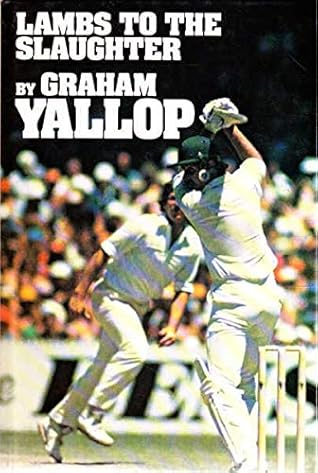
Book Review - Lambs to the Slaughter by Graham Yallop

 Lambs to the Slaughter by Graham Yallop

Collingwood, Victoria: Outback Press, 1979              ISBN 0868882275

The 1970s was a tumultuous decade for Australian Cricket - from the disastrous loss to South Africa that cost Bill Lawry the captaincy, through to the season that Graham Yallop dissects in this book, we went through the ups of Lillee and Thomson and the downs of the WSC breakup, the latter of which had a huge impact on the Australian team and the series that Yallop describes in this book.

The 1970s was also the decade in which I grew to love cricket - my first clear memories of the game are the test series against India which was the summer before the events described in this book, and of course the whole WSC circus, which made for great television, and gave a whole new generation a love for the game. As I read this book, the pain of that summer came back to me.

By the end of the book the reader is as shell-shocked as Yallop himself seems to be by the absolute thrashing delivered to Australia by England. The Australian team was young and inexperienced, as practically all the established Australian players had defected to WSC - Yallop was captain at 26 and had only played eight Tests at the start of the summer (the most-capped player was Gary Cosier with 16), while the England team had the experience of Boycott and Willis, along with the youthful talent of Gooch, Gower and Botham; the latter two having stellar seasons.

Despite the apparent difference in ability and skill, Yallop had a reasonable hope that the Ashes would be a hard-fought series. Despite Yallop's insistence in this book that it was poor pitches and poor decisions by players and umpires that made the difference between the teams so stark, hindsight and a disengaged view would suggest that the Australian team picked for that summer, one player aside, was simply not up to scratch, and England outplayed Australia at every opportunity.

This book follows Australian cricket lovers around - there is usually a copy in any second-hand bookshop that has a sports section, and "Lambs to the Slaughter" is a phrase that is now used about the "official" Test teams during the WSC interregnum. So it's strange that it's taken me until now to read it. Perhaps I was unconsciously protecting myself from the re-lived pain of what was a very low point in our cricketing history.

There are several subjects that come out for me in this book, only some of which are raised by Yallop consciously. The first is the explosion of talent that was Rodney Hogg. With a record wicket haul in the series, he was the shining light of a poor summer for Australia. He was a famously abrasive character, and Yallop goes into some detail about how he was a difficult player to manage, which was not helped by the fact that before the series started, Yallop had never met him. The second is how little assistance was given to an Australian captain back in those days - it was only half-way through the series that the Australian Cricket Board thought that appointing a manager to the team to handle logistics, the media and so forth might be a good idea. The thought that the powers-that-be of cricket dropped an inexperienced 26 year old into the "most important job in Australia" with virtually no support is quite mind-boggling.

The final subject is Yallop himself. One very much gets the feeling that he wrote this book in anger: anger at how he was treated by the press, by the Board, and by the "cricket gods". He bemoans the inability of the Australian team to gell and put together a team performance required over the time required to consistently win a test match, but in reading the book I get no sense that he took responsibility to try and build the team in that way. I could of course be selling him short, but for this reader, more insight into the off-field activities and performance would have fleshed out his narrative - I didn't really get a sense of how the players as a unit tackled their poor performance. While the descriptions of play are useful, that is not really why we armchair cricketers read these sorts of books.

Having stated that, if you want to know the story of the 1978-9 season from an Australian viewpoint, you must read this book, which has become a bit of a minor classic.


Cheers for now, from

A View Over the Bell

Monday, 4 November 2024

Book Review - The Magic of Spin by Ashley Mallett

 The Magic of Spin: Australia's Greatest Spin Bowlers by Ashley Mallett

Melbourne: Hardie Grant Books, 2019      ISBN 9781743795781

Cricket is coming - India has arrived on our shores, and it's not long now until the first Test in what could very well be an enthralling series. Most years at this time I get myself into gear for the season with a couple of (hopefully) good books. Ashley Mallett - until the advent of Nathan Lyon Australia's most successful off-spinner - usually delivers, with well-written and informative tomes. This one is a little quirkier than some of his other works, and may well be the last book he wrote before his death in 2021.

If it was, the subject matter couldn't be more appropriate - Mallett was a firm believer in the value of spin bowling in the highest levels of cricket, and spent much time coaching after his playing days were over. The Magic of Spin is Mallett's personal paean to Australia spinners past and present, and to the ongoing legacy that is handed down from (cricketing) generation to generation.

All the expected names are here - Giffen, Turner, Trumble, Noble, Mailey, Grimmett, O'Reilly, Benaud, Mallett, Bright, May, MacGill, Warne and Lyon. There are also those of the second rank, and also those that never got the chance to play Test cricket, but whom Mallett thought could have, or were great servants at first class level. Each player gets a varying number of pages, from two (Bill Howell, Don Blackie, Doug Ring, David Sincock, Tom Veivers) to fifteen (Shane Warne). Those pages contain all sorts of information - from Arthur Mailey's conversations with the King, to Terry Jenner's ideas about coaching, Benaud's stints as a commentator, down to Mallett's own peregrinations as a journalist. It may not be pure cricket, but it does give a sense of the different characters that make up this long-suffering tribe of sportsmen.

If there is a theme that runs through the book, it is the willingness of the tribe to pass down its secrets. From CTB Turner advising Bill O'Reilly to stick with his unorthodox grip, to Clarrie Grimmett sharing the secrets of his flipper, to Terry Jenner explaining spin-bowling strategy to Shane Warne, to Mallett himself (who gratefully received advice from Grimmett) advising a young Nathan Lyon on his follow-through, each generation of spinners has built on the hard-won knowledge of their predecessors.

While I would in no way suggest this is a great cricket book, it is a great way to whet the appetite for the upcoming summer, and to dip back into history to relive some great cricketing moments.


Cheers for now, from

A View Over the Bell

Monday, 10 June 2024

Book Review - The Vincibles by Gideon Haigh

 The Vincibles: A Suburban Cricket Season by Gideon Haigh

Melbourne: Text Publishing, 2002               ISBN 1877008354

There is no doubt that Gideon Haigh is the doyen of current Australian cricket journalists, and little doubt that moniker can be applied worldwide. An insightful commentator on current cricket, a wonderful writer on cricket history, and a scathing judge of cricket administration, Gideon provides thoughtful insight on all aspects of this wonderful game.

And that includes suburban cricket...park cricket...village green cricket, call it what you will, Haigh has provided us in The Vincibles with a heart-felt, heart-warming and amusing expose of a season playing in the Fourths for his beloved Yarras (the South Yarra Cricket Club), where he was at the time Chairman of Selectors (and has gone on to be a life member).

While this is a book about a particular season at a particular club, Haigh has evoked every season at every club. For me, much of the humour in the book was when Haigh described incidents that evoked memories of my times playing club cricket in suburban Melbourne. For this is as much a book about characters and off-field incidents as much as it is the on-field action.

There are a few threads that run through this "diary". Money is a major one - getting enough to keep the club's head above water is a constant theme, helped by karaoke nights, trivia nights, and all those other activities that those of us who have been club members would remember. Because Haigh was Chairman of Selectors during the time he wrote this book, selection is another theme that runs through the book, from the early season struggles to field enough people to make up four teams, to the late season struggles of whom to omit from teams when you have a situation where the Firsts have failed to make the finals and the Seconds have been bumped out in the first week, but the Thirds and the Fourths have made the Grand Final. 

The characters that make up the club are what makes the club. Glorying in nicknames such as Churchyard, Moof, Castaway, Torqs and Rasputin, Haigh introduces us to a typical park cricket team - the devout Christian, the itinerant drunk, the pantsman, the barrister - they are all here, working (or bludging) for the common purpose of trying to succeed at playing cricket.

Note I didn't state winning games of cricket: despite the myths, club cricket in Australia is more about blokes getting together to enjoy each other's company while playing a game that they love rather than the all-out pursuit of victory. If victory happens to come their way all the better, but that is not what necessarily sustains clubs and clubmen. It is the camaraderie, the combined effort to master what is perhaps the hardest game to do well at, that we remember from our playing days.

I really enjoyed this book, where the denouement that describes the day that Haigh's Fourths lost their Grand Final while on the next-door oval the Thirds claimed a famous victory shows the reader that just being a part of a team is fulfilment in itself. As Haigh writes "The second-rate, when you think about it, are much maligned. Being second-rate is still pretty good. In fact, it's usually the best you can hope for, in a world where genuine first-rate anything is a rare commodity."

I really enjoyed this book - it almost makes me want to roll the arm over again and strap on some pads.....almost. Highly recommended. 


Cheers for now, from

A View Over the Bell

Monday, 6 November 2023

Book Review - Time to Declare by Mark Taylor

 Time to Declare by Mark Taylor with Ian Heads

Sydney: Ironbark, 1999                                                           ISBN 0330361848


Cricket it seems, more than most other sports, lends itself to the written word. In my opinion there are many reasons for this - the time it takes, the breaks in play that lead to deeper thought on what has occurred and what may be about to occur, the way cricket today can reflect back to past cricketing events, and not forgetting the endless statistical delight that the game gives us.

So we come to the autobiography of the man who I feel has been the best Australian captain of the last fifty years. As a leader he was always optimistic and supportive of his team-mates, but it was as a tactician that he shone. Taylor rarely miss-stepped as captain, and he quite often made changes in the field that turned out to be inspired. This, added to his steady batting and brilliant slips fielding make him one of Australia's best cricketers of his generation. 

Unfortunately, in Time to Declare, Taylor has not chosen to discuss in any great depth his tactical decisions, or how he managed the team. This is more of a "traditional" cricketer's book, listing anecdotes, family life, and personal milestones. Taylor does weigh in on some controversies, particularly throwing and whether Australia should have separate captains for different forms of cricket: hot-button issues when he wrote this book, but somewhat old-hat now (although his opinions are interesting nonetheless).

For those of us who have seen and heard Taylor commentate, Time to Declare will hold no surprises. He is a straightforward type of man who says what he thinks. He was an aggressive captain, in the sense that he was always striving for the win, but never seemed an aggressive player. Some of the episodes he relates from his early cricketing life are about his aggressiveness, and learning how to temper that so that it became a productive force for him. There are several occasions in the book where he shows some understanding and forgiveness for the excesses of some of his younger team-mates (Ponting and Warne in particular), and explains clearly how difficult it can be to live the life of a professional sportsman.

What we don't get is very much explanation of his thinking as captain, or even as a batsman. We get the stories, but not the thinking behind them. That's a shame. I do wonder if that might be a product of Taylor writing this book in the six months immediately after his retirement: perhaps a longer period of reflection may have given us a book with more heft.

As it is, Time to Declare is pretty much another run-of-the-mill cricket book, which is not without its interest and nostalgia.


Cheers for now, from
A View Over the Bell


Tuesday, 11 July 2023

Book Review - Hitting Across the Line by Viv Richards

 Hitting Across the Line: an Autobiography by Viv Richards

Sydney: Sun, 1992                                                    ISBN 0725107073

As I write this review, we are witnessing an Ashes series for the ages - two teams going hell-for-leather with nothing between them. Even though it's the middle of winter here in Oz, one's thoughts turn to the greatest of games every night as each test match so far has ebbed and flowed. Bazball meets the World Test Champions makes for a fascinating tussle, and too much cricket is never enough, so my daytime revolves around the current cricket news, and this "autobiography", which I picked up for a song at an op-shop and will pass on to others through my local neighborhood free library.

I write autobiography in quotation marks as this book is quite clearly ghost-written (by Mick Middles), and in some ways is a let-down for me. Apart from the clunky openings to each chapter, where we get a page or two written by Middles to try and give us the essence of Viv, but which are actually cringeworthy, this book is a fairly standard cricketer's story - some chapters on youth, his breaking into the West Indian team, various chapters about the County Game, and some reflections on his life and some of the issues that Richards sees as important within cricket.

For such a dominant figure when out in the middle, this book seems, if anything, subdued. Richards gets stuck into the press, particularly the British Tabloids, but - to me at least - treats the cricket establishment, both in the West Indies and England more kindly than it perhaps deserves. He skirts around the scandal of his sacking at Somerset, and only spends a few pages discussing the internecine politics of West Indian cricket.

In fact, and I hate to state this, Hitting Across the Line feels very much like something dashed off in between other activities, with a nod to what people expect to hear, but not with too much thought. Middles' little prologues to the chapters seem to suggest that is very much what happened - if, as is indeed suggested, these prologues show how the book was written, it seems that Middles drove around Antigua with Richards and recorded his answers to questions as Richards was on the way to the local bar, or to the sporting ground.

This book doesn't do justice to such a giant of the game. Unless you are a complete Richards tragic, I'd give this one a miss.


Cheers for now, from
A View Over the Bell


Sunday, 13 March 2022

Book Review - The Inside Edge by Rodney Marsh

 The Inside Edge by Rodney Marsh

Sydney: Lansdowne, 1983          ISBN: 0701817771

Any true Australian Cricket fan is going through a tough time at the moment, with the demise of Shane Warne and Rodney Marsh. As someone who grew up in the 70s, the demise of Marsh, at this stage, has hit me more than the demise of Warne. Like many my age, my heroes could be summed up in three names - Lillee, Marsh and Chappell. Greg Chappell had the grace, Lillee had the menace, and Marsh was the everyman: there was no doubt of his skill, but he seemed like one of us...he looked like your mate's Dad.

But in every way he wasn't like your mate's Dad - he was, for quite a few years, the embodiment of Australia. He was such a presence, then and later in his career when he moved into coaching, that it's hard to believe he's gone. The Inside Edge, written just after the 1982-83 season, is a collection of Rodney's thoughts on the recently completed tour of Pakistan, the victorious Ashes series, and views on players and fans, all delivered in Rodney's no-nonsense style.

He pulled no punches in deploring crowd behaviour, especially at the WACA, where Terry Alderman busted his shoulder tackling an errant spectator. Neither was he backward in airing his views on the up-and-coming Australian players. He loved what he saw of an emerging Geoff Lawson, and the renewed vigor of Rodney Hogg and David Hookes.

He reiterates the true grit and never-say-die attitude of his great friend Dennis Lillee, and he admires the grace under fire of Bob Willis, and tells us that not only did he not see a ball of the great Border-Thomson partnership that nearly won us the Melbourne Test, but also  that he was drunk for the lot of it!

Not only is The Inside Edge a reminder of Rod Marsh's longevity, skill and sense of humour, but also reminds us of a great period in cricket, and some of the lesser lights. Reading it made me smile, and helped ease the pain of the loss of one of Australia's greats. RIP Bacchus.


Cheers for now, from

A View Over the Bell

Wednesday, 2 February 2022

Book Review - The Border Years by Gideon Haigh

 The Border Years by Gideon Haigh

Melbourne: Text Publishing, 1994            ISBN 1875847065

Gideon Haigh, on his website, describes this book as a "quickie about Allan Border's life and career, on the occasion of his retirement from international cricket. Nice pics." That is a very accurate summation of this book. As time has passed the legacy left to Australian cricket by Allan Border has become more obvious, but The Border Years is a pithy summary of the cricketing life of one of the true greats as he left the playing field.

What I enjoyed about this book - reading it in the summer of 2022 - was that it reminded me not so much of the tropes that we remember now about "Captain grumpy" or how he often came out at number 5 to save an innings teetering on disaster, but of his early pre-captain days, when he was an attacking left-hander with plenty of aggressive shots, making his mark in a team of greats.

This book also began a conversation with my eldest son, a cricket tragic, that (I hope) opened his eyes to another period of Australian cricket, and how so much has changed in the game both of us love.

This is a short coffee-table style book, and the writing, while interesting, is perhaps not up to the thoughtful and provocative best that Haigh can be. But good for an hour or so on the sofa at a rented house at the beach.

Why did I read it then you ask? Well how often can you pick up a book at an op-shop for three dollars that has been signed by the great man himself?


Cheers for now, from

A View Over the Bell

Monday, 27 November 2017

Book Review - Clarrie Grimmett: the Bradman of Spin by Ashely Mallett

Clarrie Grimmett : the Bradman of Spin by Ashley Mallett

St. Lucia, Qld: University of Queensland Press, 2003     ISBN 0702225312

Don Bradman looms like a colossus over pre-war Australian cricket history. His legacy is so great that it overshadows much of what occurred between the Wars. The casual cricket fan may have heard of Woodfull and McCabe thanks to Bodyline, and maybe "Tiger" O'Reilly, but most other players have subsided into oblivion. This serviceable biography by former Australian spinner Ashley Mallett reminds the reader that Clarence Victor Grimmett was one of the true greats of the game.

In fact Mallett, through statistical analysis, shows that Grimmett could indeed be said to be the Bradman of bowling. His test record is indeed extraordinary: in a mere 37 test matches he snared 216 wickets, grabbing 5 wickets in an innings 21 times and 10 wickets in a match 7 times. He achieved the "bowler's century" (5-for), every 1.76 tests. Bradman scored a ton every 1.79 tests.

Scyld Berry, in his book Cricket : the game of life, notes how cricket writing generally discusses batting in positive language and bowling in negative, and it would seem that to be the Bradman of spin when Bradman himself was playing was to be relegated to the second rank in the thoughts of history. This is not to claim that Grimmett wasn't viewed as a star during his career - no less a person than King George V chatted amiably with "Clarrie" and asked him to show him how to spin the ball.

Grimmett was born in New Zealand, and it was his burning desire to play cricket at the highest level that drew him "over the pond" to Australia in 1914. He landed in Sydney and soon was impressing in District ranks. However at State level the great Arthur Mailey ruled the spinner's roost, so Clarrie moved South to Victoria. He spent several very successful seasons playing for South Melbourne and Prahran, but - not for the first or last time in his career - cricket politics crueled his ability to play for his State. South Australia saw an opportunity, and lured him to Adelaide with an offer of a job. Adelaide became Grimmett's home for the rest of his life, and South Australia the State for which he took the majority of his 1424 first-class wickets (from 248 matches).

His bowling must have been something to see - his stock legspinner was deadly accurate, his variations in pace hard to pick, and his topspinner trapped many great batsmen lbw. With his peculiar round-arm action, and his habit of wearing his cap while bowling, he seemed an old-school cricketer. In many ways he was: his first-class career spanned the years 1911-1941, he bowled early in his career to the great Victor Trumper and by the end of his career he was witnessing the growth of the team that would become "The Invincibles". Grimmett was a late bloomer, playing his first test at 33 years of age, and at his last he was 45. In his last test he took 13 wickets, so the shock in the country when he was not selected for Australia's next series was severe. Grimmett himself was stunned but, as was his way, never publicly showed it. Mallett does point out that Grimmett probably held Bradman to blame for his relegation and his retaliation was to always place Bradman's place in the batting pantheon below other greats such as Trumper, and some others such as Jackson.

Mallett describes a man who lived for bowling, having his own pitch in his backyard in Adelaide, where he honed his skills hour after hour. Unlike his great bowling partner O'Reilly, Clarrie was quiet on the field: only the glint in his eyes would betray his glee on getting another scalp.

Although this book was published in 2003, Mallett makes no mention of Shane Warne, the recent great who surely brings to mind how spectators must have felt watching Grimmett bowl. The absolute control of his skill, the ability not only to create a plan for a batsman's demise, but to carry it out, and the creation of an aura that sometimes was all that was needed to get a wicket, would have been great to watch, and fearsome to face.

Mallett has a solid journalistic style, and his research is solid. The best parts of this book are the quotations from contemporaneous sources, which go some way to giving a 21st century reader an idea of what it was like to see Grimmett bowl and to face him as a batsman.

For the historian of cricket, this book is worth reading.


Cheers for now, from
A View Over the Bell

Monday, 9 October 2017

Book Review - Stroke of genius by Gideon Haigh

Stroke of genius - Victor Trumper and the shot that changed cricket by Gideon Haigh

London: Simon & Schuster, 2016                ISBN 9781471146800

Stroke of Genius: a phrase that could be employed on more than one occasion to describe the cricket books penned by one G. Haigh. The Cricket War and On Warne are two of the best books I have read on the game: they are now joined by Stroke of Genius.

I suspect that, like me, Haigh's first memory of Victor Trumper would be of seeing the Beldam image "Jumping Out". Stroke of Genius is a book about Trumper, Beldam, that photograph, and so much more. While strictly speaking not a biography of Trumper, we learn enough about his life beyond cricket to know that it was really cricket that was his life.

Haigh unpicks the legend, describing Trumper's run-ins with both cricket and rugby officialdom, and his tenuous business life, which involved runs of debt and insolvency. Haigh also gives us a wonderful history of the development of cricket imagery and action photography, and how Beldam made many advances in this area prior to World War One. In fact if it wasn't for Beldam we wouldn't have many of the iconic Edwardian cricket images at all.

Like all legends, Trumper's has been used by many people to support their cause or beliefs. Lauded  by Cardus and others as the epitome of amateurism, Haigh demonstrates that Trumper was very much the cricket entrepreneur and tried many schemes to make money from his skill. Used as an exemplar of the way Australia plays attacking cricket, Haigh explains that, until Trumper came on the scene, Australian bats were known as dour accumulators. Used by the cricket establishment as a symbol of their tradition, Haigh argues that - like Bradman in his early years - Trumper stood for players rights against the power of the hierarchy. Used by some as a stick to beat Bradman with, Haigh definitively shows them as different cricketers. Trumper's early death in the midst of war helped set the stage for the legend to build.

So it is good that another thing Haigh does very well is bring the reader an idea of just how great a player Trumper must have been. The praise heaped on his playing by those who knew what they were talking about, when brought together, is extraordinary. What struck me is how many who saw him ranked him above Bradman, for his artistry if not for his statistics. So many writers exclaimed that words could not describe his ability. The word " genius" was not in Edwardian times used in the field of sporting endeavours, and yet it was used often in attempting to describe Trumper.

What we do have are the photographs, which if studied closely, begin to give us some idea of his ability. Statistics don't always convey reality, and as Haigh points out, until Bradman came along they did not carry the authority that they do now in assessing the ability of a player. I don't know how many arguments I've engaged in where the stats are used as a final arbiter (...and I still think Mark was the superior Waugh at the crease, no matter what the numbers say).

Trumper must have been a magnificent player to watch. He must have had complete control of his technique, and a wonderful ability to demolish an attack - a cross between Gilchrist, Greg Chappell and the aforementioned Mark Waugh. Haigh has brought the modern cricket lover closer to Trumper, as well as yet again showing us cricket's intricate, sometimes brutal, yet often beautiful, history.

Another tour-de-force from a man who is surely the Trumper of cricket writers.


Cheers for now, from
A View Over the Bell

Monday, 18 April 2016

Book Review - Chasing shadows by Tim Lane and Elliot Cartledge

Chasing shadows : the life & death of Peter Roebuck by Tim Lane and Elliot Cartledge

Melbourne: Hardie Grant Books, 2015                         ISBN 9781743790120

What to make of a man's life when that man is careful to shield many aspects of it from his acquaintances? For Peter Roebuck, it seems from this book, had very few people he could truly call friend. Lane and Cartledge have tried - by talking to people who knew him, and by looking closely at the parts of his life where they could manage to find information - to discover what might have led him to throw himself from the window of the Southern Sun Hotel in Capetown in 2011.

The book looks at his upbringing, and especially at his time at Somerset, where he was a successful player almost in spite of himself, but is possibly best remembered there as the man who got rid of Viv Richards and Joel Garner, which precipitated the departure of Ian Botham. Before heading into murkier territory, his work as a journalist and life in Australia and South Africa are noted.

There is no doubt that Roebuck was an intense and odd character. Much has been made of his sexuality, and while Lane and Cartledge have discovered that Roebuck did have at least one important heterosexual relationship, there can be no definitive answers on Roebuck's orientation. However, what seems more important in his makeup is his character. He certainly had strong opinions on what made character, being firmly of the belief that cricket took a major part. This belief led him down a strange path.

The authors paint a picture of a man who, whilst obviously very intelligent, had little social sense. Roebuck seemed to have no innate knowledge of, nor does it seem he was inclined to learn, the social graces and give-and-take that make for solid bonds with other people. Some of those interviewed for the book speculate that Roebuck felt a need to be the leader, the one who people looked up to. This could go some way to explaining both what happened at Somerset, where he acquiesced in getting rid of the players that could challenge his leadership, and in the way he ran his "houses" in South Africa, where he dispensed advice and discipline.

His journalism too, as he progressed in his career, seemed to become more dogmatic and fixed on certain themes, sometimes from an angle that may seem strange to the reader. He no doubt was correct in singling out the corruption in Zimbabwean cricket, but his crusade took little note of the enmities and casualties that he left in his path.

All of which is to bring us closer to the moment of his death. Roebuck has a well-developed sense of persecution, and felt that there were forces out to get him. Initially he felt it was Botham and his supporters, but then even the Zimbabwean government seemed to enter his frame. Lane and Cartledge point out that while these theories occupied Roebuck 99% of the time, for Botham anyway 1% of his time, if at all, was given over to thinking about Roebuck. For a highly intelligent, rational man, this was odd behaviour.

Roebuck certainly thought it was Botham and his cronies who were behind the assault charge and conviction in 2001, which shattered him and haunted him for the rest of his life. However, as the authors point out, this is hard to sustain for several reasons. Firstly, it is clear that he did strike the boys, nevermind the issue of consent, and Secondly it is hard to believe that a man who got a First in Law at Cambridge could fail to understand that pleading guilty to a charge means admitting that it occurred. Yet another occasion where an intelligent man in other ways failed completely to grasp his situation in a social sense.

Despite his anguish at the assault conviction, it doesn't seem to have stopped him from believing that corporal punishment was part of the educative process: as he himself admitted he had "very right wing ideas" about education. It is very hard to get to the bottom of why Roebuck felt it necessary to cane his charges. Testimony from many of them suggests that they themselves chose that punishment, rather than be punished by household chores. Henk Lindeque, one of those who brought the earlier charge of assault, claimed that Roebuck wanted to see the welts, which was where sexual issues come into it. Roebuck claimed he only wanted to see the welts to ensure he wasn't caning the boys too hard.

The picture of Roebuck built up by the authors leaves the reader thinking that it is just possible that Roebuck was looking dispassionately at his handiwork to gauge whether he was going over the top. The tragedy really is that he seems to have had little awareness of how this might seem to Lindeque and to anyone else who heard about it.

Which brings us to his death. Itai Gondo, the man who made the claim of sexual assault that led to Roebuck's death, has been notoriously hard to find, but did make himself available to the authors for interview via Skype. Just as the reader is being led to think that perhaps Roebuck's paranoia might have a grain of truth, and that Gondo's accusations were part of a Zimbabwean government plot, Gondo's testimony sways the mind again, and it seems that indeed Roebuck may have made an inappropriate advance. And yet, Gondo seems to have done very well for himself since the incident, and how did that happen?

There are so many unanswered questions about Roebuck's death that it is hard to know where to start. The authors, I think, put to bed the theory that Roebuck was thrown from the window, and expose the incredibly shoddy police work that surrounded not only the moments of Roebuck's demise, but the subsequent handling of forensic evidence and inquest.

Whatever the truth of Gondo's accusations, it seems clear that Roebuck sensed that the hell that was his 2001 brush with assault charges was going to happen all over again, and that he couldn't cope with it. He had always been a moody depressive man, prone to extreme reactions to stressful situations, and it's possible he took what he thought was the rational route to end the pain.

What we do know by the end of the book is that it didn't have to be that way - Roebuck had people around him that, if he had let them, would have provided him a supportive network of friends, and perhaps even a partner. It's terribly sad that his life ended the way it did, although it is notable that many of the people interviewed for the book felt that Roebuck had been on the path to suicide for some time, if not all his life.

Lane and Cartledge have approached this difficult story with perseverence, candour and some heart. It is more than a book about cricket, and more than a book about the death of someone famous. Worth reading.


Cheers for now, from
A View Over the Bell

Friday, 15 April 2016

Book Review - Raw by Martin Crowe

Raw by Martin Crowe

Wellington: Trio Books, 2013            ISBN 9780986461569

It seems that recently cricket has been overtaken by far too many deaths - the tragedy of Phillip Hughes, the icon Richie Benaud, Tony Greig taken before he was ready: and the writer of the book being reviewed, Martin Crowe, dead at 53 from lymphoma.

Martin would surely be thought of by many as New Zealand's greatest batsman (although Kane Williamson seems on track to overtake him),  and no doubt thought of by all as a difficult, prickly character, which he acknowledges in this book. Crowe began writing this book after his diagnosis, and it lives up to its title: writing this was no doubt an act of catharsis for him, as he lays bare his own failures, as well as exposing those whom he felt had failed him and New Zealand cricket.

The first section of the book is not a biography per se, but Crowe looking back on his life and career and picking apart his attitude to life and sport. Fear was his major driver, and the lack of support shown by those in the cricket hierarchy who dropped him into major teams at extremely young ages did nothing to assuage that emotion. Crowe has some interesting things to say about former teammates and managers, and how they not only affected him emotionally, but how they dragged the team down as well.

In fact he has a fair bit to say on how the structures and people around cricket in New Zealand seem to be continually trying to kill what they claim to love, with some good chapters about the Ross Taylor captaincy affair, John Bracewell's stint as coach, and the machinations of the Board.

Crowe also talks of his time at Fox Sports, and how the machinations within that organisation matched or exceeded those he found within cricket. He writes of all this as therapy, letting go of the bitterness and anger he felt while describing what it was that led him to feel those emotions.

He also writes of his personal life, his relationship with his father and his other loved ones, but not so much about his cricket life, which he had covered in two previous books.

The second section of the book is about cricket, and Martin's views on the game. He describes his venture into tinkering with the game, Cricket Max, his (failed) efforts to implement a sensible DRS system for the game, his views on Stephen Fleming and snapshots of the New Zealand team of the 1980s, perhaps their greatest era. He writes of technique, and his short stint in the hierarchy of an IPL franchise.

The last section contains his lists of best players from the era 1870-1961 and from 1961-present, with his reasons for those choices. He lists the best teams for each country through history and then his all-time best team, which, like all well thought-out exercises such as this would be cause of much argument around the bar of any Cricketer's Arms.

Overall this is an interesting and worthwhile book from an interesting and worthwhile cricketer. The chapter in which he writes of a fantasy test match between the best of the old era vs. the best of the modern era is poignant now after his death: one can almost imagine him on the heavenly sward, the trademark floppy hat and steely glint in the eye, bending over his bat to face a thunderbolt from Trueman.

A sad loss too early.


Cheers for now, from
A View Over the Bell

Monday, 4 January 2016

Book Review - Cricket - the game of life by Scyld Berry

Cricket - the game of life : every reason to celebrate by Scyld Berry

London : Hodder & Stoughton Ltd, 2015                     ISBN 9781473618589


What a great book. I have not knowingly read Scyld Berry before but this book is eye opening in so many ways - to Berry's knowledge of cricket, his ability as a writer, and to so many things about this greatest of sports that I didn't know - there is much in this for any and every cricket fan.

You could call this book a bit of a grab-bag, in that while it contains much history it is not a historical work, while it contains autobiographical and biographical material it is not of that genre either. It is in fact a celebration of all that is great (and some that is not-so-great) about the game, its history and its players, and why, to Berry and a lot of us, there can never be enough cricket.

The book opens with a poignant insight into Berry's childhood and the early death of his mother, which he feels led him to find solace in cricket. He then quickly moves into a highly diverting section on the first cricket match for which we have commentary, in the form of an epic poem. The game, Kent v England in 1744 is the second for which we have a scorecard, and thanks to the poem - and Berry's knowledge of early cricket - we know quite a bit about how the game was played.

In these days of fixing, it is enlightening to read that the first organised games of cricket were played for money - Lord Sackville of Kent organised the game for a prize pool to help him with his growing debts, and the poem makes clear that one of the major interests of the crowd was betting on the result. Also fascinating is how many things about the game haven't changed - pressure leading to dropped catches, the sound of wood on leather, and the joy in getting the opposition's best player out.

Berry then continues with the history lesson, describing how cricket grows with the ability of potential players to actually practice and play, and how those situations have moved and changed across England as the centuries have rolled on. His exposition explains well how the England side has come to be dominated by those from the North Country.

Interestingly, when he discusses Australian cricket - in a chapter about the "ardent desire" of the Australians to win, especially against England - he mentions the dominance of New South Wales in Shield cricket and discusses the salaries for Australian Football League (AFL) players being worrying for the future of attracting players to the game, but seems to miss the fact that the biggest worry in AFL spreading across the country is that AFL uses players of all shapes and sizes: one reason for the preponderance of NSW and Queensland players in the Australian team is that Rugby League requires a certain physiology in a player, and if you don't have that, cricket is the place to go. I also wonder about the money equation as well, in this T20 age....Cameron White is rumoured to earn $1 million a year without representing his country: more than most AFL players.

However that may be, Berry's cultural nose is quite sharp: finding in history the roots of the current styles of cricket that appear around the world. From the native-born vs. the troops in Australia leading to the desire that has brought so much Ashes success, to the caste system in India leading to their (until recently) relative lack of skill in the field. he ferrets through the past to find interesting facts that enliven one's understanding of today's game.

As a life-long cricketing journalist would, Berry has a section in the book on words and numbers, with a nice essay on how description of batting always uses positive language, whereas bowlers are usually described with negative or destructive language. This is undoubtedly true, and something that on a subconscious level we all know, but no less eye-opening as Berry lays it out for us. The Numbers section has some interesting statistics (as all good cricketing books should), partly about fathers or brothers helping each other to the highest level. There are also some firsts here - of interest is that the first ever recorded innings of 300, 400, 500 and 600 were all scored at Clifton College in Bristol. The other number from that school that astounds in the most appalling way is that 578 of Clifton's pupils died serving in WWI - it is also interesting in this context that Douglas Haig was a former pupil.

That last sentence in a way sums up all that is great about this book - Berry has written a book about cricket, but it is also a book about so much more - whether it be an investigation of a photograph of Wally Hammond playing a cover drive that leads on to how man shows physical presence and how some cricket shots bear comparison with the greatest of sculptures, or whether Test Match Cricket is the pinnacle of sports because it lasts (coincidentally?) as long as that greatest of all matches, the battle for Troy in The Illiad. Berry shows us that this glorious thing, this wonderful game that consumes us, is at the same time strong and fragile: strong in the millions upon millions of cricket lovers throughout the world, and fragile in that despite the 300-odd years that have passed since the first games, cricket still relies on the mutual trust and sense of fair play among the 22 players out on the field, which has to survive everything that the modern world can throw at it.

I can't recommend this book highly enough - fantastic reading for the cricket junkie.


Cheers for now, from
A View Over the Bell

Book Review - Bob Woolmer's art and science of cricket

Bob Woolmer's art and science of cricket

London: New Holland, 2008                           ISBN 9781847733146

Bob Woolmer's tragic death in 2007 came as a shock to all cricket lovers. A successful player and even more successful coach, at 58 the expectation was that he would have many more productive years to give the game, as he no doubt thought himself, being most of the way to completing this book.

And what a mighty tome it is - over 600 pages devoted to almost everything one could think of to help the modern player become his or her best at this great game. Those older cricket fans would look at the title of this book and reason that inside the reader would discover the correct way to bat, bowl and field. This is indeed described within the covers (using photographs of South African greats such as Jacques Kallis and Allan Donald), but there is so much more. With sections on captaining, psychology, health and fitness, physiology, the physics of swing bowling, there is almost nothing that is not covered.

The book quotes extensively from past players and past manuals - one of the points made is that a player is always learning and information can be garnered from anywhere, and Woolmer and the editors have put this into practice in the compilation of this book.

If you are a budding young cricketer, hunt this book out and make it compulsory bedtime reading. If you are old and worn out like me, do the same for sheer enjoyment.


Cheers for now, from
A View Over the Bell