Showing posts with label Sport. Show all posts

Sunday, 5 October 2025

Book Review - Mystery Spinner by Gideon Haigh

 Mystery Spinner: the Story of Jack Iverson by Gideon Haigh

Melbourne: Text Publishing, 2000              ISBN 1876485515

"So here, perhaps, lies a little truth in the life and death of Jack Iverson. More than 2000 men have played cricket for their countries, and what have we really known about any of them? Even today, when we study and write about the players so exhaustively, the idea that we can obtain a measure of their character seems essentially a journalistic vanity. Those who watched or wrote about Jack Iverson can have had little conception of his frail sporting self-worth. No-one who played with him could have fathomed the depths of his disappointments and fears. By a man's sporting deeds, we can know only the merest fraction of him."

This, the second-last paragraph of this book, seems to me to explain why the previous 350-odd pages of this book are so fascinating, and why indeed a cricket biography of a man who only played 23 days of Test cricket in his 58 year life can be one of the better cricket books I've read - as C.L.R. James famously wrote "what do they know of cricket, who only cricket know?". Haigh has given us here the life of a complex man, who happened to be a very unusual cricketer.

The spark for this book came from Haigh's curiosity about Iverson - they both attended the same secondary school, but Haigh could not find Iverson's name on any cricket honour boards or in the record books, so he wondered how Iverson made it to the top.

Almost everything about Jack Iverson's cricket career was unconventional, whereas nearly everything about the rest of his life was completely conventionally middle-class. Son of a self-made father who became a successful real estate agent, Jack boarded at Geelong College, and spent time after school Jackarooing in country Victoria. He joined up at the start of World War II and served in an anti-aircraft battery in the Middle-East, Africa, and the Pacific. It was during the down-time during his service where his cricket career began. When he was young he was not interested in cricket, but rather golf (he was a fine golfer who won many tournaments). He had the habit in his youth of spinning table-tennis balls between his thumb and third finger as a bit of a party trick. While he was playing cricket in New Guinea, he made the decision to try this "trick" when bowling a cricket ball, and met with some success.

After the War he went down to his local club in Melbourne (Brighton) and immediately began to take wickets. His unusual method of spinning the ball (which batsmen found hard to decipher), his unerring accuracy, and the height and pace of release made him a dangerous adversary.

His rise through District and State ranks was meteoric, until he became the sensation of the 1950 Ashes Series. This height of his career was brief, mainly due to Iverson's character. Because Iverson had not come up through the ranks of cricket in the usual manner, he had not developed what Haigh calls a 'cricket brain'. Iverson's lack of experience manifested itself in a few ways. Iverson seemed unable to vary his mode of bowling - he essentially had two different types of deliveries and seemed unable to easily vary his line, length, or speed. Some of the better batsmen he bowled to worked this out and managed to survive and even make runs against him. His character and relative lack of experience meant that he was unable to cope with lack of success: if he failed, he felt it very personally. In fact as Haigh points out, it seems that Iverson felt that his "trick" as he put it, would be found out sooner or later, and that he would be exposed as some sort of fraud. After his final game for Victoria he explained that he was retiring from First-Class Cricket because "they are playing me easily."

Iverson's life after cricket descended into depression and eventual suicide: it seems to me that the depressive turn to his character was always within him, even before he started playing cricket. He was always a slightly aloof figure, and it seems that Iverson's father dominated his life, bringing him into the family business. Jack seemed to do what was expected of him rather than what he wanted to do - perhaps it was not only on the cricket field that he felt he was an imposter.

This is a fascinating book, well-written and full of nuggets of information - Haigh, in the course of Iverson's story gives us essays on the development of spin bowling and its first exponent, and on the only other man to take Iverson's method into the Test arena.

Even if you are not a cricket fan, there is much in this book to enjoy.


Cheers for now, from
A View Over the Bell


Monday, 25 August 2025

Book Review - Simmo: Cricket then and Now by Bob Simpson

 Simmo: Cricket then and now by Bob Simpson

Sydney: Allen & Unwin, 2006               ISBN 978741750416

As always, the death of a great cricketer causes one to stop and reflect on their influence on the game. Since his recent passing it has been pointed out that there are few Australian cricketers who have had such an influence on the game for such a long period as Bob Simpson did during his career as player, captain, journalist and commentator, and coach. 

Part of one of the statistically great opening partnerships in test history with Bill Lawry, Bob Simpson captained Australia for 39 tests in total, famously coming back to captain the Australian team when most of the players had defected to World Series Cricket in the 1970s. I still have strong memories of watching that comeback series in my grandmother's house in Castlemaine - fascinated by the Indian spinners, and wondering who the old bloke that led Australia was.

I have much stronger memories of his time as Australian coach, where he and Allan Border came together to build the juggernaut that became the Australian team of the 90s and 2000s. He was uncompromising, with a strong work ethic, and he turned a group of fair cricketers into a world-conquering group. He never took a backward step, and he hasn't in this book.

Cricket then and now is a journey through Simmo's mind - from reminiscences of playing with greats such as Neil Harvey, Keith Miller and Richie Benaud, to his work as coach, to thoughts on throwing, umpiring, technique and concentration, there is much in this book to entertain and while away the hours until Summer comes again.

Simpson was one of the great slips fielders, so it's interesting to learn that he ended up in that position by chance, when during a New South Wales game he asked his captain Keith Miller where he should field "Oh, I don't know, laddie. There is a hole over there. That will do for you." That "hole" was first slip, and an hour and two catches later, his fate was sealed.

Simpson is also very strong on mentorship of younger players by older, and holds Neil Harvey in very high regard in this matter. He felt that without the guidance and support of the great left-hander his cricket skills, and more importantly his cricketing brain would not have become as well-developed as they had. He is fairly explicit in this book in explaining that this idea of mentorship was what drove him to become coach of Australia - in his view that passing of information on from one cricketing generation to the next had broken down in Australia owing to the WSC interregnum, and that the side of the early to mid 80s was struggling owing to inexperience, but without the capacity to improve by learning from their elders.

Therefore Bob took up the cudgels, and worked on turning that team into matchwinners. He worked hard on fielding - "you can't teach someone to be a great fieldsman, but you can teach them to be more than competent." This truism became the backbone of the great Australian sides - catches taken, boundaries turned into threes, and singles into run-out opportunities - they made any opposing batsman's time at the crease a constant source of stress. He bemoans in this book how (in 2006) that side of the Australian skillset had been left to wither somewhat (he wrote this book just before T20 took off, he might be heartened by the fielding exploits in that arena).

Simmo notes that  (when he wrote the book) the art of swing bowling had almost died. That it has returned somewhat would be pleasing to him, and also fits in with his chapter explaining how what comes around goes around in cricket history - batteries of fast men have been the answer, until they weren't, spinners were gone, then they came back, and Simpson has seen it all before.

Simpson is not afraid of controversy. His chapter on throwing is instructive and disappointing all at the same time. His journey through the history of the problem through the 1960s is instructive to those of us who didn't live through it, and his dismay at the current way devised to tackle the problem I think is shared by many of us. What I found most valuable was his description and explanation of what advantage bowlers find through throwing, and how that affects the batsman.

He is reluctant to compare players from different eras, and explains clearly why it is almost impossible to do so, along the way showing us that stats are quite often not the most reliable way to judge a cricketer's career (or whether a particular match was entertaining).

So, Cricket Then and Now is a bit of a tour around the cricket firmament from one of its luminaries. Not a bad read, and a nice way to remember the passing of a legend.


Cheers for now, from

A View Over the Bell

Tuesday, 3 June 2025

Book Review - Silence of the Heart by David Frith

 Silence of the Heart: Cricket Suicides by David Frith

Edinburgh: Mainstream Publishing Company, 2004          ISBN 184018406X

What a strange, compelling, yet ultimately unsatisfying book! Probably only David Frith, with his stern views and dogged determination could have written it, but I do wonder whether even he might have lost heart at times during this project.

There is no doubt that as a sport Cricket is very different to most. A team game that relies uniquely on the performance of individuals, where base chance plays an inordinate part in success or failure, and where there is ample time even during a game to reflect on one's own performance, a thoughtful person could begin to wonder whether in the right circumstances depression over performance could lead to suicide.

At first it seems Frith might be on to something, as in the preface he states that Test cricketers have committed suicide at twice the rate of the rest of the population (in the UK), and goes on to show that they have killed themselves at seemingly higher rates than top-flight participants in other sporting codes.

What then follows is over 200 pages of people who have played cricket at first-class level (some only one game) across the world (although the book focusses mainly on England and Australia) who took their own life. Frith shows enormous dedication in delving not only into each person's cricket history, but also into their personal lives and (obviously) into their deaths. While some lives are short and some are boring, others are a fascinating insight into the mores and times in which they lived.

There are names with which I'm familiar (Stoddart, Trott, Wills) and others that I will no doubt never read about again. As suicides however, the stories are mostly depressingly familiar: usually those in this book killed themselves (and sometimes others) for the "usual" reasons; money, gambling, love, illness, old age. Their methods are mostly familiar as well - gunshot, gas, poison, drowning, jumping to their deaths (it might have been interesting for Frith to do a statistical analysis of the types of death - are cricketers more prone to one way of killing themselves than another?).

As Mike Brearley writes in the Foreword, we can never really ultimately know why someone chooses to take their own life, but as Frith states in the final chapter most of the suicides of which he has written occurred for reasons other than cricket (in fact pretty much the only ones he can definitely pin down to the game are those of fans rather than players). Frith then goes on to speculate whether, rather than cricket "causing" suicides, people who are more prone to depression are drawn to cricket. As Brearley said, it's really unknowable.

On a final note, another unique thing about cricket is the literature is has spawned. This book is one of the more curious.


Cheers for now, from
A View Over the Bell


Friday, 8 November 2024

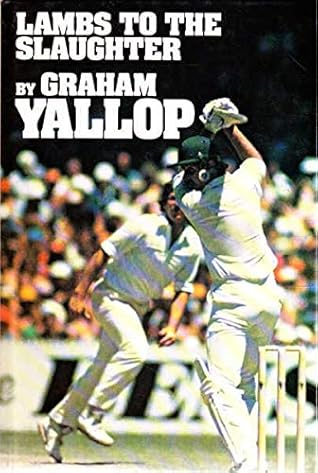
Book Review - Lambs to the Slaughter by Graham Yallop

 Lambs to the Slaughter by Graham Yallop

Collingwood, Victoria: Outback Press, 1979              ISBN 0868882275

The 1970s was a tumultuous decade for Australian Cricket - from the disastrous loss to South Africa that cost Bill Lawry the captaincy, through to the season that Graham Yallop dissects in this book, we went through the ups of Lillee and Thomson and the downs of the WSC breakup, the latter of which had a huge impact on the Australian team and the series that Yallop describes in this book.

The 1970s was also the decade in which I grew to love cricket - my first clear memories of the game are the test series against India which was the summer before the events described in this book, and of course the whole WSC circus, which made for great television, and gave a whole new generation a love for the game. As I read this book, the pain of that summer came back to me.

By the end of the book the reader is as shell-shocked as Yallop himself seems to be by the absolute thrashing delivered to Australia by England. The Australian team was young and inexperienced, as practically all the established Australian players had defected to WSC - Yallop was captain at 26 and had only played eight Tests at the start of the summer (the most-capped player was Gary Cosier with 16), while the England team had the experience of Boycott and Willis, along with the youthful talent of Gooch, Gower and Botham; the latter two having stellar seasons.

Despite the apparent difference in ability and skill, Yallop had a reasonable hope that the Ashes would be a hard-fought series. Despite Yallop's insistence in this book that it was poor pitches and poor decisions by players and umpires that made the difference between the teams so stark, hindsight and a disengaged view would suggest that the Australian team picked for that summer, one player aside, was simply not up to scratch, and England outplayed Australia at every opportunity.

This book follows Australian cricket lovers around - there is usually a copy in any second-hand bookshop that has a sports section, and "Lambs to the Slaughter" is a phrase that is now used about the "official" Test teams during the WSC interregnum. So it's strange that it's taken me until now to read it. Perhaps I was unconsciously protecting myself from the re-lived pain of what was a very low point in our cricketing history.

There are several subjects that come out for me in this book, only some of which are raised by Yallop consciously. The first is the explosion of talent that was Rodney Hogg. With a record wicket haul in the series, he was the shining light of a poor summer for Australia. He was a famously abrasive character, and Yallop goes into some detail about how he was a difficult player to manage, which was not helped by the fact that before the series started, Yallop had never met him. The second is how little assistance was given to an Australian captain back in those days - it was only half-way through the series that the Australian Cricket Board thought that appointing a manager to the team to handle logistics, the media and so forth might be a good idea. The thought that the powers-that-be of cricket dropped an inexperienced 26 year old into the "most important job in Australia" with virtually no support is quite mind-boggling.

The final subject is Yallop himself. One very much gets the feeling that he wrote this book in anger: anger at how he was treated by the press, by the Board, and by the "cricket gods". He bemoans the inability of the Australian team to gell and put together a team performance required over the time required to consistently win a test match, but in reading the book I get no sense that he took responsibility to try and build the team in that way. I could of course be selling him short, but for this reader, more insight into the off-field activities and performance would have fleshed out his narrative - I didn't really get a sense of how the players as a unit tackled their poor performance. While the descriptions of play are useful, that is not really why we armchair cricketers read these sorts of books.

Having stated that, if you want to know the story of the 1978-9 season from an Australian viewpoint, you must read this book, which has become a bit of a minor classic.


Cheers for now, from

A View Over the Bell

Monday, 4 November 2024

Book Review - The Magic of Spin by Ashley Mallett

 The Magic of Spin: Australia's Greatest Spin Bowlers by Ashley Mallett

Melbourne: Hardie Grant Books, 2019      ISBN 9781743795781

Cricket is coming - India has arrived on our shores, and it's not long now until the first Test in what could very well be an enthralling series. Most years at this time I get myself into gear for the season with a couple of (hopefully) good books. Ashley Mallett - until the advent of Nathan Lyon Australia's most successful off-spinner - usually delivers, with well-written and informative tomes. This one is a little quirkier than some of his other works, and may well be the last book he wrote before his death in 2021.

If it was, the subject matter couldn't be more appropriate - Mallett was a firm believer in the value of spin bowling in the highest levels of cricket, and spent much time coaching after his playing days were over. The Magic of Spin is Mallett's personal paean to Australia spinners past and present, and to the ongoing legacy that is handed down from (cricketing) generation to generation.

All the expected names are here - Giffen, Turner, Trumble, Noble, Mailey, Grimmett, O'Reilly, Benaud, Mallett, Bright, May, MacGill, Warne and Lyon. There are also those of the second rank, and also those that never got the chance to play Test cricket, but whom Mallett thought could have, or were great servants at first class level. Each player gets a varying number of pages, from two (Bill Howell, Don Blackie, Doug Ring, David Sincock, Tom Veivers) to fifteen (Shane Warne). Those pages contain all sorts of information - from Arthur Mailey's conversations with the King, to Terry Jenner's ideas about coaching, Benaud's stints as a commentator, down to Mallett's own peregrinations as a journalist. It may not be pure cricket, but it does give a sense of the different characters that make up this long-suffering tribe of sportsmen.

If there is a theme that runs through the book, it is the willingness of the tribe to pass down its secrets. From CTB Turner advising Bill O'Reilly to stick with his unorthodox grip, to Clarrie Grimmett sharing the secrets of his flipper, to Terry Jenner explaining spin-bowling strategy to Shane Warne, to Mallett himself (who gratefully received advice from Grimmett) advising a young Nathan Lyon on his follow-through, each generation of spinners has built on the hard-won knowledge of their predecessors.

While I would in no way suggest this is a great cricket book, it is a great way to whet the appetite for the upcoming summer, and to dip back into history to relive some great cricketing moments.


Cheers for now, from

A View Over the Bell

Monday, 6 November 2023

Book Review - Time to Declare by Mark Taylor

 Time to Declare by Mark Taylor with Ian Heads

Sydney: Ironbark, 1999                                                           ISBN 0330361848


Cricket it seems, more than most other sports, lends itself to the written word. In my opinion there are many reasons for this - the time it takes, the breaks in play that lead to deeper thought on what has occurred and what may be about to occur, the way cricket today can reflect back to past cricketing events, and not forgetting the endless statistical delight that the game gives us.

So we come to the autobiography of the man who I feel has been the best Australian captain of the last fifty years. As a leader he was always optimistic and supportive of his team-mates, but it was as a tactician that he shone. Taylor rarely miss-stepped as captain, and he quite often made changes in the field that turned out to be inspired. This, added to his steady batting and brilliant slips fielding make him one of Australia's best cricketers of his generation. 

Unfortunately, in Time to Declare, Taylor has not chosen to discuss in any great depth his tactical decisions, or how he managed the team. This is more of a "traditional" cricketer's book, listing anecdotes, family life, and personal milestones. Taylor does weigh in on some controversies, particularly throwing and whether Australia should have separate captains for different forms of cricket: hot-button issues when he wrote this book, but somewhat old-hat now (although his opinions are interesting nonetheless).

For those of us who have seen and heard Taylor commentate, Time to Declare will hold no surprises. He is a straightforward type of man who says what he thinks. He was an aggressive captain, in the sense that he was always striving for the win, but never seemed an aggressive player. Some of the episodes he relates from his early cricketing life are about his aggressiveness, and learning how to temper that so that it became a productive force for him. There are several occasions in the book where he shows some understanding and forgiveness for the excesses of some of his younger team-mates (Ponting and Warne in particular), and explains clearly how difficult it can be to live the life of a professional sportsman.

What we don't get is very much explanation of his thinking as captain, or even as a batsman. We get the stories, but not the thinking behind them. That's a shame. I do wonder if that might be a product of Taylor writing this book in the six months immediately after his retirement: perhaps a longer period of reflection may have given us a book with more heft.

As it is, Time to Declare is pretty much another run-of-the-mill cricket book, which is not without its interest and nostalgia.


Cheers for now, from
A View Over the Bell


Sunday, 21 May 2023

Inside: the autobiography by Chris Judd

 Inside: the autobiography by Chris Judd

Sydney: Allen & Unwin, 2015                               ISBN 9781760112912

I can't recall if I've ever actually read a football biography before. I bought this book for my teenage son, who like most boys these days is not a reader, but does like sporting biographies. I thought I'd give this one a go because Chris Judd was one of the great Australian Rules players, a Premiership Captain and Brownlow Medallist with the West Coast Eagles, as well as Captain of Carlton, one of the historically great clubs of the League (and the club my family has supported for five generations).

I was pleasantly surprised by this book. I'm pretty sure Judd had a ghost writer (Greg Baum, a well-known football writer gets an acknowledgement for his assistance), but it is his  thought processes, and how he went about his football career, that are of interest in this book. Judd comes through as an individual - not someone who easily swallowed what he was being told, but who thought things through himself and came to his own conclusions about things. He has written this book in four "phases", which correlate to phases in a footballers career.

As well as a journey through his football career, Inside takes us through Judd's learning journey through life - learning to be who he was, and not try to be someone else, looking back and seeing how the implosion of West Coast after the 2006 Premiership perhaps could have been avoided if the club had intervened earlier to stop certain players going off the rails, but then questioning whether they would have won if that intervention had happened. This opens up the question of just how important is football, which is a journey that Judd undertakes during the period of time this book chronicles.

While he always knew intellectually that football is just a game, and that life is much more than football, Judd's obsession to be the best, his competitive nature, meant that for many many years his life revolved around what was best for football - everything was viewed through that lens, and it is eye-opening for us "civilians" to see just how much is demanded of footballers. As for the West Coast drug scandals, I think Judd clearly explains the pressures young men endure playing and being in the AFL circus, and reminds us that, at 22, things can easily get out of hand. After reading this book, and thinking back to what I got up to at that age, I will not leap to judgement of sporting stars so quickly as I may have done before.

Judd states toward the end of the book that he is unlikely to become a coach, which may be a loss to the game, as he very clearly articulates the motivation required to be successful. It is not gaining a contract extension, or having a million followers on social media, or being a man-about-town, it is the desire to win. Focusing on that is a great enabler, and Judd, moving from West Coast to Carlton, shows us the difference between a winning culture, and a club where that culture had died, and how Judd tried (and failed) to re-instill it.

Inside is not a mere fanboy book about a footballing hero - it is more than that. It's not a classic of the genre, but it is an interesting insight into how a great sportsman goes about creating a career. Not sure I'll be reading too many more football biographies (for some reason cricket lends itself more to the written life than football), but glad I read this before passing it on to my son.

Only one thing more needs to be said.... Go Blues!!


Cheers for now, from
A View Over the Bell


Monday, 27 November 2017

Book Review - Clarrie Grimmett: the Bradman of Spin by Ashely Mallett

Clarrie Grimmett : the Bradman of Spin by Ashley Mallett

St. Lucia, Qld: University of Queensland Press, 2003     ISBN 0702225312

Don Bradman looms like a colossus over pre-war Australian cricket history. His legacy is so great that it overshadows much of what occurred between the Wars. The casual cricket fan may have heard of Woodfull and McCabe thanks to Bodyline, and maybe "Tiger" O'Reilly, but most other players have subsided into oblivion. This serviceable biography by former Australian spinner Ashley Mallett reminds the reader that Clarence Victor Grimmett was one of the true greats of the game.

In fact Mallett, through statistical analysis, shows that Grimmett could indeed be said to be the Bradman of bowling. His test record is indeed extraordinary: in a mere 37 test matches he snared 216 wickets, grabbing 5 wickets in an innings 21 times and 10 wickets in a match 7 times. He achieved the "bowler's century" (5-for), every 1.76 tests. Bradman scored a ton every 1.79 tests.

Scyld Berry, in his book Cricket : the game of life, notes how cricket writing generally discusses batting in positive language and bowling in negative, and it would seem that to be the Bradman of spin when Bradman himself was playing was to be relegated to the second rank in the thoughts of history. This is not to claim that Grimmett wasn't viewed as a star during his career - no less a person than King George V chatted amiably with "Clarrie" and asked him to show him how to spin the ball.

Grimmett was born in New Zealand, and it was his burning desire to play cricket at the highest level that drew him "over the pond" to Australia in 1914. He landed in Sydney and soon was impressing in District ranks. However at State level the great Arthur Mailey ruled the spinner's roost, so Clarrie moved South to Victoria. He spent several very successful seasons playing for South Melbourne and Prahran, but - not for the first or last time in his career - cricket politics crueled his ability to play for his State. South Australia saw an opportunity, and lured him to Adelaide with an offer of a job. Adelaide became Grimmett's home for the rest of his life, and South Australia the State for which he took the majority of his 1424 first-class wickets (from 248 matches).

His bowling must have been something to see - his stock legspinner was deadly accurate, his variations in pace hard to pick, and his topspinner trapped many great batsmen lbw. With his peculiar round-arm action, and his habit of wearing his cap while bowling, he seemed an old-school cricketer. In many ways he was: his first-class career spanned the years 1911-1941, he bowled early in his career to the great Victor Trumper and by the end of his career he was witnessing the growth of the team that would become "The Invincibles". Grimmett was a late bloomer, playing his first test at 33 years of age, and at his last he was 45. In his last test he took 13 wickets, so the shock in the country when he was not selected for Australia's next series was severe. Grimmett himself was stunned but, as was his way, never publicly showed it. Mallett does point out that Grimmett probably held Bradman to blame for his relegation and his retaliation was to always place Bradman's place in the batting pantheon below other greats such as Trumper, and some others such as Jackson.

Mallett describes a man who lived for bowling, having his own pitch in his backyard in Adelaide, where he honed his skills hour after hour. Unlike his great bowling partner O'Reilly, Clarrie was quiet on the field: only the glint in his eyes would betray his glee on getting another scalp.

Although this book was published in 2003, Mallett makes no mention of Shane Warne, the recent great who surely brings to mind how spectators must have felt watching Grimmett bowl. The absolute control of his skill, the ability not only to create a plan for a batsman's demise, but to carry it out, and the creation of an aura that sometimes was all that was needed to get a wicket, would have been great to watch, and fearsome to face.

Mallett has a solid journalistic style, and his research is solid. The best parts of this book are the quotations from contemporaneous sources, which go some way to giving a 21st century reader an idea of what it was like to see Grimmett bowl and to face him as a batsman.

For the historian of cricket, this book is worth reading.


Cheers for now, from
A View Over the Bell

Monday, 9 October 2017

Book Review - Stroke of genius by Gideon Haigh

Stroke of genius - Victor Trumper and the shot that changed cricket by Gideon Haigh

London: Simon & Schuster, 2016                ISBN 9781471146800

Stroke of Genius: a phrase that could be employed on more than one occasion to describe the cricket books penned by one G. Haigh. The Cricket War and On Warne are two of the best books I have read on the game: they are now joined by Stroke of Genius.

I suspect that, like me, Haigh's first memory of Victor Trumper would be of seeing the Beldam image "Jumping Out". Stroke of Genius is a book about Trumper, Beldam, that photograph, and so much more. While strictly speaking not a biography of Trumper, we learn enough about his life beyond cricket to know that it was really cricket that was his life.

Haigh unpicks the legend, describing Trumper's run-ins with both cricket and rugby officialdom, and his tenuous business life, which involved runs of debt and insolvency. Haigh also gives us a wonderful history of the development of cricket imagery and action photography, and how Beldam made many advances in this area prior to World War One. In fact if it wasn't for Beldam we wouldn't have many of the iconic Edwardian cricket images at all.

Like all legends, Trumper's has been used by many people to support their cause or beliefs. Lauded  by Cardus and others as the epitome of amateurism, Haigh demonstrates that Trumper was very much the cricket entrepreneur and tried many schemes to make money from his skill. Used as an exemplar of the way Australia plays attacking cricket, Haigh explains that, until Trumper came on the scene, Australian bats were known as dour accumulators. Used by the cricket establishment as a symbol of their tradition, Haigh argues that - like Bradman in his early years - Trumper stood for players rights against the power of the hierarchy. Used by some as a stick to beat Bradman with, Haigh definitively shows them as different cricketers. Trumper's early death in the midst of war helped set the stage for the legend to build.

So it is good that another thing Haigh does very well is bring the reader an idea of just how great a player Trumper must have been. The praise heaped on his playing by those who knew what they were talking about, when brought together, is extraordinary. What struck me is how many who saw him ranked him above Bradman, for his artistry if not for his statistics. So many writers exclaimed that words could not describe his ability. The word " genius" was not in Edwardian times used in the field of sporting endeavours, and yet it was used often in attempting to describe Trumper.

What we do have are the photographs, which if studied closely, begin to give us some idea of his ability. Statistics don't always convey reality, and as Haigh points out, until Bradman came along they did not carry the authority that they do now in assessing the ability of a player. I don't know how many arguments I've engaged in where the stats are used as a final arbiter (...and I still think Mark was the superior Waugh at the crease, no matter what the numbers say).

Trumper must have been a magnificent player to watch. He must have had complete control of his technique, and a wonderful ability to demolish an attack - a cross between Gilchrist, Greg Chappell and the aforementioned Mark Waugh. Haigh has brought the modern cricket lover closer to Trumper, as well as yet again showing us cricket's intricate, sometimes brutal, yet often beautiful, history.

Another tour-de-force from a man who is surely the Trumper of cricket writers.


Cheers for now, from
A View Over the Bell

Thursday, 2 February 2017

Book Review - The bicycle and the Bush by Jim Fitzpatrick

The bicycle and the Bush : man and machine in rural Australia by Jim Fitzpatrick

Melbourne: Oxford University Press, 1980             ISBN 0195542112


Serendipity and coincidence can be wonderful things. Not long ago I read Dream Millions, a book written by Fred Blakeley, the leader of the Lasseter expedition, and it was noted on the flyleaf that in 1908 he and two colleagues rode bicycles from White Cliffs to Darwin. A week or so after I had read that book I was spending time with a friend who has an interest in restoring old bicycles and mentioned Fred, and he drew my attention to this book which contains photographs of Blakeley's journey amongst its other treasures.

For The bicycle and the Bush is a cornucopia of facts, stories and pictures of an almost forgotten part of Australia's transport history. I imagine most people, like me, think of the development of transport in the Bush being one of moving from horse and camel to motor vehicle. And while that may be true of carting through rural Australia (and of course we should add bullocks to the hauling animals), for a good 20-30 years, the bicycle became an integral and valued part of the transport mix.

Once the design features of the bicycle settled on what we now recognise (Fitzgerald provides an informative and useful chapter on the history of bicycle design), riding quickly gained popularity among rural workers. The reasons are obvious when spelled out: firstly, they were (relatively) cheap to buy, and could often be purchased on a payment plan; secondly, they were very cheap to run, with maintenance costs low compared to animal transport; and thirdly, one could travel much further in a day under human power than on a horse, even if the roads required (as they often did), that the bicycle was walked rather than ridden.

After describing the history of the design of the bicycle, Fitzpatrick then goes into some detail about the sources of Australian bicycles from the 1880s on, the advantages of the bicycle over other transport, as well as detailed descriptions of the types of surfaces early cyclists had to ride on, and the dangers and inconveniences suffered from various vegetation and animals encountered while on the bike. Fitzpatrick developed this book from a PhD thesis, and it shows in these sections, where the detail can at times be somewhat overwhelming.

It is in the history of the use of the bicycle across Australia from the 1880s until the depression where there is much to fascinate and educate the reader. Given that bicycles seem to have slipped through the cracks in history even as that history was being made, Fitzpatrick's focus depends on the source material that he has managed to find, and much of it comes from Western Australia. With its good weather and relatively flat countryside, Western Australia was a perfect place to take advantage of the bicycle, and Fitzpatrick describes its use by gold prospectors, salesmen, clergy, and those who's job it was to keep the Rabbit-Proof Fence and Kalgoorlie pipeline in good order.

Western Australia was also unique in having for quite a few years a bicycle messenger service between towns and localities on the goldfields. These bicycle messengers earned good money for providing a messenger service that was faster than horse, train and in some cases telegraph. It is from these bicycle messengers that the first crop of Trans-Australia riders came.

In the early stages of adoption of any sort of new technology, there comes a period where people test what it can do, and try and best each other in doing it. The bicycle was no different, and not long after it was introduced, men (and women, as Fitzpatrick details) began to ride further and further distances. Firstly it was across the Nullarbor, and then from Western Australia to Northern Queensland, and finally all the way around. An interesting sidelight to these journeys is how many of them were sponsored by the bicycle industry in some way, and indeed that some of the cyclists themselves proposed such journeys to cycle companies in an entrepreneurial manner.

As for the eastern side of the country, Fitzpatrick outlines the beginnings of cycle-touring, and the use of the bicycle by shearers, which was not inconsiderable in the early years of the twentieth century, until cars became cheap enough for them to buy. This brings me full circle as, when discussing this book with my 87 year old Father-in-law, he mentioned several shearers he knew that used to follow the shearing from Daylesford to Innamincka on their bicycles. He also talked about his many teenage rides to Ballarat or Castlemaine.... yet more hidden history.

The bicycle and the Bush is fascinating to read, and to look at, with many interesting photographs and old advertisements that supplement the text. For an insight into a forgotten period of Australia's history, this is highly recommended.


Cheers for now, from
A View Over the Bell

Friday, 24 June 2016

Book Review - Make it take it by Rus Bradburd

Make it take it a novel by Rus Bradburd

El Paso, Texas : Cinco Puntos Press, 2013                ISBN 9781935955436


School sport here in Australia is important - I remember when our school Aussie Rules team beat the cross-town Catholic School it was a day of great joy - the First XVIII was paraded in front of the school and there was much cheering. But that's about the size of it when it comes to sport in education Down Under - coaches are part of the teaching staff, on teaching pay and don't really make it into the paper or onto the news.

The US  is a whole different ball game (pun intended), and Rus Bradburd has given us a novel about College basketball that sails us into the murky water that stagnates out of view of the stadium lights. Rus Bradburd is an author who is gaining a name for himself in the sporting genre, with two previous works Paddy on the Hardwood and Forty minutes of Hell receiving good reviews. Both non-fiction works about basketball, they were received well by those who know what they're talking (or writing) about. Rus also knows what he's writing about, as he spent over 10 years coaching College basketball.

I, on the other hand, know very little about basketball - being an un-reconstructed Australian male who grew up in the 70s, my two sporting loves are Australian Rules Football and Cricket. So why am I reading a  novel about basketball? Time for a little disclaimer - Rus is the brother of my brother-in-law, which is how I came to know about him and his work. I read Paddy on the Hardwood - the story of his year coaching basketball in Ireland - with enjoyment.

Make it take it is a good book: Rus has based the "plot" around a fictional State University Basketball team; some of their new recruits, the assistant coaches and the coach. Each chapter comes from a different viewpoint, and is almost a self-contained story. The book reveals what goes on to keep the show on the road - how much of the assistant coaches duties revolve around baby-sitting star players, solving their problems, and hunting out the gun recruit that will help them make the jump to senior coach.

As each viewpoint gets added to the mix, the reader is in turn appalled, dismayed and occasionally uplifted by what's happening. The chief coach, Jack Hood, is not a sympathetic character, and he gets his comeuppance late in the book in a way which turns out to be both funny, and an insight into his character.

Steve Pytel, the assistant coach is another protagonist who has to come to terms with what the coaching life has done to him - he almost has an "awakening" moment early in the book, which he rejects as a path forward. The soul-less nature of the basketball business has affected him, and by the end of the book he is close to achieving his dream, only to have it snatched away.

The players, seen by the coaches as kids, are characters in their own right, and their travails, suggestibility, cynicism and nobility come through as the book progresses.

What resonated most for me was the selfishness that abounds in the novel - everyone is looking for their own angle, and those that aren't are initiated by the others into doing so for themselves. Where the sport has gone, I don't know (and nor do some of the characters).

I approached this book with a little trepidation - as someone who doesn't follow basketball I wondered if I would understand it or like it at all - but what Rus has given us here is a fine study of human nature, with a basketball covering. A book I stayed up late to finish, which is always a good sign.


Cheers for now, from
A View Over the Bell

Monday, 18 April 2016

Book Review - Chasing shadows by Tim Lane and Elliot Cartledge

Chasing shadows : the life & death of Peter Roebuck by Tim Lane and Elliot Cartledge

Melbourne: Hardie Grant Books, 2015                         ISBN 9781743790120

What to make of a man's life when that man is careful to shield many aspects of it from his acquaintances? For Peter Roebuck, it seems from this book, had very few people he could truly call friend. Lane and Cartledge have tried - by talking to people who knew him, and by looking closely at the parts of his life where they could manage to find information - to discover what might have led him to throw himself from the window of the Southern Sun Hotel in Capetown in 2011.

The book looks at his upbringing, and especially at his time at Somerset, where he was a successful player almost in spite of himself, but is possibly best remembered there as the man who got rid of Viv Richards and Joel Garner, which precipitated the departure of Ian Botham. Before heading into murkier territory, his work as a journalist and life in Australia and South Africa are noted.

There is no doubt that Roebuck was an intense and odd character. Much has been made of his sexuality, and while Lane and Cartledge have discovered that Roebuck did have at least one important heterosexual relationship, there can be no definitive answers on Roebuck's orientation. However, what seems more important in his makeup is his character. He certainly had strong opinions on what made character, being firmly of the belief that cricket took a major part. This belief led him down a strange path.

The authors paint a picture of a man who, whilst obviously very intelligent, had little social sense. Roebuck seemed to have no innate knowledge of, nor does it seem he was inclined to learn, the social graces and give-and-take that make for solid bonds with other people. Some of those interviewed for the book speculate that Roebuck felt a need to be the leader, the one who people looked up to. This could go some way to explaining both what happened at Somerset, where he acquiesced in getting rid of the players that could challenge his leadership, and in the way he ran his "houses" in South Africa, where he dispensed advice and discipline.

His journalism too, as he progressed in his career, seemed to become more dogmatic and fixed on certain themes, sometimes from an angle that may seem strange to the reader. He no doubt was correct in singling out the corruption in Zimbabwean cricket, but his crusade took little note of the enmities and casualties that he left in his path.

All of which is to bring us closer to the moment of his death. Roebuck has a well-developed sense of persecution, and felt that there were forces out to get him. Initially he felt it was Botham and his supporters, but then even the Zimbabwean government seemed to enter his frame. Lane and Cartledge point out that while these theories occupied Roebuck 99% of the time, for Botham anyway 1% of his time, if at all, was given over to thinking about Roebuck. For a highly intelligent, rational man, this was odd behaviour.

Roebuck certainly thought it was Botham and his cronies who were behind the assault charge and conviction in 2001, which shattered him and haunted him for the rest of his life. However, as the authors point out, this is hard to sustain for several reasons. Firstly, it is clear that he did strike the boys, nevermind the issue of consent, and Secondly it is hard to believe that a man who got a First in Law at Cambridge could fail to understand that pleading guilty to a charge means admitting that it occurred. Yet another occasion where an intelligent man in other ways failed completely to grasp his situation in a social sense.

Despite his anguish at the assault conviction, it doesn't seem to have stopped him from believing that corporal punishment was part of the educative process: as he himself admitted he had "very right wing ideas" about education. It is very hard to get to the bottom of why Roebuck felt it necessary to cane his charges. Testimony from many of them suggests that they themselves chose that punishment, rather than be punished by household chores. Henk Lindeque, one of those who brought the earlier charge of assault, claimed that Roebuck wanted to see the welts, which was where sexual issues come into it. Roebuck claimed he only wanted to see the welts to ensure he wasn't caning the boys too hard.

The picture of Roebuck built up by the authors leaves the reader thinking that it is just possible that Roebuck was looking dispassionately at his handiwork to gauge whether he was going over the top. The tragedy really is that he seems to have had little awareness of how this might seem to Lindeque and to anyone else who heard about it.

Which brings us to his death. Itai Gondo, the man who made the claim of sexual assault that led to Roebuck's death, has been notoriously hard to find, but did make himself available to the authors for interview via Skype. Just as the reader is being led to think that perhaps Roebuck's paranoia might have a grain of truth, and that Gondo's accusations were part of a Zimbabwean government plot, Gondo's testimony sways the mind again, and it seems that indeed Roebuck may have made an inappropriate advance. And yet, Gondo seems to have done very well for himself since the incident, and how did that happen?

There are so many unanswered questions about Roebuck's death that it is hard to know where to start. The authors, I think, put to bed the theory that Roebuck was thrown from the window, and expose the incredibly shoddy police work that surrounded not only the moments of Roebuck's demise, but the subsequent handling of forensic evidence and inquest.

Whatever the truth of Gondo's accusations, it seems clear that Roebuck sensed that the hell that was his 2001 brush with assault charges was going to happen all over again, and that he couldn't cope with it. He had always been a moody depressive man, prone to extreme reactions to stressful situations, and it's possible he took what he thought was the rational route to end the pain.

What we do know by the end of the book is that it didn't have to be that way - Roebuck had people around him that, if he had let them, would have provided him a supportive network of friends, and perhaps even a partner. It's terribly sad that his life ended the way it did, although it is notable that many of the people interviewed for the book felt that Roebuck had been on the path to suicide for some time, if not all his life.

Lane and Cartledge have approached this difficult story with perseverence, candour and some heart. It is more than a book about cricket, and more than a book about the death of someone famous. Worth reading.


Cheers for now, from
A View Over the Bell

Friday, 15 April 2016

Book Review - Raw by Martin Crowe

Raw by Martin Crowe

Wellington: Trio Books, 2013            ISBN 9780986461569

It seems that recently cricket has been overtaken by far too many deaths - the tragedy of Phillip Hughes, the icon Richie Benaud, Tony Greig taken before he was ready: and the writer of the book being reviewed, Martin Crowe, dead at 53 from lymphoma.

Martin would surely be thought of by many as New Zealand's greatest batsman (although Kane Williamson seems on track to overtake him),  and no doubt thought of by all as a difficult, prickly character, which he acknowledges in this book. Crowe began writing this book after his diagnosis, and it lives up to its title: writing this was no doubt an act of catharsis for him, as he lays bare his own failures, as well as exposing those whom he felt had failed him and New Zealand cricket.

The first section of the book is not a biography per se, but Crowe looking back on his life and career and picking apart his attitude to life and sport. Fear was his major driver, and the lack of support shown by those in the cricket hierarchy who dropped him into major teams at extremely young ages did nothing to assuage that emotion. Crowe has some interesting things to say about former teammates and managers, and how they not only affected him emotionally, but how they dragged the team down as well.

In fact he has a fair bit to say on how the structures and people around cricket in New Zealand seem to be continually trying to kill what they claim to love, with some good chapters about the Ross Taylor captaincy affair, John Bracewell's stint as coach, and the machinations of the Board.

Crowe also talks of his time at Fox Sports, and how the machinations within that organisation matched or exceeded those he found within cricket. He writes of all this as therapy, letting go of the bitterness and anger he felt while describing what it was that led him to feel those emotions.

He also writes of his personal life, his relationship with his father and his other loved ones, but not so much about his cricket life, which he had covered in two previous books.

The second section of the book is about cricket, and Martin's views on the game. He describes his venture into tinkering with the game, Cricket Max, his (failed) efforts to implement a sensible DRS system for the game, his views on Stephen Fleming and snapshots of the New Zealand team of the 1980s, perhaps their greatest era. He writes of technique, and his short stint in the hierarchy of an IPL franchise.

The last section contains his lists of best players from the era 1870-1961 and from 1961-present, with his reasons for those choices. He lists the best teams for each country through history and then his all-time best team, which, like all well thought-out exercises such as this would be cause of much argument around the bar of any Cricketer's Arms.

Overall this is an interesting and worthwhile book from an interesting and worthwhile cricketer. The chapter in which he writes of a fantasy test match between the best of the old era vs. the best of the modern era is poignant now after his death: one can almost imagine him on the heavenly sward, the trademark floppy hat and steely glint in the eye, bending over his bat to face a thunderbolt from Trueman.

A sad loss too early.


Cheers for now, from
A View Over the Bell

Monday, 4 January 2016

Book Review - Cricket - the game of life by Scyld Berry

Cricket - the game of life : every reason to celebrate by Scyld Berry

London : Hodder & Stoughton Ltd, 2015                     ISBN 9781473618589


What a great book. I have not knowingly read Scyld Berry before but this book is eye opening in so many ways - to Berry's knowledge of cricket, his ability as a writer, and to so many things about this greatest of sports that I didn't know - there is much in this for any and every cricket fan.

You could call this book a bit of a grab-bag, in that while it contains much history it is not a historical work, while it contains autobiographical and biographical material it is not of that genre either. It is in fact a celebration of all that is great (and some that is not-so-great) about the game, its history and its players, and why, to Berry and a lot of us, there can never be enough cricket.

The book opens with a poignant insight into Berry's childhood and the early death of his mother, which he feels led him to find solace in cricket. He then quickly moves into a highly diverting section on the first cricket match for which we have commentary, in the form of an epic poem. The game, Kent v England in 1744 is the second for which we have a scorecard, and thanks to the poem - and Berry's knowledge of early cricket - we know quite a bit about how the game was played.

In these days of fixing, it is enlightening to read that the first organised games of cricket were played for money - Lord Sackville of Kent organised the game for a prize pool to help him with his growing debts, and the poem makes clear that one of the major interests of the crowd was betting on the result. Also fascinating is how many things about the game haven't changed - pressure leading to dropped catches, the sound of wood on leather, and the joy in getting the opposition's best player out.

Berry then continues with the history lesson, describing how cricket grows with the ability of potential players to actually practice and play, and how those situations have moved and changed across England as the centuries have rolled on. His exposition explains well how the England side has come to be dominated by those from the North Country.

Interestingly, when he discusses Australian cricket - in a chapter about the "ardent desire" of the Australians to win, especially against England - he mentions the dominance of New South Wales in Shield cricket and discusses the salaries for Australian Football League (AFL) players being worrying for the future of attracting players to the game, but seems to miss the fact that the biggest worry in AFL spreading across the country is that AFL uses players of all shapes and sizes: one reason for the preponderance of NSW and Queensland players in the Australian team is that Rugby League requires a certain physiology in a player, and if you don't have that, cricket is the place to go. I also wonder about the money equation as well, in this T20 age....Cameron White is rumoured to earn $1 million a year without representing his country: more than most AFL players.

However that may be, Berry's cultural nose is quite sharp: finding in history the roots of the current styles of cricket that appear around the world. From the native-born vs. the troops in Australia leading to the desire that has brought so much Ashes success, to the caste system in India leading to their (until recently) relative lack of skill in the field. he ferrets through the past to find interesting facts that enliven one's understanding of today's game.

As a life-long cricketing journalist would, Berry has a section in the book on words and numbers, with a nice essay on how description of batting always uses positive language, whereas bowlers are usually described with negative or destructive language. This is undoubtedly true, and something that on a subconscious level we all know, but no less eye-opening as Berry lays it out for us. The Numbers section has some interesting statistics (as all good cricketing books should), partly about fathers or brothers helping each other to the highest level. There are also some firsts here - of interest is that the first ever recorded innings of 300, 400, 500 and 600 were all scored at Clifton College in Bristol. The other number from that school that astounds in the most appalling way is that 578 of Clifton's pupils died serving in WWI - it is also interesting in this context that Douglas Haig was a former pupil.

That last sentence in a way sums up all that is great about this book - Berry has written a book about cricket, but it is also a book about so much more - whether it be an investigation of a photograph of Wally Hammond playing a cover drive that leads on to how man shows physical presence and how some cricket shots bear comparison with the greatest of sculptures, or whether Test Match Cricket is the pinnacle of sports because it lasts (coincidentally?) as long as that greatest of all matches, the battle for Troy in The Illiad. Berry shows us that this glorious thing, this wonderful game that consumes us, is at the same time strong and fragile: strong in the millions upon millions of cricket lovers throughout the world, and fragile in that despite the 300-odd years that have passed since the first games, cricket still relies on the mutual trust and sense of fair play among the 22 players out on the field, which has to survive everything that the modern world can throw at it.

I can't recommend this book highly enough - fantastic reading for the cricket junkie.


Cheers for now, from
A View Over the Bell

Book Review - Bob Woolmer's art and science of cricket

Bob Woolmer's art and science of cricket

London: New Holland, 2008                           ISBN 9781847733146

Bob Woolmer's tragic death in 2007 came as a shock to all cricket lovers. A successful player and even more successful coach, at 58 the expectation was that he would have many more productive years to give the game, as he no doubt thought himself, being most of the way to completing this book.

And what a mighty tome it is - over 600 pages devoted to almost everything one could think of to help the modern player become his or her best at this great game. Those older cricket fans would look at the title of this book and reason that inside the reader would discover the correct way to bat, bowl and field. This is indeed described within the covers (using photographs of South African greats such as Jacques Kallis and Allan Donald), but there is so much more. With sections on captaining, psychology, health and fitness, physiology, the physics of swing bowling, there is almost nothing that is not covered.

The book quotes extensively from past players and past manuals - one of the points made is that a player is always learning and information can be garnered from anywhere, and Woolmer and the editors have put this into practice in the compilation of this book.

If you are a budding young cricketer, hunt this book out and make it compulsory bedtime reading. If you are old and worn out like me, do the same for sheer enjoyment.


Cheers for now, from
A View Over the Bell

Saturday, 4 July 2015

Book Review - Cricket as I see it by Allan Border

Cricket as I see it by Allan Border

Sydney: Allen & Unwin, 2014                                        ISBN 9781760111809


For those of us that love cricket, AB needs no introduction. Holder of many records in his time, including that of the highest number of runs scored in test cricket, most test matches played, longest run of consecutive tests, most tests as captain, he was the man that steered Australian cricket through the minefield of the post WSC days, through the doldrums of the 1980s, and set up the dominance that we enjoyed through the 90s and beyond. He is the player that linked the likes of Bob Simpson, the Chappells, Lillee, Marsh and company through to McGrath, Warne, Hayden, Langer and Ponting, whilst on the way playing through the careers of Jones, Hughes, Boon and other legends of the game.

Cricket as I see it is not an autobiography - although Border does write of events throughout his career as a player, administrator and coach of the game - but more a collection of thoughts on the current state of cricket in Australia and around the World. It has the feel of a wide-ranging chat in a bar somewhere after a game (in fact it may well have started as just that, as in the Acknowledgements AB thanks the journalist Martin Blake "for putting all my thoughts down in some readable form").

There are no real bombshells in the book - it is very AB in that it is a fairly conventional take on the game, no nonsense, not too much theory, with a bemusement at the politics and darker arts that permeate the sport from time-to-time: his experience on the Board during the "Monkeygate" crisis turned him off being involved in administration, although he could see why the saga progressed as it did from the Board's perspective.

Border was always a player's man, and that brought him into conflict with the powers that be, both as a player and selector. Sometimes he was right and sometimes wrong. As a player he was ropeable when his vice-captain Geoff Marsh was dropped for Wayne Phillips, who ended up playing only one test for the country. Border asks in the book what was the point of doing that, and the reader is inclined to agree with him. When he agreed to Ian Healy having a farewell test in Brisbane however (to be over-ruled by Chairman of Selectors Trevor Hohns), he wasn't really thinking of the future of the team, which then lay with getting Adam Gilchrist in the side at the start of a series.

His description of his own development as a batsman is interesting; his discussion of trigger movements had me re-living in my mind his little shuffle and bob of the head, and his many great innings for Australia. According to this book, he had no thought of playing for Australia, until his team-mate Andrew Hilditch got a call-up for the state (NSW) squad, and Border thought "if he can do it, maybe I can do it too." Indeed, and a lot better.

He does spend some time re-living old times, and lists three teams of people he's played tests with - a best Australian XI, a best of the rest XI, and a fun XI, with little pen portraits of each player he considered, which is amusing reading. David Boon was selected in the fun XI, and Border seems to put to rest in a definitive way an important detail on one of the records Boon can lay claim to - I quote: "Before we made it to England for the 1989 Ashes tour...there was a bit of drama over David Boon, who was reputed to have consumed 52 cans of beer on the journey from Sydney to London, beating the previous record by an Australian cricketer, held by Rod Marsh. Boon has always denied the 52-can figure, although official record-keepers have it at that. I do know that I presented him with a gold-plated ring-pull, engraved with '52', at the end of the tour!"

There is an interesting epilogue from AB's eldest son, Dene, that describes what it's like to have a former Captain of Australia as a father, which he sums up as "No complaints. More pros than cons."

And that's how I feel about this book. It's not ground-breaking, but it's worth the time invested. Something to dip into during the breaks in play during this winter's Ashes series.


Cheers for now, from
A View Over the Bell

Wednesday, 1 April 2015

Book Review - Champions : the World's greatest cricketers speak - Mike Coward

Champions : the World's greatest cricketers speak conversations with Mike Coward

Sydney: Allen & Unwin, 2013                                             ISBN 9781743315613

Mike Coward is the cricket writer nonpariel (to steal one of his favourite terms). Over a long career, his writings, musings and films have always been worth reading or watching for the insights he has provided about the game, and those he has extracted from the players he has spoken with.

Champions continues that rich vein of work. Coward was asked by the Bradman Foundation to travel the world to interview cricketers to begin to  create a video archive of world cricketers talking about themselves and the game. This project, part of the Bradman International Cricket Hall of Fame, will if it continues, become a valuable resource to players, historians and lovers of cricket the World over. Champions is a selection from Coward's interviews, arranged around five themes - Leadership, Badge of courage, Philosophy, The spirit of cricket, Humour and hubris.

This is a great read for the cricket fan - the thematic structure of the book means the fan can see differing opinions side-by-side, which give an insight both into the players themselves, and into the way cricket is played around the World. The excerpts from the interviews are word-for-word, so you really get a flavour for the various characters of each cricketer as well.

If you've read, watched and talked cricket some of the things in the book you'll already know, but there is always something interesting to garner from the thoughts of great players. What is interesting in this book is how they look back at events from later in life. Allan Border thinks he went one year too long in the game, Kapil Dev thought the captaincy was given to him too early and taken away too soon, Kumar Sangakkara describes how cricket was the escape for everyone in Sri Lanka from the horrible war that was going on there.

If what is said in each section can be summed up, it's that some leaders are born not made, but that leaders can be made (Border), and that it is a definite advantage as a leader to know your own game well before you are given the mantle of captain. That courage comes in all shapes and sizes, not just out on the field - whether it's fighting the establishment (Tony Greig), risking death (Sangakkara and Mahela Jayawardene), being a ground-breaker (Rachael Heyhoe-Flint), or standing up for human rights (Henry Olonga). That philosophies vary, from winning at all costs (Bill Lawry), displaying pride in your race or country (Viv Richards), competing (Greg Chappell), having fun (Adam Gilchrist), enjoying the moment (Matthew Hayden).

The spirit of cricket section is where most of the interviewees come together in believing the game should be played in a tough but fair manner, with respect for the opposition players. As John Wright states - "The spirit means respecting the laws of the game and respecting the people you play with and against so that you can always walk off the park, go to the mirror, look at yourself in it and be quite happy with the person you're looking at."

Humour and Hubris is a lighthearted way to end the book, where we get some insights into the aluminium bat saga, the way players were signed up to WSC, and other tidbits.

If you're a cricket fan, you'll like this book - recommended.


Cheers for now, from
A View Over the Bell

Thursday, 5 February 2015

Book Review - The Climb by Anatoli Boukreev

The Climb : tragic ambitions on Everest by Anatoli Boukreev and G. Weston DeWalt

New York : St. Martin's Griffin, 1999                     ISBN  0312206372


If the 1996 Everest disaster is the most famous mountaineering tragedy in history behind the death of Mallory and Irvine, it is so probably due to the efforts of one man - Jon Krakauer, with his article and book about the tragedy, Into thin air. In that book, Krakauer describes the tragedy that befell the climbers on May 10 1996 from his viewpoint as a climber in the Adventure Consultants team. During the book he has some not-so-kind things to say about Anatoli Boukreev, who was a guide for Scott Fischer's Mountain Madness expedition. The controversy that Krakauer's book sparked continues on to this day, more than 15 years after the events themselves.

The Climb is Boukreev's version of events - given his lack of command of English, the book is really written by DeWalt, with liberal dosings of Boukreev's quotes framing the story - and in many ways, gives a more complete picture of the tragedy than does Krakauer's work.

Both Scott Fischer and Anatoli Boukreev were mountain junkies - their whole life was predicated around climbing the great peaks of the World, and trying to finance their next adventure. Fischer, a charismatic American and great climber, looked to Rob Hall's successful business model with Adventure Consultants and thought that he could replicate that success himself, by creating a business guiding people up major climbs. 1996 was the first time he had tried to do it on Everest, and when he ran into Boukreev in Kathmandu, he jumped at the chance to hire him. Boukreev, who was down to his last few dollars, readily agreed. At the time it seemed like a win-win situation for both of them - Boukreev climbed and got paid for doing so, and Fischer could advertise his climb as having a head guide who was a true veteran of 8000 metre peaks.

What rapidly becomes clear as the pages of The Climb roll on, is that while Fischer may have been a great climber, he was not a great leader. It seems that at no stage did he sit down with Boukreev or his other guides and go into any real detail on how they would tackle the peak - and he ignored Boukreev's advice on acclimatization to altitude for the clients. It also seems that he disliked confrontation, and hated to say no, so that several of the climbers who were at the South Col on May 9 shouldn't have really been there, owing to their lack of fitness.

The logisitcs of the expedition were also far from optimal - they only had barely enough oxygen for all the people on the mountain, and the plan to fix lines to the summit was never acted upon. From the armchair point-of-view, the whole Mountain Madness setup seems to have been a disaster waiting to happen. Boukreev was worried about the fitness of the clients from the start, and having never guided before, was unsure of what was actually required of him, something that Fischer never seemed to explain.

Fischer himself was not in peak form for the climb, he was exhausted, a fact that he covered up as much as he could. On the day of the summit attempt, he sent Boukreev and his other guide Neal Beidleman up the Mountain at the head of their team, while Fischer himself would sweep at the rear. The idea was, apparently, that anyone Fischer passed on his sweep would be turned around and sent back down, as if he passed them it meant it would take them too long to keep going and get back safely (before their oxygen ran out). This was a good idea in theory - in practice it was a disaster, as Fischer was so weak and slow that he didn't catch up to even the slowest Mountain Madness climbers. The other massive oversight was that neither Boukreev or Beidleman had radios, so Fischer could not communicate with them at all. The result was that most climbers summited far too late for safety. Boukreev was first to summit, but even he didn't reach the top until about 1.30pm, as he had been delayed because the ropes to the top weren't fixed beforehand as organised, so he and Beidleman had to do most of it.

In 1996 the generally accepted idea was that the latest time for summiting was 2pm. Most Mountain Madness clients summited well after that, and Fischer didn't leave the summit until after 4. By that time Boukreev was on the way down. He'd spoken to Fischer when they finally crossed paths, and they agreed that Boukreev should head down to Camp IV, as many climbers would run out of oxygen before they got down, and he might need to bring up some cylinders and generally help out.

Then the storm hit. Very soon whiteout conditions hit the top of the mountain, with clients and guides spread from the South Summit to the Balcony, and to the South Col itself. There were many heroic actions that night, with Boukreev's continued sorties from Camp IV to bring back climbers not the least of them. In fact his actions won him (along with Pete Athans and Todd Burleson) the David A. Sowles Memorial Award for valour. In all Boukreev personally rescued 3 people that night. The next day he climbed to the South Summit to try to rescue Scott Fischer, who had spent the night there, but found him beyond help. Tragically Boukreev himself was killed on Annapurna in 1997.

With all the controversy that has surrounded the 1996 Everest season, a few things are made clear by Boukreev's book. Scott Fischer did not give good leadership to either his clients or his guides. Boukreev did not understand how he fitted in to the expedition - how much initiative he could take on behalf of Fischer or the clients, and whether he could order clients or Sherpas to do as he asked - which is perhaps a criticism of both Boukreev and Fischer. The logistics of the Mountain Madness activities above Camp IV were not well organised.

All Mountain Madness expedition members, with the exception of Fischer, survived and got down the mountain without serious injury.

The edition I read (see above) has over 100 pages of extra material, mostly rebuttals of Krakauer, and a transcript of the taped "debriefing" of the Mountain Madness team which took place at Base Camp on 15 May 1996. This is fascinating reading, and gives quite an insight into the inner characters of some of the team.

If you have read Krakauer, you must read this book.


Cheers for now, from
A View Over the Bell