Showing posts with label Politics. Show all posts

Sunday, 30 November 2025

Book Review - On Writing and Politics 1967-1983 by Gunter Grass

 On Writing and Politics by Gunter Grass, translated by Ralph Manheim, introduction by Salman Rushdie

London: Secker & Warburg, 1985 (first published in German 1984)        ISBN 0436187736

Those few who may read my blog regularly will know that I've been on a bit of a Gunter Grass kick this year, having read The Rat and Peeling the Onion, and recalling my reading earlier of both The Tin Drum and The Flounder. Grass's individuality cannot be doubted, and in On Writing and Politics we can see, in snippets, how his individual take on writing developed. 

The items in this book are a combination of written pieces and addresses, and/ always circle back to the obsessions that Grass maintained all his life - trying to understand the German story of World War Two, progressing his view of democratic socialism via incremental parliamentary reform, and bemoaning the rupture of Germany and particularly Danzig, after the War.

As Salman Rushdie points out in his introduction, Grass, despite still living in Germany, was actually a refugee emigrant, constantly returning to his native home in his books, as he describes in the essay describing how he came to write The Tin Drum.

He writes about his literary inspiration Alfred Doblin in more than one of the pieces in this book, showing how he predicted the future, and how his writing is much more than Berlin Alexanderplatz. His piece on Kafka explains how he was the writer that first understood that bureaucracy is the new totalitarianism, and how no truly great writer can be claimed by any ideology.

He writes about Heine's grappling with anti-semitism in writing The Rabbi of Bacharach, in an essay dealing with how German youth had to face the guilt of the nation for the war. The political pieces in the book have much to do with the failure of revolution, of how the East and West were moving towards the same big-government capitalism, and how the hope for justice for the people lay in parliamentary socialism.

On Writing and Politics is a useful little insight in the mind of one of the great writers of the second half of the Twentieth Century.

I have included below my notes on each piece in the book (when I read a book of essays I like to take a little note on each piece as I read them).

Introduction by Salman Rushdie

Grass as emigrant and refugee, returning to his homeland in books, elaborating on the stupidities of German and World politics.

Doblin, my teacher [1967]

Essay on the debt owed by Grass to Alfred Doblin, an expose mostly about Wallenstein - avoids Berlin Alexanderplatz. Doblin's ability to be many things at once, to live with his contradictions - split personality of doctor and writer. Plea for people to engage with his complete oeuvre. "I can hope at the most, ten years after my teacher's death, to help arouse your curiosity, to tempt you, to help him find readers. He will upset you; he will trouble your dreams; he will make you gulp; you won't like the taste of him; you'll find him indigestible and he won't agree with you. He will change his reader. Anyone who is satisfied with himself should steer clear of Doblin."

Tin Drum [1974]

Brief description of writing Tin Drum, description of living in Paris, early poem about Oskar as Stylite, trip to Poland for research, writing in furnace room - first three drafts stoked the furnace. "But by then I was already famous and didn't have to stoke the furnace any more while writing. Since then I've found it harder to write."

Kafka [1978]

Description of Kafka as the master of understanding how bureaucracy is the new totalitarianism. How great writers can't be suborned into supporting an ideology. How the Czech Prague Spring was crushed.

Racing with the Utopias [1978]

Grass describes his tour of Asia and Africa while reading Doblin's Mountains, Oceans, and Giants, a post-apocalyptic novel. He shows how we are heading into that future owing to overpopulation, despoilation of the environment and repressive government, of whatever type. He focusses on repression of writers by governments, and oppression of the poor by those higher - the eta of Japan and the slums of Bombay.

What shall we tell our children? [1979]

Grass approaches the problem of war guilt by discussing Heine's story The Rabbi of Bacharach. Heine never finished it, despite a lifetime of tinkering with it, and predicting repression of the Jews would move from religion to state. Grass attempted to write a conclusion that jumped time from the 1800s to the 1930s, but couldn't make it work - hte then goes on to discuss The Diary of a Snail, which juxtaposes the destruction of the Jews in Danzig alongside 1960s German politics. He muses on what he would have done in Nazi Germany if he was slightly older, on the TV series The Holocaust, and on what he should tell his children.

Literature and Revolution or the Rhapsodist's Snorting Hobbyhorse [1969]

(Address to Belgrade writer's conference) Bemoaning the tendency of writers to jump on revolutionary bandwagons, to little effect - a defence of Social Democracy and a reminder that workers are mostly not interested in writers. "Only too often the heralds of revolution have become uncritical apologists for revolutionary terror."

Erfurt 1970 and 1891 [address 1970]

Talking about the meeting of West and East German leaders in Erfurt, and reflecting back to 1891 creation of SDP policy in that town. The gap between the theory of revolution and the practical effort to make worker's lives better, and how the two can't be reconciled. The stigmatization of revisionists, when to be one is actually a good thing - the fact that East and West will never re-unite while one side is revolutionary and the other revisionist.

Writers and Trade Unions [address 1970]

Short piece on whether writers can and should become part of a union - will they strike? will they work to a pay scale? what benefit do they bring to a union? Copyright law the only law that complies with the constitutional injunction ' property confers an obligation' - goes back to the community after a certain time - should other property be treated similarly?

A Warning against the force of habit [address 1972]

Address in Athens. Force of social democracy. The similarity between East and West - coup in Greece vs. repression in Czechoslovakia. Western private capitalism and Eastern state capitalism - treating peoples as parts of a security bloc rather than countries and nationalities. Working toward democracy.

The Artist's freedom of opinion in our society [address 1973]

Address to European representatives. Reminder that freedom of opinion also means allowing opposing voices. Writers aren't necessarily different to anyone else in allowing freedom of expression (viz. Futurists, Communist Writer's Unions). East and West both repress opinion (Czech and Greece). Europeans need to do something about it.

The destruction of mankind has begun [address 1982]

Pointing out that man is destroying the planet and wondering if there is any point to continuing to write, as writers only do it for posterity and immortality.

On the right to resist [address Jan 30, 1983]

50th anniversary of Hitler's ascension. What lessons can be learned - he gained power because people wanted it, and those that didn't weren't prepared to resist. Contrast to 1983 with extraordinary police powers and decisions to host nuclear weapons on German soil, Grass issues a call for peaceful resistance.

Superpower Backyards [newspaper article 1982]

Description of a visit to Nicaragua, just after the Sandanista's takeover. Comparison of that to Solidarity - repressions by USA and USSR - Pope condemning in Nicaragua what he supports in Poland. Germany unwilling for help.


Cheers for now, from
A View Over the Bell

Monday, 4 August 2025

Book Review - The Ministry of Truth by Dorian Lynskey

 The Ministry of Truth: a Biography of George Orwell's 1984 by Dorian Lynskey

London: Picador, 2019                                ISBN 9781509890743 

I purchased this book on a whim - it tempted me sitting on the shelves of the second-hand book dealer by being filled with newspaper cuttings to do with Orwell. I confess I didn't have a huge desire to read the book, as I feel that I have drunk enough from the well of Orwell, having read most of his work, and several biographies and critical pieces over the years.

However, I'm glad I did decide to go beyond the cuttings, as Ministry of Truth is a fascinating insight into both the journey Orwell took in life that led him to 1984, and the strange and wonderful "life" of the book itself, mostly "lived" without its "father" (Orwell died 227 days after publication - as Lynskey describes, the act of writing 1984 considerably hastened Orwell's death).

In many ways, the short focussed life of Orwell depicted by Lynskey in these pages is more than enough for most Orwell fans. The book shows how many of the events of Orwell's life led up to the moment when he finished 1984. It seems to me that Lynskey sees Orwell's time in Spain during the Civil War as a turning point for not only for how he viewed Communism, but a solidification for him of what he did believe in - individual freedom and a democratic socialism. His experiences in Spain certainly opened his eyes to totalitarianism, and steeled him for the fight against it - he fought in the best way he could - with words.

Orwell was, as we all are, full of contradictions and blind spots: despite himself, his education and upbringing coloured his view of society, and he was a man of his time in his view of women (thankfully Lynskey doesn't belabour these points too much - one can't blame someone for not having the same outlook on things as we do, seventy five years on).

Orwell saw 1984 as more a satire rather than a prediction: it was a book of possibilities to be avoided rather than a foretelling of future history. It's clear from Lynskey that Orwell was thinking about the book long before he put pen to paper. He drew inspiration from everything around him as well as from his own lived experience: from friends such as Koestler, and from his time working for the BBC, as well as through closely dissecting societal and governmental changes brought by the Second World War.

For me, it was the second part of Ministry of Truth that brought something new to the map of my Orwell world. Despite the subtitle, it's not really a "biography" of the book itself (there is no detailed analysis of its publishing history for example), but more a discussion of the many ways 1984 has gone on to influence political, social and artistic activity down to the present day. Lynskey references a gamut of voices who have felt that influence, from Terry Gilliam, Margaret Attwood and David Bowie, to Margaret Thatcher and Donald Trump. There are also fascinating snippets of information, such as the fact that so many actors that have played the character of Winston Smith in television, radio and film have gone on to play one of the Doctors in Doctor Who. Lynskey references much utopian and dystopian literature in the first half of the book as well as in the second half - Orwell's complex relationship with the work of H.G. Wells is discussed, as is the effect 1984 had on modern literature.

The reception of 1984 down the decades of politics is also well covered. It has over the years been adopted by both the Left and the Right as a talisman, often with a huge distortion of Orwell's thinking and message. At first the Left reacted against the book, treating Orwell as a traitor to the cause, of writing a polemic against Stalinist Communism. He certainly did that in Animal Farm, but 1984 is an altogether more subtle book, with a message that bites both sides of the political spectrum. Orwell was a committed Socialist, but also a committed believer in personal freedom.

At the end of the Cold War, there were some who felt that the changing political scene would lead to a diminution of the power of Orwell's book. However, Lynskey explains that 1984 has continued to be relevant - while the ideas about totalitarianism may have faded somewhat, Orwell's description of a surveillance State and of the destruction of language are more relevant than ever. Lynskey also makes some neat points about current political movements, from Trump to Putin, and how Orwell foresaw much of today's politics in the book as well.

While 1984 may not be the height of literary style, its ongoing influence more than seventy years after it was first published means that it qualifies as a great book. I think Ministry of Truth goes some way to explaining why it still has such influence. It is well-written and engaging, and even an Orwell expert may learn something new.

My only gripe with the book is that while it contains good notes there is no bibliography, the lack of which was painfully felt by me.


Cheers for now, from

A View Over the Bell


Sunday, 14 April 2024

Book Review - The Anarchists by Roderick Kedward

 The Anarchists: the Men who Shocked an Era by Roderick Kedward

London: Library of the 20th Century, 1971            ISBN 0356037215

I love this series, and the others like it such as the Pan/Ballantine History of World War II - every time I see one of these I buy it. Short, pithy histories of a concept or period of history (in this case, both), written (usually) by an academic, and profusely illustrated. They are a great introductory work on a particular topic.

Anarchism is a hard one to nail in such a format, but Roderick Kedward has done a good job to lay out the basics of the concepts and history of the movement. He explains the nature of Anarchism, emphasizing individual choice and the hatred of the idea of government. He begins with the great Russians Kropotkin and Bakunin and then describes in some detail the anarchist outrages in Europe and the ideological battle between the individualists and the anarcho-syndicalists. 

His focus is on Western Europe - France, Italy and Spain in particular, but also with mentions of Russia and England. This book was published in 1971, and Kedward implies that anarchism had died as a political movement since World War II as Europe moved to a welfare state. He doesn't really discuss the phenomenon of 1968, and of course this book was published way before the resurgence of anarchist ideas in our current century.

As a brief introduction to the concept and history of the Anarchist idea, this book isn't bad - I'm sure you could pick it up for less than the price of a cup of coffee, and it's much more fulfilling.


Cheers for now, from
A View Over the Bell


Thursday, 21 December 2023

Book Review - Nineteen Eighty-Four by George Orwell

 Nineteen Eighty-Four by George Orwell

London: Penguin Books, 2000 (First Published 1949)         ISBN 9780141187761

I'm not sure how many times I've read this book, and I'm also not sure how many copies I've owned over the years... I always seem to be giving it away to someone who has yet to read some of the most prescient writing on the nature of modern political life, in the hope that it will change the way they think about society, and learn to value individual freedom.

Orwell is rightly seen as the most clear headed writer to tackle the rise of totalitarianism, both Left and Right, in the early to mid Twentieth Century. With Animal Farm and the novel under review, Orwell skewered the falsity of ideological dictatorship, and the absurdity of following a cause even when it had turned on the path to evil. While Animal Farm is a satire of Soviet Communism, Nineteen Eighty-Four is a much deeper look at the way society - particularly politics and tyranny - can destroy the individual.

On this re-reading, I'm struck once again by how far society has headed down Orwell's dystopian tunnel seemingly without coercion from an all-controlling Party. It seems we have willingly submitted to constant surveillance, we participate in the destruction of history, and willfully deny science  ("If he thinks he floats off the floor and if I simultaneosly think I see him do it, then the thing happens"), and we, as mob, make people "unpersons". The prescience of Orwell, his understanding of human nature in that sense, sends chills down one's spine.

One thing though, that I hadn't really picked up on before to such an extent, is the fact that Ingsoc, Newspeak and the Thought Police were all wiped away, as is clear in the Appendix on the Principles of Newspeak. So, Winston Smith's vision that there was "some spirit, some principle - that you will never overcome....The spirit of Man" was in fact the truth, rather than O'Brien's assertion that "The Party is immortal." The hope of Winston Smith is the hope that we all cling to during times when it seems humanity is on the path to destruction: thankfully, amidst the gloom, evidence of the "spirit of Man" keeps re-appearing, to remind us that those that would like to control us are not all-powerful.

The book asks many questions of the reader: what does it mean to be free? What does it mean to have power? and, importantly, what is power for? These questions have resonated for hundreds of years, and are still important now. Freedom, as the Party well knows in this book means many things, but most importantly the ability to think. With Newspeak the Party works to take that ability away, but until that project is completed, they have moved one step beyond the historical totalitarianisms that we have known. It is not enough to confess, it is not enough to betray: in Oceania, one must truly believe before the final bullet in the back of the neck. Power means the ability to coerce, and what is it for? "Power is not a means, it is an end. One does not establish a dictatorship in order to safeguard a revolution; one makes a revolution to establish the dictatorship.

While we may not have dictatorships, we increasingly see in the democratic West the quest for power for its own sake. Our parties have atrophied as politics has become yet another career path. While we bemoan this fact, perhaps the rise of independent politicians will in fact improve our polity, and steer us to a brighter future. Or perhaps, like Winston, I'm dreaming.

As to the literary qualities of Nineteen Eighty-Four, there is not so much to write about. Orwell was definitely a supreme craftsman of prose, but the book rises to no great stylistic or linguistic heights. Partly I'm sure, that was Orwell's plan, given his subject matter and the message he was trying to impart. The story, as it goes, is quite a good one, and the philosophizing, when it comes, can be a little dry, although easy enough to understand.

It seems superfluous for me to add that this is one of the classics of Twentieth Century literature. If you haven't read it, why not?


Cheers for now, from

A View Over the Bell

Wednesday, 21 June 2023

Book Review - Nixon by Lord Longford

 Nixon: a Study in Extremes of Political Fortune by Lord Longford

London: Weidenfeld and Nicolson, 1980                ISBN 0297777084

I picked this book up for nothing on a throw-out pile, and on balance it was worth the time it took to read. Of course much has been written and said about Nixon since this was published, not least from the man himself. The book under review is a short political life of Nixon, focusing mainly on his achievements in foreign affairs, and on the Watergate scandal that in the end finished his presidency.

Overall Longford sees Nixon's legacy much as we see it now - while his personal flaws brought him undone, his decisions and achievements in foreign affairs were for the most part prescient and correct. His incredibly unpopular decisions to do with the Vietnam War did bring the North Vietnamese to the table, and did allow Nixon to "end" the US war with some honour intact. As Longford points out, the eventual collapse of South Vietnam can be sheeted home to the failure of Congress to support that country when the North finally invaded, from the American point of view.

Likewise his arms talks with the USSR, and his renewing contact with China were both harbingers of a time of peace and prosperity for much of the world. At the time this book was written, Nixon was Watergate, and Watergate was Nixon. Like Longford, we now have a more nuanced view of the man and his time.

And what of Watergate? I think it's fair to state that Longford has much sympathy for Nixon throughout this book, and perhaps is a little too kind to him in this respect throughout these pages. Longford points out that Nixon didn't authorize the break-in, and indeed only found out about it well after the event. Where I think Longford lets Nixon off the hook a bit is in soft-pedaling on the notion that Nixon was responsible for an atmosphere of "whatever it takes" that pervaded the White House at that time. In fact in my opinion that is one of the sadder legacies of Nixon - of creating a feeling is now not only reflected in the White House, but within society more generally - the idea of doing what you need to, and justifying/explaining it away after the event. While Nixon's guilt in the Watergate saga was his complicity in the cover-up, the whole saga was a step toward increasing the dysfunction of US federal politics. Once the office of the President sullied itself in this way, life could never be the same. Nixon, although a great political operator, and at base not an evil or even amoral man, really dropped the ball on this one - he should have shut down the conspiracy the moment he first heard of it. Easier for me to say now that for him to do then, of course.

This book would I am thinking be hard to source now, but is still a worthwhile read, not least for the fact that it is written by an Englishman, who comes to Nixon's achievements and failures with a different worldview than most of the American authors or commentators. If you really want to go down the Nixon gopher-hole, there are probably better places to begin.


Cheers for now, from

A View Over the Bell

Friday, 23 August 2019

Book Review - Spain under Franco: a history by Max Gallo

Spain under Franco: a history by Max Gallo, translated by Jean Stewart

London: George Allen & Unwin Ltd, 1973 (originally published in French in 1969)

ISBN 0049460099

This an interesting, if somewhat dense, book that focuses on the politics of Franco and the various branches of the opposition to his rule, between the Civil War and the end of the 60s. Starting with the end of the Civil War, Gallo describes how the defining characteristic of Franco was his caution - he never made a move unless he was certain of the outcome, or had another path to take if needed.

Thus although he relied on the Axis powers for his victory in the Civil War, he was able to obfuscate around joining the battle against the Allied Powers, and nimbly move to the "other" side when the outcome of hostilities became obvious.

Once the War was over, Franco kept control through a classic "divide and rule" strategy, periodically seeming to acquiesce to the claims of one or other of the Falange, Carlists or other monarchist factions, only to quash them if they got too far ahead of themselves. He also controlled the Royal Family in much the same way, pitting father against son, and both against the Bourbon pretender.

These machinations enable Franco to seem to rise above petty squabbling and portray himself as the only person who could hold Spain together, and avoid a further fratricidal struggle, and keep Spain a country that was Catholic and united.

What Gallo shows us is that one thing Spain wasn't was united. From the end of the war, opposition to Franco emerged in guerrilla activities, sabotage, strikes and pamphleteering. The regime cracked down hard on any dissent, and the opposition groups could not put up a united front, with constant bickering between the Republicans, Monarchists and Communists blighting any attempt at country-wide protest. This doomed any effort at rebellion to failure, but these failures did not dim the desire for many to rid themselves of the Franco Regime.

Gallo is certainly not on the side of Franco in this book, although he clearly shows what an effective leader and ringmaster he was. While - as a Socialist and ex-Communist himself - he clearly sides with the opposition forces, Gallo explains clearly how they failed to make much of an impression on a system that was only too happy to resort to censorship, imprisonment and state-sanctioned violence to stay in power.

Staying in power was what the regime was all about, and it did this by pandering to those large land-owners and capitalists that controlled the country. Francoism did very little over it's history to ensure working people were better off, and was more than happy to ship large numbers of them to Northern Europe as workers. The regime deliberately curtailed education and training, and periodically tried to crush regional separatism as well. While many Europeans enjoyed the sun and sand of Spanish holidays, they failed to see that Spain was, still, effectively a totalitarian dictatorship.

With the benefit of hindsight, we can see that Francoism died with Franco, and Spain rapidly transitioned to democratic rule - this was far from clear at the time Gallo wrote this book, and his fears for the future of the country are mapped out in the final few pages.

One for the aficionado, Spain under Franco is an interesting slice of history.


Cheers for now, from
A View Over the Bell

Tuesday, 12 March 2019

Book Review - On the Abolition of all Political Parties by Simone Weil

On the Abolition of all Political Parties by Simone Weil

Melbourne: Black Inc., 2013                      ISBN 9781863955881

What a wonderful little volume, containing not only the writing of Weil, but Czeslaw Milosz and Simon Leys (who translated Weil's essay).

Weil had a wonderful ability to get to the heart of the matter with a logic that it is impossible to refute or avoid. In thirty pages she demolishes every reason that may be put forward to defend the creation of any political party. Her central contention is that once a party is formed it's own growth and continued existence become of prime importance. Her other main points are equally as true as the first: that no person can completely agree to all positions held by any political party, that no collective can create doctrine as it is always an individual creation.

With these two facts Weil shows us that the only good representative democracy is one where parties are banned, and where individual representatives follow their own doctrine and ally with others when it suits to achieve their ends.

Reading Weil is a pleasure, as her style scythes through lies and verbiage to get to truth without compromise. That this takes strength of character goes without saying, which is why Milosz found Weil's life and work so personally inspiring. As Leys writes in the final essay in this book, Milosz too was a clear-eyed viewer of cant and hypocrisy in both East and West during the Cold War, and was a seeker for religious truth as well. Milosz's essay, reproduced here, shows a deep understanding of Weil, and the truth she espoused. Milosz was particularly interested in her view of God as absent from the mechanics of the World, and how organised politics was designed to enslave the working class.

At seventy pages, this is not a long work, but one that repays reading more than once.


Cheers for now, from
A View Over the Bell

Friday, 25 January 2019

Book Review - Curtin's Empire by James Curran

Curtin's Empire by James Curran

Melbourne: Cambridge University Press, 2011         ISBN 9780521146227

This short book is a timely reminder not to take national legends at face value. John Curtin's famous "look to America" speech of December 1941 has been portrayed as Australia "cutting the apron-strings" of Empire, of forging our own path and developing our own foreign policy, while praising Curtin as a visionary leader of our nation.

Curran is not the first to put Curtin's speech into perspective, but what he has also done in this book is show that Curtin never considered taking Australia out of what he termed the "British Commonwealth of Nations". While Curtin had long frowned on the way Conservative Australia fawned over Royalty, and advocated for Australia to decide its own defence policy, Curran shows that he never once considered Australia as anything other than a member of the Empire. Curran does make the point that many historians and politicians have projected their own beliefs and desires onto Curtin's actions, and have turned them to suit their own theories. What Curran mentions - and I think he could have made more of this - is that Curtin had the idea of Empire ingrained in him. I think it's clear that Curtin was very much a man of his time, so probably couldn't conceive of an Australia that was not tied to Britain, which was the feeling of the overwhelming majority of Australians at the time. Rather than the "look to America" speech being a break from Empire, Curran makes clear it was a call of expedience to save the southern bastion of Britishness.

Far from Curtin cutting ties to Britain, Curran points out that Curtin spent 1943 and 1944 pushing for an Empire secretariat to discuss and agree on foreign policy as a whole. In many ways this idea was a throwback to the days before the Balfour Declaration of 1926, but was driven by a desire of Curtin for more consultation on policy between Britain and the Dominions, and also a recognition that alone, the UK would not be a great power after the War but as part of a united Commonwealth it would be, and Australia could be a strong voice in such a bloc.

Unfortunately for Curtin, his idea was doomed from the start. Both Canada and South Africa valued the freedom the Balfour Declaration gave them to run a foreign policy that differed from Britain's. They did this for very good reasons. Both countries had sizable minorities of population that were not pro-Britain, and electoral necessity dictated at least a semblance of independence. Canada also had to be aware of the US on its doorstep: by far its biggest trading partner, and a partner that would not look kindly on Canada being hooked into an Imperial policy. Australia however, with a much more homogeneous polity, and with a feeling of being all alone in Asia, saw value in a continuing connexion to Britain.

Curran shows us that what did change for Curtin was his thinking on security policy for Australia. From his early socialist days of seeing war as a capitalist enterprise, through a phase where he advocated for a continental defence, by the end of the War Curtin was advocating that Australia police the Pacific, as well as being part of an Empire political and defensive bloc. The one thing he never wavered about was his belief that Australia was a "British" country, and part of the Empire.

A book well worth reading.


Cheers for now, from
A View Over the Bell

Book Review - A Delicate Mission: the Washington Diaries of R.G. Casey

A Delicate Mission: the Washington Diaries of R.G. Casey, edited by Carl Bridge

Canberra: National Library of Australia, 2008               ISBN 9780642276629

What a remarkable and interesting document! It has been said that Dick Casey was sent by Menzies to become Australia's Minister to the United States to remove him as a potential challenger to Menzies' position as Prime Minister. One hopes that is selling Menzies short somewhat, as Casey was an inspired choice for a role that was part diplomatic, part propaganistic, and part popularizer; three things Casey did magnificently in the two years he held the role. In that time he not only got on good terms with many lawmakers, but also men of influence such as Harry Hopkins, Henry Stimson, Felix Frankfurter, and so on: Casey proved to be not only of great assistance to Australia, but also the Empire in its prosecution of the War.

His diaries, skillfully edited and annotated with useful footnotes (in fact the NLA publication is very attractively done), are a fascinating insight into the machinations of the US Government and the frustrations of an Empire man trying to get some traction within a country that didn't care about the War, didn't really like Britain or the British, and (mostly) didn't know where Australia was.

From the evidence within these pages, Casey was a good networker, quickly making the most of the contacts he made to tie himself closely into the office of the US Secretary of State, as well as the British Embassy. He was assiduous in pushing the Australian Government's position, trying to get the US to support Britain in her hour of need, and warning the US about the possibilities of Japan thrusting South.

His diaries are also where Casey explored some political thoughts, and thoughts about the US and its people. He was frustrated with the US political system, where the minister responsible for policy was unable to shepherd his bill through Congress. He had little time for the business classes in America, as in his opinion they were only interested in money, some openly saying to him that totalitarianism was the most efficient way to run a country. Casey was also thinking about the post-war world, and foresaw a federated Europe, and the balance of power that eventuated in the Cold War.

Tirelessly traversing the country - often flying his own 'plane - speaking at events from New York to San Francisco and all points between, he proselytised for Australia and Britain while being careful not to try and influence opinion too much: he was clever enough to realise that the US had to enter the War of its own volition, it could not be dragged in by another actor.

While a lot of the personal material in the diary has been excluded in this publication, the reader still gets the sense of a man with a quick wit and a fine sense of the absurd, an aristocrat in outlook, but a worker by temperament, always thinking of Australia and how he could help in any way to bring victory closer. Australia was lucky to have a person of such calibre in such an important position at such an important time. It was a shame that the end of his tenure was clouded by Doc Evatt's scheming and treachery.

For the student of Australia's wartime history, this book is well worth hunting out and reading.


Cheers for now, from
A View Over the Bell

Thursday, 24 January 2019

Book Review - Menzies at War by Anne Henderson

Menzies at War by Anne Henderson

Sydney: NewSouth Publishing, 2014           ISBN 9781742233796

It's always interesting how a country's history is portrayed and handed down, and the history of Australia in the 1940s is a good example of how certain things get forgotten, and others are given more importance than perhaps they deserve.

The received version of these years is that Australia, under the wonderful leadership of John Curtin, was united and determined to fight and defeat not only the Fascists in Europe, but also Japan. The reality is somewhat different: Curtin didn't even become Prime Minister until late 1941, after a period of his repudiating the need for Australia to support Britain with troops. Australia was a divided country, with the Labor Party repeatedly refusing to join a Government of National Unity, and with organised labour in unrest, with strikes and other industrial troubles a common occurrence.

All was not well on the conservative benches either. After the death of Joseph Lyons in 1939, the United Australia Party was left divided, and its leader and Prime Minister, Robert Menzies, was left to try and hold together a party that had, in some respects, lost its reason for existence and was at war with itself, and its leader. The conservative vote itself was split, with the Country Party being a strong force, and containing some strong personalities.

Menzies at War is an account of those times, from when Menzies became Prime Minister, through to the time he became PM again in 1949, this time as head of the Liberal Party. Henderson's account is of Menzies' efforts to  try and bring his party, Labor and the country together in the prosecution of the War. She is particularly keen to dispel some of the stranger ideas that have been put about in the past, such as that Menzies was trying to ensconce himself in England and take over from Churchill. She shows that this was never going to happen, that Menzies wasn't seeking it, and that the whole theory seems to have sprung from what was some idle chatter at the time.

Menzies trip to Britain - which is the subject of a great portion of this book - was undertaken mainly because he wanted to impress on the British Government the importance of improving the defences at Singapore. Henderson writes that Menzies naively believed that, by the power of his rhetoric and capacity to argue a case, he could change British policy. Naive he was, as he was no match for Churchill, and could not sway Cabinet and in fact reluctantly agreed to sending Australian troops to Greece, which turned into a disaster. While in England Menzies' eyes were opened not only to the dangers of war - seeing bombed cities at first-hand - but also to the haphazard way that the British were running their War. He realised that Australia and the Far East were very low down the priority list. It would have been very interesting to see, if Menzies was still Prime Minister after Pearl Harbour, whether he too would have turned to the United States, as Curtin famously did.

But of course that wasn't to be: what has been forgotten, obscured by the sixteen post-war years of Menzies' rule, is that in his first stint as Prime Minister he had not developed the political skills to successfully hold together a fractious group of politicians. While he was desperately trying to get the Australian public to appreciate the seriousness of the war situation, his own party members were assiduously working against him, some annoyed at his high-handedness, others against his policy direction.

When this discontent came to a head, Menzies resigned, aware that he didn't have the numbers, and that stable government was required for Australia to successfully prosecute the War. As he pointed out himself, what he had managed to do in the time that he was Prime Minister was to put in place many of the planks of the platform on which Labor went on to build Australia's war-fighting ability.

Menzies spent the rest of the war years thinking on his failures, and determining a comeback based around a combined conservative force: the Liberal Party. This new sense of cohesiveness - combined with a more formal coalition relationship with the Country Party - did not immediately bear fruit, but when Labor made the disastrous political mis-step of attempting to nationalise the banks against a background of Communist agitation in the labour force, the conservative side of politics was ready to jump, and claim power; power they held on to for the next 23 years, helped by the internal frictions in Labor becoming a bona-fide split.

Henderson has written a book that sets the record straight on a few historical furphies that have emerged over time about what was a tumultuous part of Australia's political history.


Cheers for now, from
A View Over the Bell

Monday, 7 January 2019

Book Review - Arthur Fadden: a political silhouette by Tracey Arklay

Arthur Fadden: a Political Silhouette by Tracey M. Arklay

North Melbourne: Australian Scholarly Publishing, 2014     ISBN 9781925003840


Who remembers Arthur Fadden today? For someone who was Prime Minister, Deputy PM, Treasurer, Leader of the Country Party, in Federal Parliament for over twenty years, as well as serving a term in the Queensland Legislature, Fadden seems a forgotten man in the panoply of past Australian politicians. Arthur Fadden: a Political Silhouette will not be the book that brings about a change in that status, but is a short reminder of why he should be remembered better and given more credit for Australia's success in re-establishing post-war prosperity. 

Fadden was not one to write copiously on his own life, and not one to have a large mass of personal papers, which adds some difficulty for an any author who wants to write about him. While Arklay has written a serviceable book, she has had to rely too much on newspaper reports and Hansard, which unfortunately means this book contains a lot of what happened, but not too much of why it happened. We don't - beyond a surface-level view - get much of an insight into what made Fadden tick as a man and as a politician. It is always a hard balance to strike as to how much contextual material should be included in books such as this, but I feel this one would have flowed better with some more additions of such material. 

As it stands Arklay shows us a man who liked to be popular, who knew when to take advice from experts, but also one who had a nose for how things would work politically. Never a great intellectual, Fadden used his hail-fellow-well-met personality to advantage, never more so than when he took over the Prime Ministership from Menzies after the latter resigned, when Fadden's popularity amongst the combined United Australia Party and Country Party membership led him to be unchallenged for the position. 

When in opposition, sometimes to the detriment of his party and its members, Fadden tried to work with Curtin to successfully prosecute the War. Once he was back on the government benches, Fadden proved crucial to the success of the Coalition. He was always ready to see the bigger picture and take personal and policy hits for the sake of the country, and for the Country Party's stake in the Government. This did not mean that he didn't work hard for his constituency, and maintained a strong Country Party representation in Cabinet. 

What does come across in this book is Fadden's outgoing character, his genuine wish to be liked, his sense of humour, and his sense of loyalty - to country, to party and to his mates. 

This is not the definitive book on Fadden - it seems it is yet to be written. It is however a serviceable introduction.


Cheers for now, from
A View Over the Bell

Tuesday, 30 January 2018

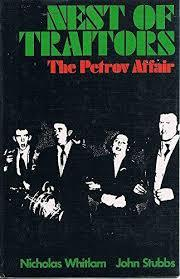
Book Review - Nest of Traitors: the Petrov Affair by Nicholas Whitlam and John Stubbs

Nest of Traitors : the Petrov Affair by Nicholas Whitlam and John Stubbs

Milton, Queensland: The Jacaranda Press, 1974     ISBN 0701607963

The Petrov affair, as it has become known, has - in the twenty-first century - become a footnote of the Cold War; a minor episode in the to-and-fro of the espionage activities of the Eastern Bloc and Western Allies.

At the time it was a major sensation in Australia, which had long been considered a backwater in most aspects of policy and activity in this struggle. Petrov's defection, and the Royal Commission into Espionage initiated by Prime Minister Robert Menzies in its aftermath, changed the political landscape in Australia, led to the toppling of Opposition Leader and head of the Parliamentary Labor Party Doc Evatt, and also led directly to the Labor Split, which consigned that party to opposition for another twenty years.

Therefore the circumstances of Petrov's defection, and of the Royal Commission, have been for many years a source of historical and political angst, not helped by the fact that - given the nature of what occurred - much secrecy surrounds the whole affair.

This book, written by the son of former Prime Minister Gough Whitlam (in fact published while he was running the country) and a journalist, certainly has an agenda to push. That agenda is, that if the defection wasn't actually staged by the Government, it was at least timed by Menzies to help him win the election in which the defection, Royal Commission and the spectre of Communism became major issues. The authors use a classic straw man set up to try and show that many of the documents that Petrov bought with him were manufactured, and that Petrov himself wasn't all that he claimed to be.

While there is little doubt that Menzies used the defection for maximum political advantage, it is also clear that Evatt did much to contribute to his own downfall. By choosing to represent his staffers, who became embroiled in the Commission, he became personally involved himself, and was obsessed with the idea that the documents - the infamous document "J" in particular - were forgeries, and that Petrov, far from being the MVD agent he claimed, was merely a lowly cipher clerk.

Whitlam and Stubbs rely heavily on John Burton and Michael Bialoguski's stories of what happened, and of course on the proceedings of the Commission itself. I find their excoriation of Petrov, based on the Commission's findings, a trifle naive; as even at the time it was clear there was material Petrov had brought with him that was not in the public domain. Many years after this book was written the publication of the Venona decrypts supported Petrov's version and shed light on such additional information that he provided the West. Burton is not an unbiased source, as he was closely allied to Evatt and the Labor Party, and also had strong views about whether Australia should in fact have it's own intelligence and counter-espionage service.

As a guide to the Petrov affair, this book needs to be read with reservations. As a guide to the political storm the defection caused at the time, and was still causing twenty years later, it's a fascinating time capsule.


Cheers for now, from
A View Over the Bell

Tuesday, 17 October 2017

Book Review - Chinese Shadows by Simon Leys

Chinese shadows by Simon Leys

New York: Viking Press, 1977                 ISBN 0670219185

A few years ago I really enjoyed reading Hall of uselessness by Simon Leys  (the pen-name of Sinologist Pierre Ryckmans), and having read other glowing reviews of his work, including the volume under review here, I will slowly hunt them down and read them.

Chinese shadows consists of a selection of impressions from a six-month visit to China in 1974, when the country was still endeavouring to recover from the upheaval of the Cultural Revolution. Ryckmans casts a critical eye over not only the state of the country at that time, but at the standard of critical commentary coming from the West about China and its recent history.

The book has longer and shorter vignettes and reflections on just how badly the Maoist experiment had gone wrong, and how all totalitarian societies end up with the same problems, no matter whether they espouse a leftist or a rightist philosophy (Ryckmans has a lot of fun with the forms of words used by the Chinese government and bureaucracy "sometimes,...leftism is a rightist error").

Ryckmans has several larger points to make in this work. The first is that the first thing that suffers under totalitarian rule is culture. This applies especially to Communist totalitarian regimes, where all of history must lead to the inevitable success of the revolution. When, as had happened in China, some heroes of that history needed to be purged, or the importance of an historical moment changed, one needed to try to change history. This resulted in China in the closure of museums, the destruction of monuments, and the censorship of literature and opera, to the extent that the only theatre that could be shown was that written by Mao's wife, the only books on the shelves were those by Stalin or Mao, and Ryckmans could not visit any University classes or academics in his entire six month sojourn. The destructive power of this sort of repression on a culture is hard to gauge.

The reaction of the lower functionaries in a system where white can be black, and the established structure and hierarchy can change in an instant, is another theme in this book. Ryckmans is constantly frustrated in his attempts to visit archaeological sites, or to meet people, or even in the simple act of asking directions. This, as he explains, is down to the natural fear of functionaries to give him permission to do something when the view of the regime is unclear on whether permission is allowed. It is easier, and safer for the flunky involved, to do nothing and admit nothing. As he writes of the cadres - "...we should consider how unrewarding and dangerous their job is....Directives from on high are deliberately ambiguous; in case of failure, the leaders thus have a fall-back position, while those who applied the policy are stranded and unprotected, and can be sacrificed to the rancor of the masses. It is unfair to criticize Maoist bureaucrats for their slowness and inertia: most often nonaction is their best chance of survival."

Ryckmans is more scathing of those apologists in the West who were writing paeans about China at the time - as he writes about one of them "She could have written in Europe, without leaving her room, if she had had some issues of Peking Review at her disposal; she would have gotten the same results. Her China experience was limited to a visit of a few weeks, and to three dozen interviews." He points out that many of the so-called Sinologists cannot speak or read the language, and have no understanding of the history or culture of China. Yet it is their views that were in the ascendancy at the time of writing.

All of the above smacks of the polemic, but Chinese shadows is much more than that: an elegy to what was lost during the Cultural Revolution, a celebration of innate Chinese cheerfulness, and a corrective to a flawed Western understanding of Chinese history - "If the start of the industrial revolution in Europe had coincided with one of those times when China was wide open to the outside world - which was its normal historical situation - China would never have been out-distanced in the modern 'race to progress'....In fact, because of this fatal historical accident - the establishment of the isolationist and totalitarian Ming system...China confronted the modern world blind and paralyzed, with the worst possible political heritage."

As a reminder of the path taken by China to get to where she is today, and as a book that still has a lot to give the reader, Chinese shadows is worth picking up.


Cheers for now, from
A View Over the Bell

Tuesday, 10 October 2017

Book Review - Japan's Imperial Conspiracy by David Bergamini

Japan's Imperial Conspiracy by David Bergamini, with an introduction by Sir William Flood Webb

London: Heinemann, 1971                               ISBN 0434066907

What a piece of work this book is. The subtitle on the cover; "how Emperor Hirohito led Japan into war against the West", is what Bergamini sets out to show us in over a thousand closely argued and densely woven pages. Bergamini (who was interned by the Japanese in the Philippines during the war) sets out to show the reader that Hirohito, far from being the puppet ruler of common historical thought, was actually a driven empire-builder, who spent decades preparing his "Strike South" into Asia, attempt to rid Asia of American and British influence and assert Japanese overlordship of the globe. There is no doubt that Bergamini had a fire in his blood to prove his thesis.

Whether he does, even after a thousand pages, is unclear. Even though there are almost one hundred pages of notes, Bergamini often puts his own interpretation on what his sources are saying, sometimes to the point of stating that the sources mean the opposite of what they say. He makes much of the allusive style of the Japanese, and the horror of losing face, to perhaps twist motivations and actions of people to fit his ideas.

So what is his thesis? Basically that Hirohito was fulfilling his grandfather's pledge to rid Japan of Westerners and become a great empire. The two options to do that were to "Strike North", attack Russia and slice off Siberia for a Japanese enclave, or "Strike South", and move into South-East Asia and gain the raw materials there. Bergamini sets up the two factions, and shows that Hirohito early on decided on a "Strike South" strategy, and spent years discrediting the "Strike North" faction by engineering all the coups and assassinations that occurred during Japan in the 1930s. Hirohito then prosecuted the War, not as a puppet-like figurehead, but as a vigorous war leader.

Unfortunately for Bergamini, when he gets to the crucial parts of his thesis, the evidence lets him down. During the various coups in the 1930s, Hirohito did not play the part Bergamini wants him to play, and the general absurdity of his idea that Hirohito would countenance a coup against his government and assassination of his Prime Minister to discredit one faction or another is a bit too much to take.

However, there is a lot of information in this book, and it is a fascinating insight into recent Japanese history. The quick technical advancement of the Japanese nation, which combined with a kind of naivety about world opinion and affairs, is something that characterises the period of which Bergamini is writing.

When it gets to the War (to give an idea of how much space Bergamini commits to the intrigues of Japanese history before the War, the Pearl Harbour attack doesn't appear until page 800), Bergamini is perhaps on surer ground, but still draws some strange conclusions; for instance, he claims that Japanese brutality toward prisoners was a deliberate ploy to try and get the West to sue for peace - now the Japanese may have been naive as to the ways of the West to a certain extent, but it's hard to see how Bergamini can come to the conclusion he does on the evidence he presents.

So what was Hirohito's role in the planning and execution of the War? Bergamini is probably right when he (briefly, given the size of his book), explains how Hirohito escaped charge at the end of the War, and that the 28 "Class A" war criminals sent to trial were carefully picked to ensure that Hirohito's name was not sullied. There is no doubt that Hirohito should have faced court as did other leaders of Japan, he was not a constitutional monarch like George VI, and had much more control over events than has been generally explained. Certainly the Australian Government wanted Hirohito to be tried. The Americans - led by MacArthur - who had to run occupied Japan, knew that they needed a compliant Hirohito to enable that occupation to take place, and to help Japan rebuild herself after the devastation. To a Western outlook, Hirohito cannot have escaped the moral guilt of waging aggressive war, even though he escaped the arms of justice.

I'm not sure if I recommend this book or not. There is certainly a lot of information in here for the student of recent Japanese history, but it needs to be leavened with much other reading.


Cheers for now, from
A View Over the Bell

Monday, 5 June 2017

Book Review - Culture of Complaint by Robert Hughes

Culture of complaint by Robert Hughes

London: Harvill, 1994                                       ISBN 0002730022

When this book was released in the early 1990s, during the height of the "cultural wars" of that time, it made quite a splash. Now, nearly twenty-five years later, much of what Hughes wrote seems to the current reader to be prophecy. The "culture of complaint" now seems to be dominant; turbo-driven by the advent of social media.

Hughes' book came out of a series of lectures he gave in New York, in which he discussed in turn politics, multiculturalism, and morality in art. One of the themes that weaves throughout the book describes the way in which both the Left and Right of the political spectrum are driving the breakup of US society into its constituent parts, creating ghettos of race, sex, sexual orientation and so on.

What Hughes does so well is punch holes in the idea that creating these ghettos actually "empowers" those who chose to identify with them in any meaningful way. While not for a moment suggesting that there hasn't been a hegemony of the "White West" for many centuries, the solution is not to retreat into a self-reflective circle of your own kind, or, conversly, to claim genius for works or ideas that don't deserve to be given that label. Hughes also exposes, in withering fashion, how those that would denigrate what has happened in the past use the same methods now to push their own barrows.

Unfortunately we have seen, since this book was written, an increase in the acceptance of the ideas that one can't criticise if you are not part of the "group" from which the work or history eminates, or that the idea of quality when it comes to art is a suspect notion that smacks of old-fashioned imperialism. We have now entered a world that Hughes predicted in this book: groups of artists and politicians speaking only to themselves, in a language only they understand, and blaming the "other" - whoever that might be - for their lack of success.

Hughes goes on to explain that this "culture of complaint" has also had an effect on those institutions that exhibit. Caught between the faux moral and religious outrage of the Right, and the equally prudish theorising of the Left, museums and galleries have played it safe with what they exhibit.

As one would expect from Hughes, it is the section on visual art that has the most meat. Hughes gives us a potted history of how art has been absorbed in America, and why it is in that place in particular that art is seen as something that should be morally uplifiting and therapeutic. Hughes doubts that art can ever have those properties, in fact he believes that art is justified by its beauty alone, and that any other claims it might make - particularly political claims - are tendentious. Art doesn't change history.

His final few pages explain the irony that, at the moment in history when the West has never been more open to accepting great art without any baggage of racism, sexism or homophobia, many of these previously repressed groups have retreated from the idea of entering a mainstream of cultural life. The Balkanisation of American political and cultural life does no-one any good, least of all those who were in the past marginalised.

As Hughes writes, we happily accept, in the world of sport, that there are players of genius and that a rigorous selection process leaves the best at the top. The same should occur in art: new art should always be compared to the best, and strive to be the best.

For those who wonder how we got to where we are today, this book is worth reading. It has aged well.


Cheers for now, from
A View Over the Bell

Tuesday, 9 August 2016

Book Review - Islam and the future of tolerance: a dialogue - Sam Harris and Maajid Nawaz

Islam and the future of tolerance: a dialogue by Sam Harris and Maajid Nawaz

Cambridge, Mass.; Harvard University Press, 2015      ISBN 9780674088702

This short book takes the form of a dialogue between Sam Harris, author of books such as The end of faith and Maajid Nawaz, former member of Hizb ut-Tahrir and author of the book Radical, and co-founder of the Quilliam Foundation.

The book is a timely discussion about Islamic extremism, or Islamism, and how it can be tackled. What comes out of this discussion is the urgent need for other voices than those radical jihadists to get out into the World and be heard. It's clear that the Islamists dominate discussion around the Qu'ran and what it means, and Nawaz in particular is keen to get the alternative, more peaceful and tolerant, interpretations of Islam more into the mainstream, both to quell the West's hostility, and to show potential radicals that God is not on the side of the Islamists.

While for Muslims the Qu'ran is the word of God, Nawaz points out that the interpretation of those words is all too human. As is the case with the Bible, there is much that is seemingly contradictory in the Qu'ran, as well as obscure. Add to that the difficulty of translating the old Arabic in which it is written, and there is a mass of interpretation that has to go into even a basic reading. As (Sunni) Islam has no structured priesthood, guidance on how to interpret the text can and does come from everywhere.

Islamism, as Nawaz styles it, is more a political ideology than a truly religious movement, but it is the religious aspect that enables the likes of ISIS to brainwash people to die for the "cause". Both Harris and Nawaz are clear that this false view of religion needs to be tackled front on, and that it is Muslims that need to be seen to be doing it. At the same time, they are both agreed that the political and military structure of ISIS needs to be destroyed utterly. Such destruction will have the effect of showing would-be radicals that God does not smile on their jihad, and that in fact the deluded views of ISIS leadership in no way correspond with God's.

There is in the book also some discussion of the tendency for the West to hold minorities and Middle Eastern countries to a lower standard of human rights and freedom than that which they demand for themselves. Both authors call this out as mindless and actually fuelling the ends of the terrorists.

This book will take an hour or two to read, and is well worth the time invested.


Cheers for now, from
A View Over the Bell

Monday, 11 April 2016

Book Review - Philby of Arabia by Elizabeth Monroe

Philby of Arabia by Elizabeth Monroe

London: Quartet Books, 1980                         ISBN 0714333465

It's a sad state of affairs that when one mentions the name Philby usually the first person to be discussed is Kim, the Soviet Spy and British traitor. His Father, Harry (known as St. John) Philby, or as he came to be known "Philby of Arabia", is a more fascinating man for all sorts of reasons.

In this book Elizabeth Monroe has done a serviceable job of relaying a life of a driven, difficult, yet talented man who carved out his own niche in the history of the political development of the Middle East, and in exploring both the geography and history of much of the Arabian Peninsula. 

The subject of a broken home, Philby exhibited his precocious talent early, winning an exhibition to the famous Westminster School, and on to Trinity College at Cambridge. His mother's lack of means meant that rather than continue on at University he went to India to work in the civil service, where his quick facility for languages served him well, but where his quick temper and forthright views served him less so. He was seen early on as a bit of a "queer fish" owing to his mingling with the locals, and his developing views on Indian independence, although in many other ways Philby was English to his core, never losing his love of London club life, or watching cricket at Lords.

Like many men of his era, World War One was a turning point in his life. He chafed to be of use to his country, and eventually found his way to Mesopotamia, where he worked with the governing forces. He never saw action, but became a vital member of the civil government for a time. However, his forceful nature and inability to compromise saw him lose favour with the powers that be, which was a constant theme in his life. He did have his supporters though and they suggested he be sent to gauge the political outlook of Ibn Saud, the major Sheikh in Arabia during the War. Philby, in the course of this task, became the first European to traverse Arabia from East to West, and was one of the first to enter Riyadh and stay there for any length of time. He became friends with Saud, and in his impulsive way, saw Saud as the true liberator and ruler of all the Arabs. Because Philby was a man who only saw things in black-and-white, this meant that he was totally opposed to Hashemite rule in Arabia, which again brought him into conflict with the British Government. He played a small part in the negotiations around the political shape of the Arabian peninsula after the War, but was never able to grasp the bigger picture, failing even to see that Ibn Saud was following an agenda different to the one Philby thought he should.

Philby though had seen one thing - that his future lay in Arabia. He revealingly wrote to his long-suffering wife, Dora - who was left in England for long periods without much money to bring up their children - that he was desperate for fame, and he felt that Arabia was the place for him to find it. He had written a book about his wartime journey, and was seen as something of an Arabian expert, so was hired by a company to represent them in Arabia. It took several "lean years" before he could turn his friendship with Saud into a profitable one, years in which he further antagonised the British government with his outspoken writings suggesting Arabia should be independent. During these years he also converted to Islam, which seems to have been driven by practical motives as it enabled him to be with the King in the Holy City of Mecca - Philby never seems to have been a very religious man.

His business career began to meet with some success in the 1930s, and he was given permission by the King for the first of his Arabian journeys, into the Empty Quarter. Although Philby in many ways was not a nice person, he was a good explorer and mapmaker, producing quality geographical information on his trips, as well as collecting interesting specimens of wildlife. Philby being Philby, he also caused a diplomatic incident when he entered Yemen without permission, which made Ibn Saud wary of giving him permission to explore in similar areas near the border.

World War Two saw Philby spend some time under arrest in Britain for his views on Britain and its Middle Eastern Policy: Philby thoughout his life could never understand why his outspokenness may not be welcome, and always saw himself as a loyal but critical Englishman. His short foray into politics was similarly damaged by his outspoken nature, gathering only 526 votes the only time he stood for office.

After the war he was back in Arabia, living well until the demise of Ibn Saud, which included starting another family with a girl given to him by the King. In the 1950s he made several expeditions into the ancient lands of Midian, before being for a time banished from the Kingdom after Saud's death, for criticism of the Kingdom's growing problem with corruption and greed.

Philby eventually was welcomed back, but by this time he was an old man, and eventually died at his son Kim's home in Beirut in 1960. By this time Kim was already under pressure, with speculation about him being "the third man" rife: he fled to the Soviet Union shortly after his father's death.

Philby's legacy is his exploration and mapping work, with the results of his Midian expedition with Rykmans still being written about to this day. His was one of the last of those lives lived when an Englishman could impose himself anywhere in the world and live a life worth writing about. A fascinating man, this book is a good introduction to him and his achievements.


Cheers for now, from
A View Over the Bell