Showing posts with label Literary Criticism. Show all posts

Sunday, 20 April 2025

Book Review - The Romantic Imagination by Maurice Bowra

 The Romantic Imagination by C.M. Bowra

Oxford: Oxford University Press, 1961 (first published 1950)     ISBN 0192810065

In a series of thoughtful and thought-provoking essays (originally lectures delivered at Harvard University in 1948-9), Maurice Bowra skilfully dissects the great Romantic poets, showing us how in their view "the creative imagination is closely connected with a peculiar insight into an unseen order behind visible things."

Bowra focusses on the major poets of the era - Blake, Coleridge, Wordsworth, Shelley and Keats - and also the "fellow travellers" who shared some of the thinking of the major poets, but either could not surrender fully to the imagination (Byron, Christina Rosetti), or surrendered to it too fully (Swinburne, Poe), or could only work with the thinking in a limited way (Dante Gabriel Rosetti).

Bowra shows how these poets succeeded, and where they failed, and links those successes and failures back to the driving ethos behind Romanticism. While the Romantics opened new vistas for poetry to explore, by turning their backs on the Augustan and Elizabethan tradition, Bowra explains that the Romantics had no tradition to fall back on when inspiration failed; "for tradition enables a poet to conserve his powers, to recruit his strength from other quarters when he is not able to do everything from his own resources. It even helps him to exert himself in fields for which he is not ideally suited, but in which none the less he may be able to win noteworthy successes. The Romantics relied on what was most unlike others in themselves, on their own peculiarly individual gifts. The result was that, by too much concentration on them, they exhausted these gifts and had nothing to put in their place."

In his essay on Wordsworth's Ode: Intimations of Immortality from Recollections of Early Childhood, Bowra explains this process as it worked through this poem and Wordsworth's life, and how Wordsworth came to terms with the waning of his inspiration, in a way that Coleridge could not. In both men poetry waned, but only Coleridge stopped writing. I think Bowra sees these two as the peak of true Romanticism, most able to successfully commit their "philosophy" to poetry that could readily be understood.

Blake, and to some extent Swinburne and Poe, struggled on that front as they used their own personal idea of the "supernal" in their poetry, and thus made it harder for the reader to understand what they were trying to say. They also moved away from using ordinary everyday scenes and words which was key for Wordsworth and Coleridge in particular, and their poetry suffers because of it. 

Poe and Swinburne in particular, in their strivings for tonality and musicality, could stray too far from meaning.. It's probable that Swinburne would have agreed with Walter Pater's maxim that "All art aspires constantly to the position of music", even though it was written well into the Victorian era. However, this idea is fundamentally flawed: poetry is an art (and a craft) that deals with words, and words convey meaning. No matter how "musically" words are grouped together, if they fail to convey meaning, a poem has failed. This was often a trap for Swinburne (and for God-knows how many poets that have come after him).

Bowra's essay on Christina Rosetti was for me the most powerful. It brings together his theories, showing how while Rosetti was a wonderful poet, she was not a Romantic because she cleaved to traditional religion rather than a self-created spirituality. She longed for God and fought her worldly desires for love. These strains are all worked out in her verse, and because she does have a focus for her "unseen order of things" her poetry doesn't fall into the trap of say, Poe's work, which too often falls into the "un-nameable" or "un-knowable" other.

I suppose the question for me is do I agree with Bowra's views as expressed in this book? I think, for the majority of them, the answer is yes, especially when he discusses Wordsworth, Coleridge, Keats and Shelley. His essay on Blake is interesting, and requires more thought from me. The essay that opened my eyes the most was the one concerning Christina Rosetti - I will go back to her work with a new outlook and respect.

If you like the works of the Romantics, but feel that you need a bit of a scaffold on which to build a greater understanding of their achievement, I can highly recommend this book - well worth reading.


Cheers for now, from

A View Over the Bell

Thursday, 4 July 2024

Book Review - The Problem of Style by J. Middleton Murry

 The Problem of Style by J. Middleton Murry

London: Oxford University Press, 1967  (first published 1922)

This is an interesting little tome. Originally lectures delivered at Oxford University in 1921, Middleton Murry has grappled in this book with the notion of literary style, what it is and what it isn't, and how authors achieve it.

Through a connected series of pithy chapters, Murry contends that style comes from the author's heightened sensibility approaching language in a way that explains exactly the message or story that he or she is trying to express - "every work of enduring literature is not so much a triumph of language as a victory over language".

Therefore there are potentially as many styles as there are authors, although not all authors necessarily have a style. The process of creating a style comes from an author using their individual sensibility to pin down exactly what it is they are trying to say - "but the smallest writer can do something to ensure that his individuality is not lost, by trying to make sure that he feels what he thinks he feels; - that he thinks what he thinks he thinks, that his words mean what he thinks they mean."

Style differs when the story differs: Murry does not feel there is any difference between poetry and prose in terms of a hierarchy of style, merely that one form or the other is perhaps more appropriate to convey certain messages. This leads Murry to talk about the appropriateness of poetic language in prose, and back to the contention that the author should use exactly the language required to impart their vision, nothing more. Of course this might mean a more or less florid style as is suited to the message, but using language merely to aggrandize is always wrong.

As a relatively poor student of literary criticism, there is much in this book for me to ponder. Worth a look.


Cheers for now, from
A View Over the Bell


Friday, 28 October 2022

Book Review - Stolen Words by Thomas Mallon

 Stolen Words by Thomas Mallon

San Diego: A Harvest Book, 2001 (originally published 1989)      ISBN 0156011360

This book was an interesting read, but doesn't quite live up to the breathless blurb on the cover ("The classic book on plagiarism). Thomas Mallon, through five case studies looks at what plagiarism is, and what it isn't, and why it takes place.

After a brief history lesson on the beginnings of copyright, Mallon looks at the career of Laurence Sterne and his theft of Robert Burton. He then moves on to the case of Charles Reade, and his copying of Mlle. de Malepeireacademic malfeasance in Texas, the sad case of Jacob Epstein's copying of Martin Amis, before tracking his way through the Falcon Crest saga.

He uses these examples to not only delve into the nature of plagiarism, but also to try to investigate why plagiarists do what they do. He is fascinated by the fact that many plagiarists are very active in hunting out others that have engaged in the same activity. Charles Reade in particular was vociferous in his denigration of those who stole from their French compatriots, and yet he blatantly copied Mlle. de Malepeire by Mme. Reybaud...when he didn't need to after his own successful career. It seems that many plagiarists have what Mallon calls "a death wish"....they actually want to get caught. The case of Jacob Epstein, son of literary lions Barbara and Jason, is a case in point. Stealing large chunks of Martin Amis was bound to be found out eventually, but the embarrassment of actually being found out by Martin himself made the scandal all the more juicy for the newspapers.

In academia, Mallon shows us that a fear of litigation can lead to plagiarists thriving, and that the excuse of "I mixed up my notebooks" has been alive and well for hundreds of years. However, sometimes something that is similar is not plagiarism. After all, there are only so many stories, and so many ways you can describe an individual event. The key, as Mallon shows us, is in the words - plots can't be copyrighted, but words can, and plagiarism is really stealing words rather than ideas.

Overall, this book was easy to read and interesting, but in my opinion there was a bit too much blow-by-blow description and not enough discussion of the motivation behind the examples he writes about. I think more philosophical musing might have made this work a bit better...but you may differ.


Cheers for now, from

A View Over the Bell

Monday, 7 December 2020

Book Review - Eight Victorian Poets by F. L. Lucas

 Eight Victorian Poets by F. L. Lucas

Cambridge: Cambridge University Press, 1930

If you are a book accumulator like myself, you no doubt have many books such as this lying around your house: picked up for a song, on a subject you like (or would like to know more about), and put in the pile to read "one day". Well, for Eight Victorian Poets, that day has come, and on balance it was worth the time to read.

Frank Lucas was a well-known critic and commentator in his day, and was famous for his scathing review of T.S. Eliot's The Waste Land, although his real expertise was in poetry of earlier eras: it's important to keep in mind that, having been published in 1930, Eight Victorian Poets was discussing near contemporaries, not an era ancient to the author. In fact Lucas points out that several of the poets discussed died not many years previous to the publication date of this book (which, from the introduction, I take to have originally been radio broadcasts).

Lucas has written short, quite personal essays on what he saw as major poets of the Victorian era: Tennyson, Robert Browning, Matthew Arnold, Arthur Clough, Dante Gabriel Rossetti, William Morris, Swinburne, and Thomas Hardy. Whether by design or chance his chosen subjects range across most of Victoria's reign, and so we see the "development" of poesy through that time (if indeed development is the correct term).

In dealing with Tennyson and Browning, Lucas compares and contrasts their styles - Tennyson the great evoker of scenery, where Browning was much more concerned with people rather than places. Both are to be enjoyed, in Lucas's opinion, in fragments rather than by trying to read their longer poems in one sitting: Browning in particular he exposes as hard to understand at times. Both he considers failed themselves when they turned too much toward preaching rather than the music of poetry, with both becoming lost in their fame and the adulation they received from a sometimes too credulous public.

Lucas moves to discussing Arnold, whom he considers had a great art, but repressed it because he felt that it was too frivolous a thing to be writing poetry when there was so much more to do in the world. He compares this to Clough, who's art was destroyed by his engagement with big questions (faith, love), which left him little time to be much more than a dilettante, but one with much talent.

Rossetti in some ways Lucas sees as a pivotal figure of the period, the one who brings the "passionate South", into the cooler "Northern" air of Victorian poetry. While he became a bruised personality, he worked hard on the art of poetry, rather than concentrating on moralism or preaching like Tennyson and Browing.

In Morris, Lucas sees a poet somewhere between the extremes he has previously delineated, one who did use his talent wisely in his verse. He likes Morris's fecundity in all things, and while not suggesting all his work was successful, the following quote sums up his feelings for the work - "Between the fireside glitter of societies like Pope's and the sun-blinded vapours of souls like Shelley's, lies a middle sphere. In it are found reason without insensitiveness and imagination without unreality, sense without hardness and deep feeling without sentiment; in it the greatest name is Shakespeare, and far from the least is William Morris."

His final two studies, Swinburne and Hardy, are again contrasts for Lucas: whereas Rossetti was "driven mad" by Victorianism, Swinburne was "eaten up" by it, barely surviving his first foray into poetry, and, as a poet, never really moving beyond his initial youthful exuberance, Lucas portrays him as "childish and cruel", his poetry showing a want of proportion and experience, judgement and restraint. While his music as a poet was sublime, he mostly had nothing to say - he failed to ripen.

Hardy on the other hand, he portrays as never being "young" - ruthlessly truthful all the time, he had no need for sentiment or flowing adjectives. His sincerity and intellectual honesty shine out in his poetry - "There are poets like Tennyson who think of Beauty before Truth; they tend to produce poetry that is perfect rather than great: and there are poets like Hardy who have a feeling for Truth even before Beauty; these tend to produce poetry that is great rather than perfect."

This book is a pithy introduction to these poets, with Lucas providing a pithy introduction about the value of reading verse over succumbing to science - Lucas enjoins us to read and enjoy, and enjoy just for enjoyment's sake. Which is what I'm heading off to do right now.


Cheers for now, from
A View Over the Bell


Sunday, 16 September 2018

Book Review - The Art of the Novel by Milan Kundera

The Art of the Novel by Milan Kundera

London: Faber & Faber, 1990           ISBN 0571142222

I've never read any of Milan Kundera's novels, so it might seem strange that I start my relationship with him with this book. In some ways I'm glad I did, as it gives a great insight into Kundera's view of the role of the novel - particularly in Europe - and what he is trying to do with it.

This book is a compilation of pieces written in other contexts, for other reasons: some have been manipulated to make this work hang together a bit better.

Kundera's theme in this book is to show how the novel developed from Cervantes through to the end of the twentieth century, how the modern world had circumscribed the novel with ideas of realism and notions of the absurd that have come to limit what writers do with the form these days. Kundera, a composer as well as a writer, strongly believes in the connexion between the two arts, and that a book is written much as a sonata or other multi-part opus may have been written.

Kundera's view that the novel is an exploration of the human condition, and as such finds the biographical impulse of critics and so-on repulsive. He is a firm believer of novelists not speaking other than in their novels, and notes with satisfaction that Debussy destroyed all the works he felt he didn't want to leave behind.

The irony is that one of Kundera's favourite novelists is Kafka, who famously told Max Brod to burn his works after he died. The section of this book that deals with Kafka should be required reading by every faculty member who dissects his work. What they do is actually destroy what Kafka was trying to achieve. Kundera, a fellow Czech, who also grew up in a system that Kafka in some ways prefigured, shows a deep understanding of Kafka's understanding of human nature, and of modern life.

He also warns us of the dangers of translation, and why one must be very careful when reading a work not in it's initial language...anecdotes of translators of his works that can't read Czech are both funny and disturbing at the same time.

In  this book, published in 1986, Kundera flags the death of the novel as he knows it, in the rise of mass media and the loss of privacy. Some of his comments are prescient. In an age where it has never been easier to access great literature, it has never mattered less, in academia in particular.

This is a book of parts, but some of the parts are well worth reading.


Cheers for now, from
A View Over the Bell

Tuesday, 11 October 2016

Book Review - Oscar Wilde: a summing up by Lord Alfred Douglas

Oscar Wilde: a summing up by Lord Alfred Douglas, with an introduction by Derek Hudson

London: Icon Books Limited, 1962

There's little doubt that the line of the Marquesses of Queensberry was a troubled one - suicides, depression, violence and alcohol running through the family during the Nineteenth Century. Most famously Alfred Douglas' father, John, 9th Marquess of Queensberry, was a violent abusive man, who took Oscar Wilde to court which led to Wilde's imprisonment for homosexuality and following destitution, all in an attempt to belittle his own ex-wife and son, Alfred.

The book under review was written by Alfred a few years before he died, and is an interesting snippet of Wildeiana. Alfred in many ways was like his father: passionate, disagreeable and wilful. Oscar Wilde: a summing up is Douglas scoring some final points against his enemies, and re-assessing and justifying his own actions, while also muddying the waters as to his own culpability when it comes to Wilde's downfall.

While Douglas famously repudiated Wilde after the latter's death, in this book he softens his attack on him. Having converted to the Roman Catholic faith, he naturally deprecates Wilde's sexuality, while at the same time excoriating his imprisonment for it. As Douglas reckons it, while homosexuality is a sin, it is not a crime and to treat it as such is wrong. He also claims that he himself never engaged in a homosexual relationship with Wilde, and had no idea of Wilde's "perversion" until it came out in the trials, which is very hard to believe.

Douglas gives a quick overview of Wilde's life, correcting some misinterpretations and falsehoods that had crept into the publications extant at that time, and provides some critical insight into Wilde's work. His criticisms on the whole accurately sum up the worth of Wilde's output but adds nothing new.

This is a quirky book, it reads like an old man talking over an afternoon cigar - wanting to make a point but constantly being side-tracked into explaining other things that crop up in the conversation, crusty and set in his views, and unrepentant over his role in the affair.

What Douglas does convey is the beauty of Wilde's wit and conversation, a facility that won over many of his enemies and was his ticket to fame. He was loved by no-one more than Douglas, and this book shows us that, as well as being an insight into Douglas himself.

The blurb on the back of this paperback edition states that "this book is a last word about Oscar Wilde.." and while that may be when it comes to Douglas, it is certainly not the last word on what was an amazing life and titillating scandal.

One for complete-ists only.


Cheers for now, from
A View Over the Bell

Wednesday, 22 June 2016

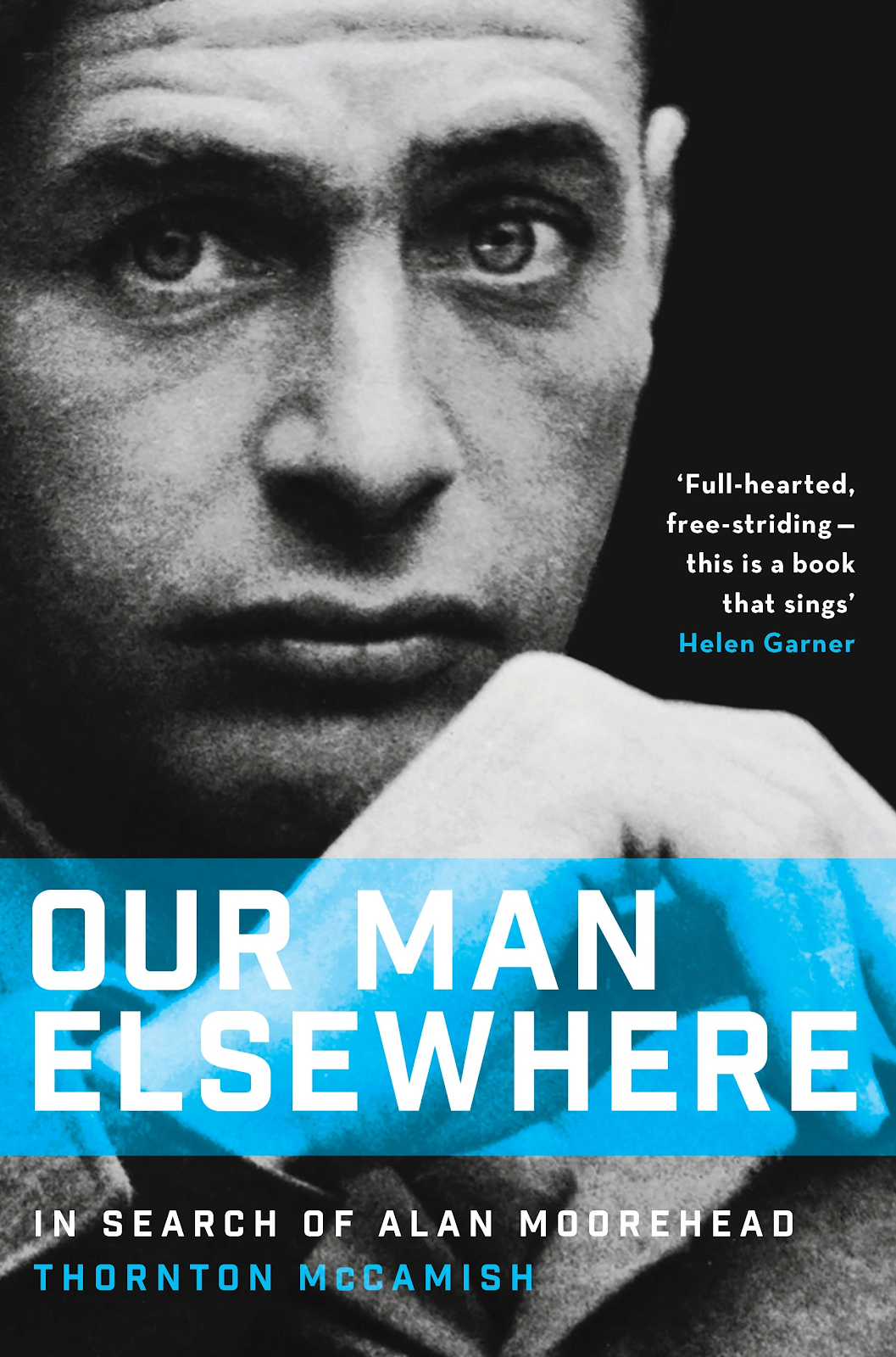
Book Review - Our man elsewhere by Thornton McCamish

Our man elsewhere : in search of Alan Moorehead by Thornton McCamish

Carlton: Black Books Inc., 2016                  ISBN 9781925203110


In the acknowledgements at the end of this book, Thornton McCamish calls his effort a "sort-of biography", which I guess is true, but sells this well-written and entertaining book short. Part detective story, part hagiography, part travel diary, this book about one of Australia's most well-known post-war writers begins by trying to understand a mystery, a mystery that has also intrigued me a little over the years, and a mystery that drove McCamish to great lengths.

Alan Moorehead, at the peak of his powers in the early 1960s, was one of the best-known writers in the English-speaking world, mentioned in the same breath as Hemingway (they were friends, of a sort), and whose latest tome was eagerly awaited by both publishers and readers alike. His version of history as travel, with a bit of himself thrown in, had no equivalent in his own time, and few equals since, and there have been many who have tried to capture the essence of his writing in their own, and failed.

The mystery that McCamish outlines at the beginning of Our man elsewhere is how someone like Moorehead could - half a lifetime after he stopped writing - now incite a response of "Alan who?" if mentioned in conversation, particularly in his home country of Australia (McCamish too is Antipodean).

Like McCamish, I have a deep affection for Moorehead's work. Unlike McCamish, I came to him first through his later books such as The White Nile and Cooper's Creek. McCamish first came across his war writing in the African Trilogy and was instantly swept up by the power of his prose, and the seemingly effortless way he transferred experience to paper. This began a multi-year process of trying to track Moorehead down in archives and on the ground. It seems that at some stages this activity became almost an obsession for McCamish, rather than merely research for a book.

As McCamish gets further into his subject, the reader travels with him across Europe, experiencing his personal reaction to the various revelations he has while walking in the footsteps of his hero. We learn that Moorehead was desperate to leave Australia, and when he did in the mid 30s, his luck landed him on the doorstep of the opening salvos of World War Two.

McCamish, even though he clearly has great respect for his subject, is not averse to describing his less-than-perfect traits, one of which was his pushiness. This characteristic - much unloved by the Englishmen around him - enabled Moorehead to get on the ground in Egypt to witness the Western Desert fighting. When he arrived there he was a working journalist, unknown outside his newspaper, and one of many war correspondents assigned to the theatre. By the time the campaign ended with Allied victory, his byline alone was selling papers, and his successful war books were being put through the presses.

While he was covering the war, he was also having a good time. McCamish conveys the almost University College-like feeling of men being together all for a common purpose, with the danger and discomfort adding to the cameraderie. For Moorehead, it was also like the University education he never received, spending much time drinking and arguing with his contemporary English correspondents, and learning much about the world, literature and history.

At the end of the war, Moorehead was determined to make his mark as a writer, but floundered for the next decade, producing several poor novels (McCamish, ever ready to praise Moorehead's writing, can find little good to say about these efforts - I'm glad he read them so I don't have to), and surviving on articles for magazines such as the New Yorker and others.

He gradually came to realise that his forte as a writer was non-fiction, and over the period from his highly praised book about the Gallipoli campaign to the release of The White Nile he found his true metier - narrative history with an "I was there" feel. His ability to describe places, imagine a place in time and to sketch character, all developed in the crucible of war, were now put to good use, and both The White Nile and The Blue Nile were bestsellers.

As well as these successful books, Moorehead continued to write articles for magazines, and tried (and failed) to get into writing for films. He travelled constantly, but his home base was a house he built in Porto Ercole in Tuscany, and on his brief soujourns there he hosted a constant stream of writers, actors and other members of high society who came and spent time with him. It was a good life.

Writing the book about Gallipoli brought Moorehead back to Australia: when he left in the 30s, he cast aside his home country, to the extent that he even changed his accent. In the early 50s he returned for a short period to write a book aimed at the overseas market (Rum Jungle), which did little to endear him to the Australian literary scene, as it was then. After he finished the Nile books, he was searching around for a new subject, and his friend Sidney Nolan (Moorehead was on friendly terms with many artists) suggested the Burke and Wills story as suitable. The result was not only Cooper's Creek (still the best treatment of the Burke and Wills expedition), but a realisation by Moorhead that his home country did have a lot to offer a writer. True, it had no long human history in the European sense (which is why he left in the first place) but it was a country that was still in the process of creating its (white) mythic stories, and those stories contained much that was of interest to a writer.

This homecoming for Moorehead was therefore a physical and a psychic one, and he was finding his endless wanderlust was passing (his other desires however were another story; an inveterate womaniser, McCamish deals with Moorehead's numerous affairs and flings with honesty and tact).

Then tragedy struck - the stroke he suffered at the end of 1966 stopped his writing for the rest of his life, and meant that his final 15 years were one of limited horizons: he couldn't really communicate much verbally, was essentially unable to read and could not write (he could however, paint, with his left hand). The fact that he published two further books is down to his wife Lucy, who managed to gather together and edit material that emerged as Darwin and the Beagle and A late education. Lucy comes through  in this book as an equal partner in the Moorehead "business" - since the war she had been essential in his output - typing, editing, dealing with publishers and making sure business was finished, as Alan was travelling and writing.

All of this is related by McCamish in an easy-to-read way; interspersing his own story of tracking down his hero and revisiting places Moorehead stayed or visited and comparing the now to the then. Once into the book the reader realises that what McCamish is doing is writing a Moorehead book: a narrative history with a present-day "I" at the centre. It is a touching tribute to Moorehead, and a successful one too - many books of this type fail because the "I" becomes too intrusive, but invariably in Our man elsewhere McCamish's appearances add to, rather than detract from, the story.

The quibbles I had with the book were few - a couple of editorial mistakes (Frank Clune, not Cluny, and I couldn't find the article in Horizon  magazine that was mentioned) and a very occasional slip in McCamish's evocation of the past (in Melbourne in the early 60s they would be drinking Claret and listening to the wireless, not Fruity Lexia with a radio). McCamish has a wonderful way of expressing what it's like to research thoroughly for a book; I loved how he hated to see the name Morshead in the index of books because it meant there was no mention of his pet subject (resonating with me because I'm often looking  for Morshead and am annoyed at Moorehead appearing!).

McCamish also had problems with Moorehead's view on topics such as native Africans and Australian Aboriginals, wondering why Moorehead wasn't more progressive, but he was certainly a man of his time, and a man of Empire toboot, so it would seem to me that his views were of a piece with that. Where Moorehead was ahead of his time was in his views on conservation, with No room in the Ark and The fatal impact years ahead of their time in their description of man's impact on other life. It would have been interesting to see how Moorehead's writing developed in that area if he hadn't had his stroke.

As with all good biographies of writers, Our man elsewhere reminded me of what I should revisit, told me things I didn't know (i..e. that he didn't die until 1983!), and has driven me to some of Moorehead's work that I hadn't read. By the end of the book, as McCamish revisits the Moorehead archive at the National Library of Australia for one last time, he himself seems to reach the end of his obsession, and can comfortably close the cover on what is an interesting biography of an interesting man.

Highly recommended.


Cheers for now, from
A View Over the Bell

Friday, 4 March 2016

Book Review - The thirsty muse by Tom Dardis

The thirsty muse : alcohol and the American writer by Tom Dardis

London: Abacus, 1990               ISBN 0349101434

"Of the seven native-born Americans awarded the Nobel Prize in literature, five were alcoholic." Thus begins this fascinating book, which looks at four of the great twentieth-century American writers - Faulkner, Fitzgerald, Hemingway and O'Neill - and the toll that their alcoholism took on their lives.

Dardis, who himself was a recovered alcoholic, writes with power and knowledge about the effects of the disease on the body and the mind, and the inevitable progression - if the subject doesn't stop drinking - into depression and early death.

The book is divided into four sections, one for each writer, beginning with Faulkner. Part of what makes this book a fascinating one to read is the illustrations of the connections that flow through these writer's lives apart from alcohol. One is that they all had trouble with their partners and wives: trouble partly caused no doubt by alcohol. Faulkner's wife and family were a source of financial stress as to keep them all Faulkner felt that he had to go to Hollywood to write for the movies. Whilst he felt that this type of work was beneath him, he was actually not a very good scriptwriter, and soon struggled to hold a position at any studio; his predicament was not helped by his frequent alcoholic breakdowns.

Another common thread throughout the book is the need for these writers to ensure their partners were unable to upstage them in their chosen profession - at times Fitzgerald, Hemingway and O'Neill sought to repress the literary ambitions of their spouses. This smacks of a greater insecurity that certainly manifested itself  in Hemingway, who constantly was looking over his shoulder at the achievements and drinking of his contemporaries. Hemingway was quick to brand others as "rummys" - Faulkner in particular - but was blind to his own drinking. Dardis points out that denial of the problem is typical of alcoholics, and all four of these writers denied they had a problem, except O'Neill, who managed to escape the disease's clutches.

As well as charting the progress of alcoholism, Dardis (who was a professor of English), charts the progress of each person's writing. It's fair to state that typically the standard of writing inversely followed the progression of each writer's alcoholism. Faulkner's early genius slowly dissipated, and his later works, particularly A Fable, did not have the same power as his earlier books. Faulkner found it harder and harder to string words together, and spent a decade writing A Fable, where in the past he could write a book in a matter of months. He eventually descended into a great silence, not writing, but regularly attending clinics to dry out.

Fitzgerald seemed to spend a lot of time running away from his gift. After completing The great Gatsby, Fitzgerald was content to churn out stories for the Saturday Evening Post at $2,500 a pop, to keep him in the lifestyle he wanted. Hemingway was not the only one who thought he was wasting his talent: Fitzgerald defended his decision, but one wonders if deep-down he knew that he was destroying his skills with alcohol. Eventually his abilities eroded to the extent that he couldn't sell any stories at all, and those that he managed to get published were second-rate by his standards. By this time Zelda was pretty much institutionalized, although Dardis shows us that she was clear-headed enough to realise that it was Fitzgerald's (and her own) drinking that had a lot to do with both of their problems. Fitzgerald, like most alcoholics, refused, or was unable, to see that alcohol was the problem.

Hemingway always saw alcohol as the solution: "when things were really bad I could take a drink and right away they were much better." His drinking was legendary, but in the early years he kept his drinking and writing strictly apart. As his disease progressed, the time he would have spent writing was taken up with his drinking, and the writing diminished. Hemingway's drinking made him more likely to carry on brawls - both literal and literary - with those he saw as his enemies. His desire to be seen to be the best and most manly in any pursuit led him to cut a more and more ridiculous figure - there is nothing quite so pathetic as an old man pretending to be young, especially if he's also a drunkard. Hemingway always saw drinking as a moral issue, and those that couldn't take it (Faulkner, Fitzgerald) had failed as men when they let drink get the better of them. Hemingway took control of his own demise, but alcohol had conquered him long before he pulled the trigger.

The essay on Eugene O'Neill is the shortest in this book; he is the only one of this quartet to defeat the bottle, by the only truly effective method - becoming teetotal. There were two reasons O'Neill succeeded in beating alcoholism where the other three failed. Firstly his new wife wouldn't stand for it, where his previous wife drank with him, and secondly he had enough self-awareness to realise that his work was deteriorating markedly and rapidly under the influence of drinking. Darids shows us how, by stopping drinking, O'Neill not only prolonged his life, but he managed to produce his two best plays, The Iceman Cometh and Long day's journey into night. In both these plays, O'Neill used his insight into addiction to produce masterpieces of modern theatre.

The thirsty muse is a reminder that alcohol is the great deceiver when it comes to art, especially writing. It can never lead to good, despite what Hemingway in particular liked to think. All four of these writers ended their lives as sad and lonely men, trapped in spirals of ill-health and depression. One wonders what they all might have achieved if they had been able to master their disease. As it is, their literary lives went to further the idea that to be a great writer meant being a great drinker, and burnt out before the age of 50. For these four writers of genius, it was possible to write and drink, for a time at least. So many more failed.

This book is a great insight into a literary mindset, and a well-written account of a time and place in literature that will never occur again. It is also a salutary reminder of how fragile we all can be.

Highly Recommended.


Cheers for now, from
A View Over the Bell


Wednesday, 24 June 2015

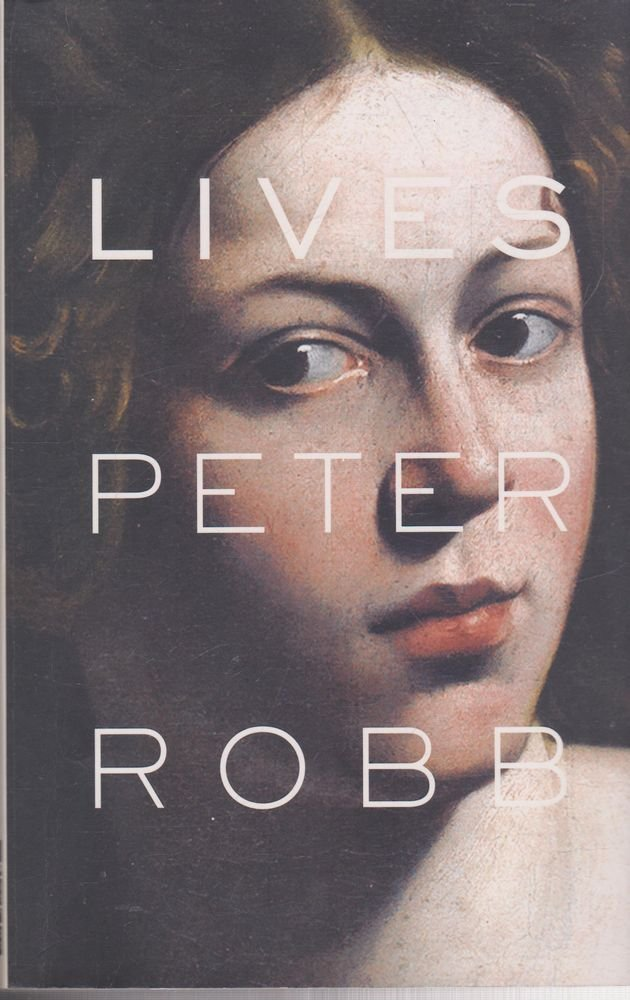
Book Review - Lives by Peter Robb

Lives by Peter Robb

Melbourne: Black Inc., 2012                      ISBN 9781863955638


Those who have read my review of Midnight in Sicily will know that I rate Peter Robb very highly as a writer. The works of his that I've read have certainly weaved a web in my brain - they have been hard to forget, mainly due to Robb's limpid style, within which the reader is afloat on a sea of words, beautiful even when describing horror. Robb tends to write about ambiguous or mysterious situations, and it's clear that he is fascinated by things that fall through the cracks, or are not quite what they seem.

Lives is a collection of Robb's shorter non-fiction; as his thankyou note in the beginning of the book elaborates, most of these pieces made their first appearance in magazines and newspapers. Thankfully - for the most part - Robb's facile yet deep style is unaffected in a shorter format. The book is divided into three sections: Australia, Italy, and Elsewhere. While these groupings are obviously geographic, there is nothing really homogeneous in the lives that are investigated within these pages. Many of the pieces are to do with people working in the arts (actors, film-makers), some are book reviews, and some are reportage. Some articles give the reader a new view on a person they thought they might know fairly well, some introduce the reader to a person they'll want to know more about, and some give the reader the complete picture.

Interesting pieces for me in the Australian section were on Julian Assange: a double book review, but also a psychological insight into the man himself, an extended piece on Marcia Langton, and a wonderful combined travelogue, interview, political commentary and film discussion revolving around a road trip with Ivan Sen.

As you would expect, the section on Italy covers everything from the wonderful Baroque art in Rome to the machinations of the Mafia. These musings are covered in articles ostensibly about Robert Hughes' Rome, The Leopard, and articles about Fellini, Pasolini, and other less well-known figures in Italian art and law.

The Elsewhere section is even more eclectic, running from Joseph Conrad to Gary Gilmore; the Gilmore piece being a perceptive appraisal of Norman Mailer's work, and another reminder to me to add Executioner's Song to my to-read list.

Perhaps the piece I liked best was the one entitled Jilly, which consists of extracts from Robb's diary, mostly about the comings and goings within the block of units in which he lives. As with all Robb's work, it's hard to know what's real and what isn't, what is observed fact and what is imputation - an insight into an author who is always trying to look under the surface, and make connexions between people and events.

Well worth picking up and reading, even if only in part. Recommended.


Cheers for now, from
A View Over the Bell

Thursday, 12 February 2015

Book Review - Will in the World by Stephen Greenblatt

Will in the World : how Shakespeare became Shakespeare by Stephen Greenblatt

New York: W.W. Norton & Company, 2004                      ISBN  0393050572


Who was William Shakespeare? That seemingly simple question has consumed a lot of ink over the centuries, and, it seems, continues to do so at if anything an increasing rate as the years go by. While many of these books are of dubious value, or are  even junk (vide Baconians and other fruitcakes), there have been quite a few books that allow us to view Shakespeare in a new light. Will in the World is one of them.

Stephen Greenblatt is at the forefront of current Shakespearean studies, and has used his considerable erudition in the area to produce a book that weaves what we know about Shakespeare’s life, material from his plays, and from the wider world he lived in, into an interesting and colourful book about the greatest playwright to have lived. It can be dangerous to read too much of a writer’s life into their works, as some have done referring to Shakespeare, but Greenblatt corroborates his readings by looking at wider influences on Shakespeare and England to reinforce his conclusions.

And what does he conclude about the man from Stratford? That he was a passionate, canny, quiet, hard-working man, who enjoyed making money and hated the idea of being cheated out of it. He was a man that listened, looked and read intently wherever he was, and who used every bit of material he had gathered in his work. While he knew how to keep his head above water and how to keep out of trouble, he liked to use his native wit to push the boundaries.

Greenblatt is deft in showing how Shakespeare responded to the times when writing his plays – whether it be bouncing off Marlowe (the Jew of Malta leading to the Merchant of Venice, Tamburlaine inspiring Henry VI), or responding to the ideas of King James (Macbeth). While Shakespeare used very little of his personal life in his plays, Greenblatt teases out some thoughts on Shakespeare’s marriage (not happy), his pride (he wanted to be successful), his religion (probably not too fussed).

Greenblatt’s suggests that during Shakespeare’s “lost years” he did in fact work for some Catholic families in the north of England, some members of whom lost their heads: which Greenblatt suggests led Shakespeare to be very careful about how much he wrote or spoke about certain matters. It seems relatively certain that at least some of his immediate family were Catholic, and in fact it could be that his father’s beliefs were part of the cause of his fall from grace; something that seems to have stayed with Shakespeare throughout his life. While he was careful not to reveal his thoughts in the plays, it’s clear that Shakespeare was very familiar with the old rites.

That was not the only thing Shakespeare was familiar with: he was well-versed on the legalities of loans and shares, the wool trade, leather work and glove making, among other trades. References to these are scattered through the plays, and in some way are the ‘smoking gun’ that proves he was indeed the author of the canon we know today. (Surely it’s much easier for someone like Shakespeare to gain a basic familiarity with court ritual than it would be for a Noble to learn the ins and outs of a trade or mercantile affairs.)

Greenblatt surmises that Shakespeare saw his work as just that – work. He seems to have spent his time writing, running the company, and ensuring that the money he made was well invested and looked after. It does seem that he had some affairs of the heart, which are revealed to some extent in his sonnets, but again it is hard to know for sure just how far these progressed.

Perhaps the greatest mystery in the book is Shakespeare’s retirement; why did he give it all away and go back to the country? Greenblatt struggles to provide a satisfactory reason, but, as a country boy who went to the big city and who is now back in the town I grew up in, it seems natural to me that Shakespeare just wanted to go home, and he had enough money to do so in style. By that stage his favourite daughter had married well and had children, so I think he just wanted to relax and see out his days in as carefree a manner as possible. Alas for him he died not long after.

Of course there is also the possibility that Shakespeare began to realise he was reaching the bottom of the well - from his early plays, which were drawn from clear sources and had more traditional structures, Shakespeare had changed the way theatre interacted with both audiences and actors, with concealed and unknowable forces propelling late characters such as Macbeth and Prospero. After expending so much effort to create his late masterpieces, perhaps Shakespeare felt he'd done what he could, and that to continue would not reveal anything more.

For anyone interested in Shakespeare and his times, this book is really a must-read. There is so much information in it that it rewards re-reading and going back to the plays to see how Greenblatt infuses new light into them. While not setting out to refute anyone else's "theories" about Shakespeare and the plays, this book is fairly conclusive in showing that William Shakespeare was the author of the canon as we know it, and some other works besides. Engaging and well-written, it is probably the go-to book for a life of Shakespeare in the early 21st century.

Highly Recommended


Cheers for now, from
A View Over the Bell


Monday, 2 December 2013

Book Review - Moving among strangers by Gabrielle Carey

Moving among strangers : Randolph Stow and my family by Gabrielle Carey

St. Lucia, Qld : University of Queensland Press, 2013          ISBN 9780702249921


This book is a memoir with a difference. Gabrielle Carey is most well-known for being the co-author of Puberty blues, a very famous rite-of-passage novel here in Australia (also made into a popular film). Carey has written other books, including In my Father's house, an attempt to come to terms with her Father's suicide.

I haven't read any of Carey's previous work, but was drawn to this book because I, like many other Australians (including Carey), feel that Randolph Stow was and is possibly Australia's finest novelist. Carey's Mother, Joan (nee Ferguson) was a lifelong friend of Stow, having lived in Western Australia in Geraldton with Stow and his family.

Carey was drawn to write this book after getting in touch with Stow to let him know of the impending death of her Mother from cancer. She exchanged some letters with him before he too died in 2010. In a strange way his death led Carey, who had grown up in Sydney, to travel across to Western Australia to not only try to connect with Stow, but also to the long-estranged branches of her family who still resided there.

The intertwined threads of the Carey, Ferguson and Stow families form the basis of what is a moving paean to what was, and what might have been. Carey's surprise at finding that her Mother was much more independent than she thought, and her wonderful descriptive writing when confronted with the decaying wrecks of farmhouses that form such an integral part of Stow's writing and her family history make reading this book a joy.

What strikes Carey most about the Stow's writing is how he strives for the spiritual: the religiosity of his novels was something that was noted at the time they were published, to some disdain amongst Australian critics. Stow, striving for a rootedness he couldn't find in Western Australia, moved to England, the home of his ancestors, and spent most of his life either in "exile", or at "home", depending on one's viewpoint.

Carey journeyed to seek out those that knew Stow, in East Bergholt and Harwich, but finds no further answers to the questions she has about the man: questions he avoided answering whenever he was asked directly, and that resist answers after his death. The journey that Carey has undertaken in writing this book has led her to places she didn't know about - her parents' lives contained many stories she was never told - life in Geraldton was almost a universe away from her childhood - and that Randolph Stow (known as Mick to the Careys), has left his body of work as the only explanation for his life.

If you love Stow as I do, this is well worth reading. If you don't love Stow, read him and you will.


Cheers for now, from
A View Over the Bell

Thursday, 26 September 2013

Book Review - The trip to Echo Spring : why writers drink by Olivia Laing

The trip to Echo Spring : why writers drink by Olivia Laing

Edinburgh : Canongate, 2013                                       ISBN 9781847677945


That there is something fascinating to many about the connexion between alcohol and writing is evidenced by the bibliography of the book under review, which contains a healthy selection of articles and books discussing the issue from all sorts of angles. One of the books in the bibliography, The Thirsty Muse : alcohol and the American writer, is a book I've read several times: I was hoping that The trip to Echo Spring would be another enjoyable essay into this murky subject, but alas I closed the book feeling disappointed.

Initially this book was full of promise - Laing writes near the beginning "There have been many books and articles that revel in describing exactly how grotesque and shameful the behaviour of alcoholic writers can be. That wasn't my intention. What I wanted was to discover how each of these men [Fitzgerald, Hemingway, Tennessee Williams, John Cheever, John Berryman and Raymond Carver] - and, along the way, some of the many others who'd suffered from the disease [alcoholism] - experienced and thought about their addiction." Laing was hoping to come closer to finding the reason why such talented individuals drank so dangerously. Along the way there would be short diversions into medicine and psychology to help Laing and the reader along the path to understanding.

Unfortunately for the book these are not the only diversions. This book is, disappointingly, what I call "new" non-fiction, by which I mean non-fiction where the author's activity takes up a healthy share of the pages. This is a most annoying circumstance of our current literary age: whether it is an indication of the rise of a "me" generation, or whether it is felt that by doing so personalises and makes a book easier to read I don't know, but, apart from a very few works of genius it is a mode that usually fails, as it does here. As the book moves on the authorial intrusion becomes more, well, intrusive. Apart from a few passages where Laing describes why she became interested in the subject (her experiences with alcoholic family members / partners) and some descriptive material about places she visits that are to do with the authors, all of the writing about herself (mostly to do with the train journey she takes across the USA to visit the authorial sites) is really superfluous to the subject of the book, and is at times frankly strange. Snippets of conversation, descriptions of views from train windows, discussions with fellow passengers which have nothing to do with writing or alcohol just struck me as out of place in this book. It's a very brave or foolish author who sets their descriptive writing alongside quotations from the likes of Fitzgerald and Hemingway as Laing does in this book. The comparison is not favourable.

However, it's not all bad news - Laing does find some interesting connexions between the writers discussed, and does delve into their literature, letters, memoirs &c to find where they've either tried or failed to come to grips with their problems. Inevitably she has to, from time-to-time, discuss their shameful behaviour, but on the whole she stays true to her desire not to make that the main focus. Her writing on the families of the writers studied is interesting and I think does shine some light into the problems they had. As a person who doesn't read many biographies of writers, I was unaware that both Hemingway's and Berryman's fathers committed suicide - which had lasting effects on each of them.

In the end there is no definitive answer as to why writers and drink sometimes form such a toxic combination, although if there's any connecting link between these six it might be that they drank to hide their insecurities, from others and from themselves.

I will, after reading this, go and read some Cheever, and re-visit Carver and Berryman, who I haven't looked at for a long time. Laing has given me a new way to look at them.

If Laing had not decided to make this book a vehicle for herself as much as her subject she might have produced a very good short book. As it is, she has produced an average three hundred page book. A shame.


Cheers for now, from
A View Over the Bell

Tuesday, 13 August 2013

Book Review - Why read Moby-Dick? by Nathaniel Philbrick

Why read Moby-Dick? by Nathaniel Philbrick

New York : Viking, 2011                        ISBN 9780670022991


Moby-Dick usually figures prominently in most lists of greatest ever works of fiction. I am not one to complain about that - in my opinion it is certainly a contender for top spot on any such list. Like Nathaniel Philbrick, I have read it about a dozen times (I have read some, if not all of it, every year since 1986), and it never fails to give me something new each time I dip into it.

Nathaniel Philbrick, an author well known for his sea stories (In the heart of the sea, about the sinking of the Essex, is his best known work, and a vital source for Moby-Dick as well), has written a short impassioned plea to readers, who may be intimidated by the bulk and mythology that surrounds Melville's greatest work, to dive in and be subsumed by that greatness.

In this very short (127 pages in a smaller format book) account, Philbrick ranges not only over the narrative of the work itself, with insights into the characters of Ahab, Ishmael, Starbuck and Queequeg, of Nantucket and the whaling industry, but also the "rag and bone shop" nature of the book,  the circumstances of Melville's authorship and reflections on the stresses in American society at the time that are reflected in the text.

Philbrick explains quite clearly how the work reflects upon the stain of slavery that had befallen the America of Melville's time (Moby-Dick was written more than a decade before the beginning of the American Civil War). The micro-cosmos of the whaling ship as an image of the questing, democratic nature of society is mentioned, as is the ability of a demogogue such as Ahab to bewitch his public and take them on a voyage to tragedy.

What comes through mostly is Philbrick's enthusiasm for the novel as a rollercoaster ride for the senses, a vibrant package of the glorious cruelty and magnificent dullness of life - a whirlpool of a book that sucks you under for what seems an age until, like Ishmael, you reach the surface again gasping for air, with the realisation that your life will never be quite the same again.

I am sure that Philbrick, like me, would urge you to read Moby-Dick rather than his book if you were choosing between the two. If, however, you feel you can't face the leviathan, the book under review here will take you a couple of hours to knock off, and is a great insight into what is one of the greatest books ever written.

If you, like me, have read and loved Moby-Dick, it's worth picking this book up as it will take you back to the source, and possibly give you new insights.

Recommended.

* Re-read in 2024 - I was driven back to this book because my wife has finally decided to tackle the leviathan herself, and is reading Moby-Dick after listening to paeans to it from Benjamin McEvoy of Hardcore Literature Club fame, and is following his advice to tackle one chapter a day if the whole book seems too much to read in a more "traditional" fashion. I think it's a great idea, and something you should try, as it gives plenty of space to think about what Melville is writing, and how he is writing it. Re-reading Philbrick has brought me back to the delights of his book as well, which gives so much context for the writing of Moby-Dick and how Melville made this story of whaling into the story of Man. It's a great companion-work.


Cheers for now, from
A View Over the Bell