Showing posts with label Russan Army. Show all posts

Monday, 9 August 2021

Book Review - Hubris: the Tragedy of War in the Twentieth Century by Alistair Horne

 Hubris: the Tragedy of War in the Twentieth Century by Alistair Horne

New York: Harper, 2015                    ISBN 9780062397805

Those few who regularly read my blog will know that I've read a few books written by Alistair Horne, and enjoyed them all. I enjoyed this one too, as it is well written and informative, but I must state that I found the premise of the book a little thin. Horne, in his introduction to Hubris, states his aim to be to show how that state of over-confidence can lead to disaster, and how, often after a great victory, hubris creeps in and infects (Horne likens it to a virus) the body politic and the body military and leads to inevitable downfall.

To illustrate his point he chooses key battles from the first half of the Twentieth Century, Tsushima, Nomonhan, Moscow, Midway, MacArthur in Korea, and the battle of Dien Bien Phu. His contention is that in each case it was hubris that led to defeat, and that victory could lead to the development of hubris in the winners. This theory is fairly self-evident to any serious student of military history, and Horne does not add significantly to thinking in this area in my opinion.

Nevertheless, he does show the links between Japan's victory in 1905 and their over-confidence in Mongolia in 1939 and at Midway in 1942. America's crushing of Japan can be argued to have instilled a sense of inevitability to the United States and MacArthur's view that the Korean War would lead to a speedy victory; and the similar racist views of the French (as well as their internecine bickering and arrogance) led them to grievously underestimate the Viet Minh and General Giap.

Although Horne only touches on them, to me two other themes loom large in this book - racism, and ruthlessness. Much of the hubris shown by the Russians, Germans, Americans and French was engendered by their racist view of their opponents. European commanders - and political leaders for that matter - had a very dim view of their Asian brothers. What is fascinating to see is how these views remained unchanged, despite all the evidence to the contrary. Japan in particular suffered from European scorn, despite destroying the Russian Fleet in 1905 and conquering Manchuria and Korea after that. This meant little to the Americans and British who continued to see the Japanese and other Asians as less than human.

This racism led directly to their hubris when facing the "Asian hordes", as did their lack of understanding of the ruthlessness of their foes. Both MacArthur, and the various French leaders in Indochina (the revolving door of French military leadership at the time surely didn't help their cause) looked at their opponents through their own eyes. They failed to understand that the North Koreans, Vietnamese and Chinese were prepared to sustain much greater casualties than their Western counterparts could bear, and, although they may not have had the latest technology, they had a greater will.

No-one was more ruthless than Stalin. Unlike his Western "comrades" of World War Two, he had no racist limits to his thinking, so when Japanese troops encroached on his Mongolian border, he threw in his best troops, his best tanks, and Zhukov, his best general. In fact, when it came to the battle of Nomonhan, it was the Japanese who underestimated their Slavic opponents - not racially, but ideologically. Stalin smashed them, as he eventually smashed Hitler. Hitler's hubris came from his victory in France, and his racially inspired theories that led him to think that the Russians were less than human. Stalin was prepared to not only destroy his country to deny it to Hitler, but send millions of his countrymen and women to their deaths to stop him.

While Hitler was just as ruthless than Stalin, he didn't have as many men to sacrifice, and so lost.

As always, Horne writes smoothly and well - Tsushima is fading into history, and Nomonhan has always been obscure, so to re-read the narratives of those battles is pleasing. Horne provides good context for those battles and the others he discusses. He uses his narrative flair to take the reader right into the history of each battle, but his theoretical strength is less gripping; at times the hubris angle seems tacked on, or an afterthought to his racing narrative history.

So, what to make of this book? As narrative history it's gripping, as a theoretical work less so. I note that some of this book first appeared in the Military History Quarterly, and that makes sense to me, as I think the issue with this book is the lack of connexion throughout the book. It seems that Horne may have thought of these episodes separately and tacked them together. Perhaps I'm doing him a dis-service but, for me, this book was less than I hoped for given how it was marketed, but still was a good read.


Cheers for now, from
A View Over the Bell


Monday, 19 March 2018

Book Review - The Third Reich at War by Richard J. Evans

The Third Reich at War : how the Nazis led Germany from Conquest to Disaster
by Richard J. Evans

London: Penguin, 2008 (first published 2007)     ISBN 9780141015484

There is no doubt that both the collapse of Communism in Russia and Eastern Europe and the passing of the war generation has led to a revolution in the historiography of both the Third Reich and World War Two. One allowed historians access to hitherto hidden archives, and the other has allowed a less personal and more probing look at what went on during the years 1933-1945.

With these advantages, and building on the work of historians before him, Richard Evans has written a detailed, scathing and (as it says on the cover) terrifying account of the Third Reich during the period of the War (1939-1945). This book is the final of a three part account of Nazism written by Evans (the others being The Coming of the Third Reich, and The Third Reich in Power). Along with Ian Kershaw's biography of Hitler and Saul Friedlander's history of the Holocaust, Evans' work gives the early twenty-first-century reader a clear and chilling insight into what was perhaps the most murderous regime in history.

What Evans makes clear in this work is that murder - annihilation of entire sections of society, entire classes and indeed entire races - was at the core of everything National Socialism stood for. Their way of "making Germany great again" consisted only of eliminating "enemies". Evans shows us how much time, effort and expense went in to eliminating not only the Jews, but anyone else that the Nazis felt needed to be got rid of.

Hitler, and by extension the cronies he'd gathered around him, had a very narrow idea of what constituted a good German: anyone who didn't fit that idea, and certainly anyone who wasn't German (or "Aryan") was not considered to be human, and so fit for destruction. The warped Social Darwinism of the Nazis drove them to ever more killing, as the stock of "good Germans" was reduced by the war. The executions continued up to (and even beyond) the end of hostilities.

Evans mentions several times throughout the book that the Nazis never garnered more than about 37% of the popular vote in elections, so how did they manage to keep the whole country under control for so long? There was no doubt that Nazi Germany was a police state, which became ever more the case as the war dragged on. Fear was a big factor in the quiescence of the population. The victories early in the war were genuinely popular, and by the time the war turned against Germany, it was clear that a whirlwind of vengeance would descend, and the Nazis played on that fear to keep the country fighting. Much of the population, as Evans suggests, were by this time expending all their energy in trying to get enough food and fuel to live, and so didn't have time to foment rebellion.

Apart from the July plot, there were other small attempts at defiance of the regime, which usually ended in failure, imprisonment or worse. Evans spends some time on the ambivalent attitude of the Church - both Roman Catholic and Protestant - to Hitler and the regime, with their desire to protest compromised by their desire to not lose their position or possession in society. It's fair to state that they don't come through unscathed by shame.

Evans also spends time focusing on the political economy of the War. That Germany was destroyed by the War we know; that it was always going to be the case was probably not in doubt even early on in the conflict. The German economy was simply not big enough to equip an army for the task Hitler set, nor was the German population big enough to replace the horrendous losses entailed in fighting in Russia. Evans shows clearly that, even without US industry, the Allies were producing more weapons and food than Germany. Despite having over 400,000 foreign workers and hundreds of thousands more POW and Concentration Camp inmates working in agriculture and industry (the latter classes often being worked to death), the German economy was simply unable to provide enough material for the Army to prevail. The irony of the racial state of the Third Reich having to rely on the "lower" races (Slavs, Jews) to undertake vital work is not lost on Evans. Any fraternising between these imported workers and native Germans was forbidden, with harsh punishments for those who transgressed.

What comes through very clearly in Evans' work, and indeed through most studies of the government of the Third Reich, was how - apart from the Police apparatus - shambolic the systems and activities of government were. The personalized nature of the Nazi dictatorship meant that all "law" emanated from Hitler, and so when he did not codify activities and behaviour, his disciples made it up, according to what they thought he wanted. Combined with Hitler's inability to delegate power to one person (most areas of the economy had two or three departments attempting to run them), this led to constant bickering and power-grabs by whomever thought they might have the upper hand at the time. This extended into the military sphere as well, with Albert Speer's attempts to streamline military production constantly stymied by personal projects of other Nazi leaders.

At well over seven hundred pages this is not a short book, and given its subject matter not always easy to read, but it is a masterful overview of the final years of Nazi power, which drew the World into a War that ended up destroying not only the Third Reich, but Germany itself. Designed to be read as a stand-alone book or as the final of Evans' trilogy, it's a must-read not only for those who wish to know more about one of the darkest periods in human history, but also for serious students of World War Two.


Cheers for now, from
A View Over the Bell

Friday, 23 October 2015

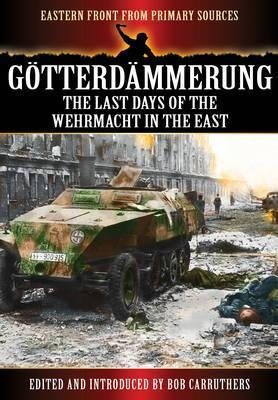
Book Review - Gotterdammerung: the last days of the Wehrmacht in the East

Gotterdammerung: the last days of the Wehrmacht in the East edited and introduced by Bob Carruthers

(a volume in the series Eastern Front from primary sources)

Barnsley, Yorkshire: Pen & Sword Military, 2012                    ISBN 9781781591369


I've recorded my frustration with Pen & Sword publications before - they've hit on what for them is a successful model of publishing older reports, memoirs and such unedited, which is both a blessing and a curse.

This book continues that tradition - a bit of a grab bag, the main portion of this work is a study of the German defense of Berlin written for the US Army by Wilhelm Willemar, an Oberst in the Wehrmacht. Because this report doesn't fill out a book, there are a few US Army intelligence reports tacked on to the end which discuss German and Soviet street fighting tactics and weaponry, and the Volkssturm.

Because these items are just slapped into the book, this is not a work for someone who does not know much about the Battle of Berlin. However, being a first-hand report (Willemar interviewed many of the officers involved in the fighting) it has value for the more serious student of conflict.

The report highlights the almost complete lack of planning that was involved in the defence of Berlin - stores and supplies were dumped in depots on the outskirts of the city which were quickly overrun by Russian Troops, there was no co-ordination by defenders, or even communication, so groups found themselves surrounded because their neighbouring comrades had withdrawn without their knowledge, some people constructed defences in the streets that had to be torn down again to allow German movements, and the list goes on.

The other factor that stands out is the lack of coherent command. Hitler, Goebbels and other Nazi figures interfered constantly in tactical decisions, and based actions on the movements of troops that were in no way fit for battle.

The result was of course catastrophe, and yet more senseless waste. Only after Hitler's death was surrender thought of, and even this was bungled, with contradictory orders to breakout of the city, stay put and fight, and surrender doing the rounds at the same time.

If ever the myth of the ruthlessly efficient Wehrmacht held some truth, it is not to be found in its final hours.

This book is recommended only for the reader with lots of background already to hand.


Cheers for now, from
A View Over the Bell

Tuesday, 25 August 2015

Book Review - An infantryman in Stalingrad by Adelbert Holl

An infantryman in Stalingrad : from 24 September 1942 to 2 February 1943 by Adelbert Holl, translated by Jason D. Mark and Neil Page

Sydney : Leaping Horseman Books, 2005                                   ISBN 0975107623


Stalingrad. A name that inspires horror into any person's breast; a name that means death, destruction, desolation, despair, heroism, and the beginning of the end for Nazi Germany.

Adelbert Holl was one small part of the German Sixth Army, the force tasked by Hitler to take Stalingrad as part of the Nazi push into the Caucasus. What the bare bones version of the Russian front story doesn't emphasise are the large losses borne by the Germans in their push into the Soviet Union. While they inflicted truly horrendous casualties on the Red Army, the Germans too lost many many men in their push eastwards. So, when Hitler determined to make a push for the oilfields around Grozny, he didn't really have enough troops to both do that and take Stalingrad in force. As the advance moved forward, the Stalingrad spearhead was gradually stripped of men and armour, which all turned south to assist in the invasion of the Caucasus. This was the first in a chain of events that led to the eventual encirclement and destruction of the Sixth Army by the Russians.

Holl's story has little to do however with grand strategy. The book as we have it here is a diary of little over three months fighting in the city, at first when the Germans were attempting to take the city and then experiences of survival as part of the "Kessel". Holl arrives back at his unit in September after recovering from a wound (his third), to be put in charge of a company attempting to reach the banks of the Volga. The fighting is hard, but successful, with his squad achieving their objectives day by day, but losing many men in the process. The description of the house-to-house fighting is vivid, and Holl's concern for his men apparent. The story becomes more harrowing for his company as the Army is surrounded, and he and his men begin to suffer from the lack of food, ammunition and clothing as the winter sets in. Holl's story is the story of the Sixth Army as a snapshot - the diminishing number of troops available leads to wounded men staying in the front line, the lack of ammunition requires his men to pilfer Russian equipment from the dead, and the lack of food means loyal animals are all slaughtered to keep the men from starving. Holl's retreat to his final position leads to two of his men freezing to death as they walk (at this stage, owing to their lack of condition and to the weather, they can barely make a few kilometres in a day's march). The final pages of the book describe how Holl decides to stay with his wounded comrades rather than retreat further, and the final sentence sees him in his bunker awaiting the arrival of the Russian troops.

The fate of many of the Germans that were captured was not good, many dying in captivity, either from disease or overwork. This edition has an excellent apparatus, including footnotes describing the careers and lives of many of the people Holl mentions; so many of whom died in the battle, or a short time after in captivity. The apparatus also includes many photographs of the areas that Holl fought over, excellent photographic maps showing his positions, and many of the Army's situation reports and orders that refers to areas where Holl was active. There is also an appendix that describes Holl's career from official documents.

It seems that Holl was captured and survived to return to Germany after the war, where he wrote this book in the 1970s as well as another which covered his period in captivity - which has not been translated into English. As an insight into the horrors suffered by both Germans and Russians in Stalin's City, this book is worth reading. One for aficionados.


Cheers for now, from
A View Over the Bell