Showing posts with label Fiction. Show all posts

Friday, 27 September 2024

Book Review - That Deadman Dance by Kim Scott

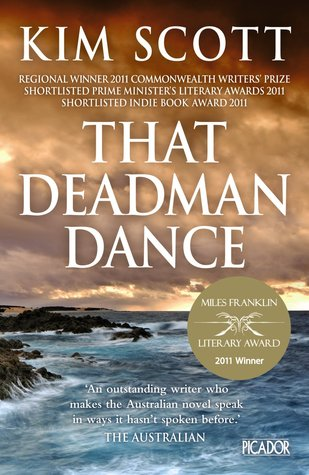
 That Deadman Dance by Kim Scott

Sydney: Picador, 2011 (first published 2010)               ISBN 9780330404235

The blurb on the front cover of this paperback edition, (from a review in The Australian newspaper) gushes "An outstanding writer who makes the Australian novel speak in ways it hasn't spoken before." Alongside this quote is information telling the reader that not only was this book shortlisted for the Prime Minister's Literary Awards and shortlisted for the Indie Book Award, it was the regional winner of the 2011 Commonwealth Writers' Prize and won the 2011 Miles Franklin Award.

So the question needs to be asked - does it live up to the hype? Well....it's a much better book than some other Miles Franklin winners that I have read, but I really don't think the book "... makes the Australian novel speak in ways it hasn't spoken before." In fact in some ways I think That Deadman Dance travels a well-worn path in Australian literature, albeit with a slightly different focus.

After all that preamble, I will state up front that this is a good novel. It's well written, well paced, and evocative. The story it tells is interesting and how it is told adds to that interest. I found the ending unsatisfactory and a bit formulaic, but others may not see it that way.

Simply put That Deadman Dance is a story of the early settlement by white men of the southern coast of Western Australia (Kim Scott is an indigenous man of that area). The story is told mostly through the lens of "Bobby" Wabalanginy, who begins the story as a precocious orphan taken under the wing of the military surgeon of the initial British party to land in Bobby's tribal area, setting up the settlement of King George Town. The surgeon, Dr. Cross, is careful to treat the Aboriginal people well, fully understanding that without them and their assistance the white men cannot hope to survive. The passage of time that occurs during this novel shows the unravelling of this initial partnership, where give-and-take between the two cultures changes to the whites taking from the blacks without any recompense.

Scott's tracing of Bobby's life, from being an indispensable bridge between black and white as well as an important worker for the settlement in their efforts to expand pastoralism and whaling, to him ending up a tourist attraction telling his stories after leading what was effectively a rebellion against the white takeover of his land, contains pathos and humour.

Geordie Chaine, who befriends Bobby after the death of Dr. Cross, is the white man who builds King George Town and the surrounding area up from "nothing", to the thriving settlement it has become by the end of the book, is a sympathetically written character. The reader knows that he thinks the blacks are a lower order of people than white, but he is happy for them to live alongside his world as long as they are "useful". He is genuinely sad when Bobby leads his people in stealing food, but completely fails to understand, unlike Cross, that he had stolen everything from Bobby's people when he fenced the land for his stock, killed all the wildlife to feed the whalers who were overfishing the seas. When imprisoned for stealing stock and provisions, Bobby explains how he must feed his people, and when Dr. Cross and the white men came Bobby's people shared the land, and he is merely doing the same now with the white man's stock and stores, given the land has been stripped bare of traditional food by Chaine and his compatriots.

Scott suggests in the novel that it could have been different. Jak Tar, a deserting whaler, partners with Binyan, a local Aboriginal woman, in a loving relationship. While their love transcends their cultural differences, it is not only the white people who spurn the two of them: the elders of the tribe do as well. It seems that mutual understanding can only reach so far.

This area of Western Australia, as Scott notes in an afterword, is sometimes known by historians as the "Friendly Frontier", as there was very little fighting between black and white. As Scott makes clear though, even without such skirmishes many indigenous people died from disease (as did whites), and the resulting dispossession was no different to other areas.

Scott is skilful in his characterizations. Bobby is a wonderfully drawn character, interested in everything and everybody, and everybody interested in him and what he does. He is a joyful and positive presence even when things are going badly. Dr. Cross and his good friend Wunyeran represent first contact in a positive light, while Menak and Chaine well represent the respective feelings of both sides as settlement became more permanent. Chaine's daughter Christine, who grows up with Bobby, is also well-drawn, in her confusion of her place in the world, and Bobby's. Each of these characters along with the ex-soldier Killam and the ex-convict Skelly represent a part of a wider narrative, but none are cardboard cut-outs - Scott writes well.

So, has this novel broken new ground, as the blurb on the cover might suggest? No, not really. But, it is certainly a good story well written, and one that will stay with me for some time. Recommended. 

Cheers for now, from
A View Over the Bell


Wednesday, 29 November 2023

Book Review - White Meat by Peter Corris

 White Meat by Peter Corris

New York: Fawcett Gold Medal, 1986 (first published 1981)    ISBN 0449130274

Well, I'm officially hooked on Cliff Hardy - after reading the first, third and fourth books in the series, I just had to find the second book to fill in the gaps in Hardy's developing milieu... I couldn't get my hands on a copy anywhere, but the good old Internet Archive helped out where no-one else could - they are worth your support. Ironic that I had to read an American edition on an American site, but that's the way of the world in 2023.

White Meat is another tangled affair that sees Hardy enmeshed in the worlds of boxing, drugs, and Aboriginal Sydney. After being hired to find his local bookie's daughter, who has gone missing, Hardy finds himself deep in Redfern trying to track her down. The trail leads to rural New South Wales, where he realises that the girl in question (Noni) is in on her own kidnapping. There is also the question of the missing bank heist money, just who is the kidnapper's real father, and why so many people want to use Noni for their own ends.

Of the four Hardy novels I've read so far, this is the weakest in terms of style. There are too many clunky bits of writing that are trying too hard for the grunge/noir style that Corris is aiming at. Perhaps he tried to cram too much into this particular narrative container. The twists in the plot sometimes led me to backtrack just to make sure I knew what was going on, and the ending was a bit of a let-down.

That stated, White Meat was a page-turner, and hasn't put me off continuing what is rapidly turning out to be a summer of Hardy.


Cheers for now, from

A View Over the Bell

Friday, 24 November 2023

Book Review - The Empty Beach by Peter Corris

 The Empty Beach by Peter Corris

Sydney: George Allen & Unwin, 1983                          ISBN 0868612294

Crime fiction can be like junk food - probably not something you'll remember as you do a fine dining experience, but a quick delicious hit that leaves you wanting more. So it is with Cliff Hardy, the shambling Sydney PI created by Peter Corris. The Cliff Hardy novels have everything required for the quick fix of the crime genre - a noir hero who just manages to keep things legal, a helpful cop, always a woman who the hero may (or in this case may not) bed, and the usual assortment of criminals and down-and-outers who help the plot along.

In The Empty Beach the plot revolves around the death of John Singer. The police thought suicide, but his wife thinks differently - she thinks he may still be alive. That's when Cliff comes in. In his search for the truth he allies himself with some social campaigners and drunks, and faces up to the sleaze of gambling and drugs. As is usual in a Cliff Hardy book, a couple of people get killed. Cliff is beaten up, kidnapped and pistol-whipped, and it all turns out well in the end, as Cliff returns to his shabby house in Glebe.

This, the fourth book in the series, introduces some new characters - Hilde, Cliff's boarder, and Frank Parker, Hardy's new contact with the police. There is another twist in the plot that involves Hardy's client and why she wanted him to investigate her husband's death.

Corris has set The Empty Beach in Bondi and the suburbs surrounding, and as seems usual in the Hardy books, the Sydney suburbs are their own character in these books.

And now, like junk food, I need more.... I can see a summer of Hardy coming up.


Cheers for now, from
A View Over the Bell


Thursday, 23 November 2023

Book Review - The Marvellous Boy by Peter Corris

 The Marvellous Boy by Peter Corris

Sydney: Allen & Unwin, 2014 (First published 1982)       ISBN 9781743439883

I was keen to get my teeth into another Cliff Hardy book after reading the first in the series (The Dying Trade) recently. I couldn't get my hands on the second book, and so it's number three, The Marvellous Boy that has kept me occupied for a few hours this week.

Hardy is back again, this time trying to track down the long-lost grandson of Lady Chatterton. Corris has obviously become more comfortable with his creation, as he in turns follows and is followed, roughs people up and is roughed up himself, and gets entangled with a female reporter while fending off a suspect's wife.

For me, there was a bit of a sense of Corris going through the motions here - ensuring that Hardy is knocked out a couple of times, that he has the appropriate number of run-ins with less salubrious members of society, and that he has the right number of knotty problems to unravel before he gets his man.

That stated, The Marvellous Boy is a page-turner, and the grittiness of Sydney in the 1980s comes through the writing. It's not great literature, but it's a good read - I imagine I'll work my way through the series.

One strange thing I noticed - one of the protagonist's cars changed from a Datsun to a Toyota mid-chase...hmm...


Cheers for now, from

A View Over the Bell

Monday, 13 November 2023

Book Review - The Dying Trade by Peter Corris

 The Dying Trade by Peter Corris

Melbourne: Text Publishing, 2012 (first published 1980)     ISBN 9781921922176

I'm not a huge consumer of crime fiction, but every now and then I have an itch I need to scratch. I have never read any Peter Corris before this book (the first of his Cliff Hardy series) but I will certainly be reading more in the future. I can see why Corris has been crowned the unofficial King of Australian crime literature, and why he went on to write another 41 books featuring the rumpled, hard-drinking army veteran Cliff Hardy.

The Dying Trade is a suitably convoluted story about illegitimate children, blackmail, and money. While the plot is a page-turner and keeps the reader on their toes, in many ways it's not the most important part of the book. Corris has written a piece of "Sydney noir", where we have all the ingredients of the style, except set in a sunny harbourside city. The juxtaposition of the hard-bitten detective genre with wonderful harbour views and expensive restaurants makes this book a little different from other books of this type.

Hardy is smart and world-weary, but no so much that he doesn't make mistakes, get beaten up, or expose his vulnerabilities to women. He's a man who has seen some active service, has lost a wife, regrets not having children and drinks white wine with soda at breakfast time. He is also a man who knows how to use a library to get ahead, which I found particularly endearing.

I can't vouch for the rest of the series, but The Dying Trade contained no gangsters, no criminal masterminds and no massive plots to destabilize the World: just a nice refreshing PI investigation that led to unexpected places.

Those few people who read my reviews would remember that during COVID I read Peter Temple's Jack Irish series. I now see where he got his inspiration. I think I prefer the source to the simmer.


Cheers for now, from

A View Over the Bell


Saturday, 19 November 2022

Book Review - The Man who was Thursday: a Nightmare by G.K. Chesterton

 The Man who was Thursday: a Nightmare by G.K. Chesterton

Harmondsworth: Penguin Books, 1958 (first published in Penguin 1937, first published 1908)

I'm almost ashamed to admit that until this book I've never read any G.K. Chesterton. I've had the Father Brown stories recommended to me by many people but never got around to them, although I've seen the TV show a few times. And so to The Man who was Thursday.

What a rollicking read this is! I think Conrad's Secret Agent came out about the same time as this book, and both books make the most of the anarchist scare that was extant at the time (as we have had a spate of books about Islamic Fascism in our generation). Whereas Conrad's book was a serious tale, Chesterton has written an action-packed thriller/mystery that, while of it's time in many ways, is still an enjoyable read more than a century after it first appeared.

The basic plot-line is that we meet the main protagonist, Syme, as he argues about anarchy versus society with the poet Gregory. He manages to get Gregory so annoyed that he takes Syme to an anarchist headquarters, which is about to elect their representative onto the Central Anarchist Council. Syme manages to get himself elected as "Thursday" (each member of the Council is named after a day of the week). This was Syme's plan, as he is actually an undercover policeman.

He goes to his first Council meeting - run by the huge and terrifying Sunday, the President - where they discuss their planned bombing of the French President and Russian Czar in Paris. During the meeting Sunday unmasks one of the seven, Gogol, as a police spy. Syme leaves the meeting shocked and relieved, only to realise that he is being followed by another of the seven. After a long and fruitless pursuit, Syme eventually confronts his pursuer only to find that he to is an undercover agent. They both agree to confront Bull, one of the masterminds of the bombing plot. They discover that he is also a policeman! 

The three of them then travel to France to stop the Marquis, another of the seven, from planting the bomb. Syme challenges the Marquis to a duel, to ensure that he will miss the train to Paris from Calais. As they fight with swords, the train arrives at the platform and disgorges a squad of men, led by the Secretary of the Council. The Marquis then reveals that he is also a police agent, and they flee from the oncoming mass. When they get to the nearest town, they find that the townsmen are up in arms against them, and they fear that Sunday has called for the anarchist revolution to begin. They are about to make a final stand, when the Secretary of the Council reveals that he too is a police agent, and was attacking them because he thought that they were true anarchists! 

Bewildered, the group decide to confront Sunday at the next meeting. Sunday escapes their clutches and lead them on a merry chase involving Hansom Cabs, Elephants, and Balloons. During the chase the group reflect on what Sunday has meant to them, and they all describe different facets of his character, which reflect more of their own makeup than Sunday's. They eventually track him down only to be led to a castle where they are all dressed in robes that reflect which day of the week they are, according to the Genesis story. Thursday is dressed in a robe that separates night from day. They are then seated around a central chair, on which Sunday comes to sit. He reveals himself as the Almighty, and was the man that initially recruited them all as policemen, as well as being Sunday. It becomes clear that what the men have gone through is a test, and that as they have stayed true to good, they have come through to the other side. 

It is then that Syme finds himself walking again with Gregory, on the way back to Gregory's house, and to Gregory's sister, whom Syme is falling for.

One thing I do know about Chesterton is his strong Catholic faith, and there are obvious pointers to that in this book, as well as his faith in the ordinary man and suspicion of intellectuals and the wealthy. This book does come with a short afterword by Chesterton admonishing the reader (and reviewer) to carefully note the subtitle, and so we shouldn't try for too much subtext in what was probably meant as a light-hearted take on a serious subject.

While I enjoyed this as a pleasant diversion, I'm not going to recommend it.


Cheers for now, from
A View Over the Bell


Sunday, 3 October 2021

Book Review - White Dog by Peter Temple

 White Dog by Peter Temple

Melbourne: Text Publishing, 2012 reprint (originally published 2003)  ISBN 9781920885298

Well, I have finished my journey through the world of Jack Irish. Having watched the television adaptations of the books during earlier lockdowns, I hunted out the books to carry me through this current lockdown. I've finished the books, but the lockdown continues.....c'est la vie....

After my disappointment with the third Jack Irish book, Dead Point, I'm pleased to state that White Dog sees Temple back on track with Irish, or more particularly with his friends Harry Strang and Cam Delray, Charlie Taub, and the Fitzroy Youth Club. As with all the other Jack Irish books, the city of Melbourne is a character all of its own, constantly raining and cold (none of the Jack Irish books seems to be set in the summer months), with the inner suburbs that Jack haunts becoming more and more gentrified.

White Dog, like the other Irish books, is a complicated tale of corruption and murder within Melbourne's construction industry, with connections to drugs and prostitution. Jack is initially hired by his friend Andrew Greer to try and help him clear Sarah Longmore of the murder of her ex-partner Mickey Franklin. It's soon clear that Sarah has been fitted-up, and Irish falls down a hole into a cover-up of a dastardly deed committed by one of Melbourne's property king-pins that has re-surfaced in blackmail and murder.

Temple has written these books in a strong noir style, and Irish is the ultimate noir character - once successful, now living on the edge of respectable society, looking on in sorrow more than anger, knowing that he can no longer move in the circles that he once did. His friends are always looking out for him, even as they despair over his choices (or lack of them).

White Dog sums up the Jack Irish series well - the writing is stylish, but slap-dash (too many non-sequiturs, slips in historical knowledge, and un-needed complexities that could have been ironed-out with some more editing), the plots are just on the wrong side of believable, but entertaining, and there are just enough un-answered questions and thrills to keep the reader turning the pages. 

At the end of White Dog Irish flies off into the sunset to meet up with his love overseas, not sorry to be going, but not expecting anything great. He'll be missed by his friends, and I'll miss him too: a great Australian literary character.


Cheers for now, from
A View Over the Bell


Friday, 24 September 2021

Book Review - Dead Point by Peter Temple

 Dead Point by Peter Temple

Melbourne: Text Publishing, 2014 (originally published 2000)    ISBN 9781922148384

As I write Victoria is going through yet another lockdown - my hometown's sixth. There is not much else to do in lockdowns other than to trawl streaming services for content (hint - most of it is not worth watching) or to read. I've been dividing my reading time between the "worthy" and the "easy", with the "easy" side of the ledger being taken up in the last month or so with Peter Temple's Jack Irish crime books.

Dead Point is the third book in the series, and doesn't stack up against the other two. While the plot is convoluted and interesting, the characterizations have become lazier, and at times the reader definitely feels that Temple is going through the motions. At some stages the noir manner is so clipped that the flow of a scene dries up as the reader becomes lost, and while in the first two books the horseman Harry Strang and the cabinet maker Charlie Taub are light relief, in Dead Point they don't really make an appearance.

The plot revolves around Irish's attempts to track down some salacious photographs that are being used to corrupt a local judge. There are all sorts of people involved - corrupt cops, shonky developers, former TV personalities, and a mysterious gigolo. At times the loops and whirls of who is doing what to whom and why can be confusing, although there are exciting moments throughout the story.

In Dead Point, Temple seems to have lost interest in evoking the milieu of Melbourne at the turn of the century, and his occasional non-sequitur - such as his quartermaster friend dealing out Tim Tams during the Vietnam War - can jar. 

Dead Point is a disappointing follow-up to the first two Jack Irish books - I will go on to read the fourth, to see what happens to Irish, and to see if Temple picks up the ball he has dropped in this volume.

Disappointing compared to the others in the series, but still not bad as crime novels go.


Cheers for now, from
A View Over the Bell


Friday, 10 September 2021

Book Review - Black Tide by Peter Temple

 Black Tide by Peter Temple

Melbourne: Text Publishing, 2012 (First published 1999)   ISBN 9781921961571

Those infrequent readers of this blog will know that I recently read the first Jack Irish bookBad Debts -  after watching the television movies derived from the book series. Black Tide is the second book in the series, and is yet another hard-boiled romp through Melbourne and Regional Victoria, with international conspiracies, hit-men and horse racing, and a bit of cabinet making and football thrown in for light relief.

Black Tide revolves around a huge multi-national money laundering ring. Jack Irish gets drawn into the mystery when he agrees to help one of his father's ex-team-mates from Fitzroy to try and track down his wayward son, who has absconded with $65,000. Along the way, he has a fling with a photographer, makes some great furniture under the scornful eye of his mentor Charlie Taub, and gets involved with his horse-racing friends Cam Delray and the irrepressible Harry Strang in a very complex multi-layered scam to fix a horse race at Moonee Valley.

As in Bad Debts, Black Tide evokes an inner city Melbourne that used to exist before every warehouse was filled with apartments and every pub became artisinal. Temple almost (but slightly annoyingly not quite) nails the atmosphere of 90s Melbourne, and weaves an acceptable complex and tension-filled web around Irish - what starts as a simple missing-persons job becomes something much more dangerous for him and his friends.

As I was reading this book, I did muse on how much life has changed in the twenty years since it was written - this book is very male, down to the sex-scenes, and certainly not PC, although I gather that is a good reflection of Temple himself from what I've heard. As crime writing goes, Jack Irish is a good character, and Black Tide a good story.

Temple I think must have been a bit of a glass-half-empty person, as his descriptions of people and places are always bleak. Melbourne is always dark, dingy and wet, Ballarat and Port Fairy windy and cold, and Tasmania menacing. It is only in Charlie Taub's cabinet-making workshop that the reader gets a sense of peace and serenity. While this is fine for this style of book, the sense of the pointlessness of life and the bleakness of the lived experience of the vast majority of people is a little depressing. At times Temple's writing can seem almost a parody of itself, and the genre.

That stated, if you like crime fiction, especially with a home-grown taste, I can highly recommend Black Tide.


Cheers for now, from
A View Over the Bell


Thursday, 12 August 2021

Book Review - Bad Debts by Peter Temple

 Bad Debts by Peter Temple

Melbourne: Text Publishing, 2012 (originally published 1996)       ISBN 9781921758812

Along with many other people, I have been watching more television during the COVID19 outbreak. Part of my viewing has included the Jack Irish television movies and series, starring Guy Pearce. I enjoyed the way they referenced a Melbourne life that I myself remember when I lived there. I knew about the books of course, as some of them were written at the back table of a cafe in Ballarat that I used to frequent - I have no doubt I crossed paths with Temple in there at some stage. And so, I went to see my mother, who has every crime book ever written, or so it seems, and of course she had a copy of everything Temple published, so I snaffled some Jack Irish books to have a look.

Jack Irish is the main character of Bad Debts. A lawyer who, after his wife was killed by an enraged client, has moved into debt collection and gambling. If it sounds like hard-boiled detective fiction, that is very much the genre in which Temple has placed this book. Irish is a Vietnam vet, a Fitzroy supporter (his father an ex-player for that team), and a frequenter of inner-city Melbourne pubs and cafes. Temple has cleverly weaved several side-stories for Irish: he works for a cabinetmaker in his spare time, and he also spends time with Harry Strang and Cam Delray, who arrange dodgy business at the racetrack. 

There is a distinctly Australian- in fact Victorian - flavour to Bad Debts, and most of the time Temple has a good ear and eye for Melbourne in the 1990s, when the working class nature of the inner suburbs was being changed by the influx of middle-class hipsters. He also writes believable policemen, with his friend Barry Tregear very much the "old school" of detective - fat, vulgar, vaguely corruptible, but basically a good bloke. Jack Irish's enemies are also coppers, and altogether meaner than Tregear

The Jack Irish of the book is more cynical, and darker in mood than the TV version of the character. The weather is always wet, many of the locals stupid (he is especially scathing of Ballarat, where he lived), and the streets, pubs and housing are either decrepit, or completely restored and owned by wankers.

The story is acceptably convoluted and swarming with corrupt politicians, dodgy cops and pederast priests, revolving around purchase of waterfront land to create an upmarket residential district. Jack gets involved with an investigative journalist, who is the love-interest for him. The sex scenes are typical of the genre, as is much of the dialogue - short, sharp, and cliched. 

I did enjoy this book - in many ways it's much like other crime books, but the touch of local flavour provides something extra to enjoy. I will be reading the rest of the series.


Cheers for now, from
A View Over the Bell


Thursday, 29 July 2021

Book Review - Transient Desires by Donna Leon

 Transient Desires by Donna Leon

London: William Heinemann, 2021                      ISBN 9781785152627


Hmmm. I was asked to read this by someone special in my life, who had read it because Donna Leon was an award-winning crime writer. My someone special asked me to read it because she had found it extremely disappointing, and wanted a second opinion. Our opinions concur.

This book, the latest of the Commissario Brunetti series of crime books, is one of the most slapdash, poorly plotted, sluggishly paced, and just plain confusing pieces of crime fiction I have read. Now, I haven't read any others of the series, and I think this is about the 30th of the batch, so maybe the earlier ones are better, and Leon has run out of ideas and puff. Not sure.

What I can state is that the characterization of Brunetti is extremely thin - we get no sense of a personality, but rather pieces of prose that are merely the author showing off. We get some sense of place: the book is set in Venice and even Leon can't entirely destroy the images of that place no matter how much she tries. The plot is woefully plain, and yet convoluted at the same time, and the writing is wooden.

Leon's writing, in this book, is full of unnecessary description, and yet lacks description in other places where it's needed, or would be enjoyable. It is full of non sequiturs - Brunetti ruminating on Tacitus, or the state of politics, in the middle of some scene where it doesn't make sense and where someone wouldn't be thinking those thoughts. Again, these lines seem to me to be the author trying to show off.

There were other things that annoyed me such Brunetti enjoying the "verbal sparring" with another protagonist, that had me re-tracing my steps to find the page or two of bland dialogue which constituted the "sparring". The pointless addition of Italian names for things, such as telefonino - it's jarring in a novel in English, doesn't add to the atmosphere and, in my opinion is lazy and childish.

The end of the book, which I won't give away, was also infuriating: in fact I asked my someone if the last ten pages had fallen out. The book is unfinished.

Reading Transient Desires was a waste of time, and unfortunately I've had to waste more of my time writing this review. Avoid.


Cheers for now, from
A View Over the Bell


Sunday, 6 December 2020

Book Review - Casino Royale by Ian Fleming

 Casino Royale by Ian Fleming, with an introduction by Alan Judd

London: Vintage Books, 2012 (first published 1953)        ISBN 9780099576853

My mother is a great one for crime books, spy books and horror books - her shelves bulge with Agatha Christie, Stephen King, and every writer of note in those three genres; shelves and shelves of them. One part of one of the shelves has, in order, the Bond novels, in their early Pan paperback guise. My mum wasn't much of a fan of those books, but she read them anyway. Not being much of a fan of genre novels myself, I never read them as a child, but of course like most my age, enjoyed the films immensely as they came out regularly during my younger years. Enjoying the films did not however lead me to the books, and it's only now, in the second half of my life, that I've picked up my first Bond book: the first to be written, Casino Royale.

It is interesting to come to the "paper" Bond from the "celluloid" Bond - on the page Bond is more human, less cock-sure, and less funny than he is portrayed on film. In fact at times in the book he is philosophical, which would be unheard of coming from Connery, Moore, or Craig.

The philosophy passes soon enough, as the reader is taken on a journey where Bond wins and loses at Baccarat, survives being blown up and tortured, and falls in love only to be betrayed. The book in some respects is of it's age, with casual racism and misogyny sprinkled throughout the text, but if the reader slips out of 21st century mindsets, the story is still a good one.

It is interesting to note that Fleming, even in this very first book, was employing what is now called "product placement" to try and establish just what sort of character Bond was. As Alan Judd points out in his short introduction, in 1953 England was still under rationing, so mention of Taittinger Champagne and Caviar was far more exotic to readers of the day than it might be to us. Personally, I enjoyed very much that Bond was driving his own personal car, a supercharged Bentley...there's something in this for all the boys.

And a boys book it is - guns, fighting, gambling, and beautiful women - in the end Bond doesn't get his girl, but he does eliminate the bad guy. And it's interesting to note that the bad guy doesn't own the world or have an army of henchmen or scientists, but is merely a Soviet agent gone rogue.

I enjoyed this book: it's not as badly written as some in the genre, but it is certainly not the best genre novel I've read. I'm not sure if I'll read another, but as my annual beach holiday beckons, just maybe I might grab another to keep me company on the sand.


Cheers for now, from

A View Over the Bell

Friday, 9 October 2020

Book Review - To Each His Own by Leonardo Sciascia

 To Each His Own by Leonardo Sciascia, Translated by Adrienne Foulke, with and Introduction by W.S. Di Piero

New York: New York Review Books, 2000                 ISBN 9780940322523

I very much like the writing of Leonardo Sciascia, and have reviewed other works of his here over the years. To Each His Own is yet again a little literary insight into the mindset of Sicily - an ancient mindset that comes from a time before governments, and even before nation-states in the sense that we know them. A mindset of unspoken bonds, of deeds seen by everyone but at the same time unseen, and of silence and words chosen carefully.

The story revolves around Professor Laurana, the friend of Roscio the doctor, and the Pharmacist, who have both been found murdered. The Pharmacist had received, a few days before, a threatening letter, and the assumption of the town is that Roscio was killed merely because he happened to be in the wrong place at the wrong time. Laurana notices something odd about the threatening letter - the cutout words from the newspaper on the letter were from a very particular newspaper that only a few people in the town subscribe to. 

Laurana, initially as nothing more really than an intellectual exercise, follows this clue, trying to make sense of a senseless crime. The police and authorities, naturally, are following leads to do with the pharmacist, following every rumour. Laurana begins to suspect that Roscio was actually the target, and a few chance discoveries confirm his suspicions. He begins to wonder if Roscio was murdered so that someone could take his very beautiful wife for themself.

Unfortunately for Laurana he is too honest and too free with his words, and too trusting. When Roscio's wife suggests his suspicions might be true, he is blinded by her beauty, which leads to his eventual doom. The cruel irony Sciascia creates at the end of the book, when the reader discovers that many other men in the town had worked out what really happened (that Rosello, the lawyer, had been having an affair with Roscio's wife for many years, and organised the killing so he could marry her), sums up his Sicily: be careful talking about what you know, to whom, and know when it is safe to do so.

The beauty of Sciascia's work (and kudos to his translators is due here) is the way his language evokes Sicily. His short pithy sentences gives the reader a feeling of being there, of trying to navigate a course that keeps one safe, but still relevant and in the know, and how difficult it is to live and be true to oneself. How some people just go with the flow and forget the deeper life, and those who can't are at risk.

A short book, a very readable book, and an insight into another world. Recommended.


Cheers for now, from
A View Over the Bell


Monday, 13 January 2020

Book Review - Nightmares & Dreamscapes by Stephen King

Nightmares & Dreamscapes by Stephen King

London: New English Library, 1994               ISBN 0450610098


Ever since scaring myself silly reading Salem's Lot when I was a teenager, I've had a soft spot for the works of Stephen King. Not the grandiose later works, but the early, scary stuff. His first collection of short stories - Nightshift - is a particular favourite of mine, and well worth reading.

Nightmares & Dreamscapes is not as strong as Nightshift, with some stories being a little formulaic, but there are definitely some good ones. The collection varies between outright horror, sci-fi, and the fantastic, according to the whims of King's mind. And what a mind it must be, fizzing with thoughts that most other people would not enjoy having. In the Introduction King suggests that he doesn't necessarily enjoy all of them either, feeling compelled to write. There is no doubt King is at his best dealing with horror: he is the master of the build-up; of evoking a "normal" neighbourhood and people, and then inserting the terrifying. In a collection such as this though, the normalcy tends to look the same in each story, so by the end of the book you can at times see through the construction of the tale, which bits are formula, which bits are building plot etc. None of which takes away from the pleasure of enjoying his ideas.

And there are some great ideas. Killer toad-storms, houses that are space-ships, and a great zombie story too. There are two vampire stories, both of which are good, and a couple of ghost stories, which are less strong. Also less strong are the stories that King writes as homages to other writers - in this collection there is a story in homage to H.P. Lovecraft, a Raymond Chandler homage, and a Sherlock Holmes story. When King attempts these stories they are very close to becoming parody or pastiche rather than what I'm sure he intends. The Holmes story in my opinion shouldn't have been included - the language is not right, with the story merely reminding the ready how much better the real thing is.

Nightmares & Dreamscapes is a great book for having on hand during the holiday season: not too much thought required, and entertaining enough.


Cheers for now, from
A View Over the Bell

Monday, 9 October 2017

Book Review - The edge of running water by William Sloane

The edge of running water by William Sloane

New York: Dodd, Mead & Company, 1955 (1st ed. 1939)

(Digitised copy access via openlibrary.org)

As an avid reader of the New York Review of Books, I keep an interest in, and am notified about, the books released by their publications arm New York Review Books. I recently came across a blurb for their recently published omnibus of William Sloane's novels, which intrigued me enough to scout out one of his works, which I fortunately found as a freely borrowable ebook on openlibrary.org.

Fortunate being an appropriate word, as this book rises above the ruck of the run-of-the-mill SciFi and Horror written in the '30s. In fact this book crosses a few genres: SciFi, Horror, Mystery, Detective Novel and even a bit of Romance thrown in to spice up the mix.

The nuts and bolts of the story: Psychology Professor Richard receives a letter from a former mentor and electrophysicist friend of his Julian, to come to his country retreat to help him on a problem he has been working on for some time. Julian dropped out of Richard's life after the death of Julian's wife Helen, a woman Richard also loved.

Richard arrives in small-town Maine to find Julian shacked up in a remote house working on a mysterious apparatus, with an even more mysterious assistant, Mrs. Walters. Helen's younger sister Anne is also in the house, having just arrived back from Europe. Richard soon sees that all is not well, with Julian clearly ill. At first Julian will tell Richard nothing about his experiment, which is carefully locked away in one room of the house. The novel revolves around Richard's piece- by-piece unveiling of Julian's purpose, which then becomes tied up in the death of his housekeeper Mrs. Marcey, who apparently dies in a fall at the house.

The true horror of Julian's mania, and his genius in unveiling a new power to science come together in a final scene, which I won't reveal here.

Where Sloane has succeeded beyond the hack writers, is in his effective and efficient character building, and in the way builds the horror of what might be happening without revealing too much until the end of the book. Mrs. Walters remains an ambiguous character until very far into the book, and even after the last page it is unclear if Julian had succeeded in what he had set out to accomplish.

The readability and page-turning nature of this book is evinced in the fact that I knocked if off in a little over three hours. This isn't great literature, but for the type of book it is, it rises above the ruck.


Cheers for now, from
A View Over the Bell

Monday, 7 August 2017

Book Review - The Road by Cormac McCarthy

The Road by Cormac McCarthy

London: Picador, 2007              ISBN 9780330513005

Those few who have followed my reviews will know that I rate Cormac McCarthy's novel Blood Meridian very highly: so highly in fact that I have never attempted any of his other books for fear of being let down. Thankfully, while The Road is in many ways a very different book to Blood Meridian, it in no way diminishes my view of McCarthy as a writer.

McCarthy has great power as a descriptive writer; whereas Blood Meridian revelled in an almost baroque descriptiveness, The Road is a model of concise writing, paring words down to the essential. Which of course reflects what the protagonists are doing: cutting life back to its essentials. While the Father fervently wants to believe that what they are doing is not mere existence, his son is not so sure. As for the reader, we are left in a state of suspense - will they find a promised land? What will life become? And of course the big one - what really happened to the World?

McCarthy, never one to telegraph his intentions in a book, leaves the reader to make up their own mind on many of these questions. Much as in Blood Meridian with the character of the Kid, we don't know what drives the Father in The Road: does he really believe in a better future, or is he just trying to outrun death? Or is he a coward? The description of how his wife decides to suicide can be read several ways... certainly God seems to have deserted humanity, even though the Father is still invoking him at the end. In fact, like all good literature, The Road not only reflects the reader's thoughts, it flings them back into your face, making you question your own beliefs.

The horror of the Father and Son's predicament dawns slowly; it is by stages that we discover that they are not in fact travelling towards a safer place, and that in fact the whole World is destroyed. We see how the cruelty it takes to survive in such situations, while driving those with a predilection to evil further down that path, also begins to corrupt even "the good guys": the Son being the moral compass that the Father tries to, but can't, ignore - and in fact needs - to stay human. He sees his Son as the special one, and indeed he might be, as the Son seems throughout the book to be the only person who does keep his human-ness the whole time. Yet even he at stages seems to wish for death. The question must be asked what is the point of surviving in such a World?

If the expectation is that McCarthy will provide us with a point, disappointment will be all that the reader will harvest. Perhaps one thing McCarthy does give us is a picture of the indomitable will of humans to go on: that no trial is too much, at least for some, even if there seems to be no hope, and no adversary will not be faced when survival is at stake. Like Blood Meridian, there is much to ponder in this work.

I briefly touched on the style of the book at the beginning of this review and will return to it now. The book is written in many (over a hundred) small vignettes, mostly describing what the Father and Son are doing on their journey. The writing is spare, without flourish for the most part - just the facts. That the facts are so depressing makes the small wins - like finding a can of Coke in an upended vending machine - that much more of a highlight. The early "history" of what happened after the catastrophe (nuclear war? Hinted at but not confirmed) leads the reader to expect a constant battle with evil: but while it is an ever-present fear (and a very occasional reality), it is cold and hunger that are the real enemies, in a landscape where most houses are destroyed, food looted, and countryside barren.

The spare writing style works well in a book where dialogue mostly consists of brief exchanges between Father and Son. The style is also a page turner. I started this book on a Friday night after work and finished it three hours later in a single sitting. I couldn't even speak for the next half-hour, such was its effect on me. I will have to read it again: the spell it casts is different to Blood Meridian but just as strong. I have no idea how they managed to turn this book into a film.

Is this a bleak book, a book with a depressing view of the human race? I'm not so sure of that, but I am sure it's a classic.


Cheers for now, from
A View Over the Bell

Thursday, 10 November 2016

Book Review - Fear is the rider by Kenneth Cook

Fear is the rider by Kenneth Cook, foreword by Douglas Kennedy

Melbourne: Text Publishing, 2016          ISBN 9781925240856

Some time ago I reviewed Kenneth Cook's Wake in fright, which I was spurred to read after hearing news of an until-then undiscovered manuscript found in Cook's papers. The manuscript has been published this year under the title Fear is the rider, and if fear is your thing, this book will be worth an hour or two of your time.

This fast-paced thriller was originally developed as a film script by Cook and his children, and then novelized by Cook toward the end of his life. The story is simple: man (Shaw) travelling the outback runs into pretty girl (Katie) travelling in the outback, follows her in the hopes of beginning a romance, only to have her running at his car out of the scrub after being attacked by "the man". The rest of the story is a classic chase tale, with both Shaw and Katie trying to flee the relentless malice of this unknown killer. The characterization is thin, but the action is non-stop, a mash-up of films both old and new: Cook obviously inspired by Duel, and there are touches of Wolfe Creek in this story as well. What gives an added frisson of fear is the fact that there has been more than one occasion when travellers in remote Australia have been brutalised and murdered by mad killers.

Apart from a short and relatively under-done attempt to portray "the man" as some sort of mythological creature that has haunted the area for thousands of years, there is nothing to this story apart from the suspense and horror of the chase and fight to the death. It is definitely not up to the level of sophistication of Wake in fright, and clearly sits at the pulp fiction end of the spectrum - I could see this being turned into a very good film.


Cheers for now, from
A View Over the Bell

Friday, 24 June 2016

Book Review - Make it take it by Rus Bradburd

Make it take it a novel by Rus Bradburd

El Paso, Texas : Cinco Puntos Press, 2013                ISBN 9781935955436


School sport here in Australia is important - I remember when our school Aussie Rules team beat the cross-town Catholic School it was a day of great joy - the First XVIII was paraded in front of the school and there was much cheering. But that's about the size of it when it comes to sport in education Down Under - coaches are part of the teaching staff, on teaching pay and don't really make it into the paper or onto the news.

The US  is a whole different ball game (pun intended), and Rus Bradburd has given us a novel about College basketball that sails us into the murky water that stagnates out of view of the stadium lights. Rus Bradburd is an author who is gaining a name for himself in the sporting genre, with two previous works Paddy on the Hardwood and Forty minutes of Hell receiving good reviews. Both non-fiction works about basketball, they were received well by those who know what they're talking (or writing) about. Rus also knows what he's writing about, as he spent over 10 years coaching College basketball.

I, on the other hand, know very little about basketball - being an un-reconstructed Australian male who grew up in the 70s, my two sporting loves are Australian Rules Football and Cricket. So why am I reading a  novel about basketball? Time for a little disclaimer - Rus is the brother of my brother-in-law, which is how I came to know about him and his work. I read Paddy on the Hardwood - the story of his year coaching basketball in Ireland - with enjoyment.

Make it take it is a good book: Rus has based the "plot" around a fictional State University Basketball team; some of their new recruits, the assistant coaches and the coach. Each chapter comes from a different viewpoint, and is almost a self-contained story. The book reveals what goes on to keep the show on the road - how much of the assistant coaches duties revolve around baby-sitting star players, solving their problems, and hunting out the gun recruit that will help them make the jump to senior coach.

As each viewpoint gets added to the mix, the reader is in turn appalled, dismayed and occasionally uplifted by what's happening. The chief coach, Jack Hood, is not a sympathetic character, and he gets his comeuppance late in the book in a way which turns out to be both funny, and an insight into his character.

Steve Pytel, the assistant coach is another protagonist who has to come to terms with what the coaching life has done to him - he almost has an "awakening" moment early in the book, which he rejects as a path forward. The soul-less nature of the basketball business has affected him, and by the end of the book he is close to achieving his dream, only to have it snatched away.

The players, seen by the coaches as kids, are characters in their own right, and their travails, suggestibility, cynicism and nobility come through as the book progresses.

What resonated most for me was the selfishness that abounds in the novel - everyone is looking for their own angle, and those that aren't are initiated by the others into doing so for themselves. Where the sport has gone, I don't know (and nor do some of the characters).

I approached this book with a little trepidation - as someone who doesn't follow basketball I wondered if I would understand it or like it at all - but what Rus has given us here is a fine study of human nature, with a basketball covering. A book I stayed up late to finish, which is always a good sign.


Cheers for now, from
A View Over the Bell

Friday, 10 June 2016

Book Review - The Day of the Owl / Equal Danger by Leonardo Sciascia

The day of the owl / equal danger by Leonardo Sciascia, with an afterword by Frank Kermode

Manchester: Carcanet, 1984                           ISBN 0856355666

Sicily is a unique place, historically, geographically, and socially. Those three aspects have intertwined to give the world some of the most horrible (mafia) and wonderful (cuisine) things. It has also given us some very good writers over the years, Leonardo Sciascia being one of them.

What he writes about in these two novellas is a state of mind, a culture, that is Sicilian. Nothing is as it seems, and the honest man is at a disadvantage not necessarily because he is honest or principled, but because no-one else can believe that he can be honest and principled.

In both these novellas, the main protagonist is a detective who is investigating multiple murders, and in both stories the detective is the only person involved who is disinterestedly searching for the truth of the matter.

What Sciascia lays bare in both books is the workings of the mafia system, which pervades all layers of society, including the pillars of the law. Both the mafia and the judicial system have their own mores, and those that don't fit in are excluded, via exile or the dreaded lupara. Bellodi, the police captain investigating the murder of a businessman in The day of the owl, causes much consternation because he doesn't follow the "script" - the police want the easy way out and a quick conviction, regardless of the facts, and those politicians in Rome that help the mafia become more and more concerned as Bellodi's investigation begins to get too close to home. As the story unfolds we see that Bellodi has cleverly got to the truth, but, being a "mainlander" and not well-versed in the ways of Sicily, we see his work fall apart through the machinations of those higher than him, and the story ends with him back in Parma as his case dies, yet he is determined to return to the island "Even if it's the end of me.".

In Equal danger Inspector Rogas has a very illuminating discussion with the President of the Supreme Court, where the President espouses the view that judges can by definition never be wrong: like priests delivering communion no matter how flawed, the fact that justice has been dispensed makes it right. This, well into a story where state powers are doing everything to move the investigation of the murders of several lawyers and judges in the direction that they want it to take to fulfill their pre-arranged narrative.

"But Rogas had principles, in a country where almost no one did." Those principles lead Rogas to investigate these crimes based on the facts, rather than pre-suppositions. What the reader sees in Equal danger is how power can subsume those with principles, and eventually drive them mad.

So these are "detective novels" with a difference. The social comment is severe, yet ironic and elusive, two factors heightened by the cryptic author's notes at the end of each work. It is the language - even in translation - that is the highlight of Sciascia's writing: his desriptions of the sere, bare landscape and people, the allusive language of hint, metaphor and suggestion, all add to the sense of foreboding and inevitable failure that hangs over the protagonists of these stories.

Sciascia has an excellent reputation, and reading these it's easy to see why.

Recommended.


Cheers for now, from
A View Over the Bell

Friday, 29 May 2015

Book Review - The Hunger Games trilogy

The Hunger Games

Catching Fire

Mockingjay

by Suzanne Collins


Sometimes when you're laid low by sickness, you don't feel like reading anything too weighty. A perfect time, I thought, to get into this series of teen-fiction books, which my wife loved, and which she wanted me to read to see if I thought they were suitable for my ten-year-old son.

Well, I'm still not sure if they are suitable for a reader his age, but, given that I got through the three books in about 24 hours, I can certainly say they are a rollicking read, and that they are not just pap for empty-headed teens.

The story centres around a young girl (Katniss), who is selected to be a tribute in an annual games to the death that is fought in a future USA that has been ravaged by war and famine. The games are held so that the districts are forever kept under the heel of the Capitol. Collins deftly introduces the reader to the miserable conditions the residents of the districts have to put up with, versus the decadence of the Capitol, and quickly sets up a love triangle that our heroine has to negotiate throughout the whole trilogy. Katniss, after she wins the Games, becomes a focus for a growing rebellion against the Capitol.

As well as the excitement of the Games themselves, and the rebellion, which Collins handles expertly, there are larger questions at play in this series - questions of power and who wields it, the nature of the justness of war and violence, as well as growing up and facing life's pressures.

The all-pervading nature of media is a part of this work as well - how easy it is to get sucked into being watched by everybody, how much of what we see is real, and how do you influence people once they stop listening to you. One of the things that I found most chilling about the perception of media in the trilogy was that no-one questioned the compromises they had to make to achieve what they wanted through it.

What makes this trilogy superior to a lot of sci-fi or fantasy for kids is that while the sci-fi parts were clever, they never detracted from the story. And what a story it is. I literally couldn't put it down.

Recommended.


Cheers for now, from
A View Over the Bell