Showing posts with label Ancient Greece. Show all posts

Sunday, 8 February 2026

Book Review - Travels with Epicurus by Daniel Klein

 Travels with Epicurus: a Journey to a Greek Island in search of an authentic Old Age by Daniel Klein

Melbourne: Text Publishing, 2012 (first published in the USA 2012)     ISBN 9781922079695

My wife bought this book as she thought it might give an insight into how to approach old age, which is rapidly looming for both of us. I read it because my eighteen year old son who has an interest in philosophy, read it and enjoyed it.

Daniel Klein studied philosophy at Harvard and had co-written a couple of popular philosophy books before Travels with Epicurus. This book is a lightly-paced journey through not only Epicurus, but Plato, Sartre, Kierkegaard, Heidegger and others, as well as Hindu beliefs on end-of-life spirituality.

In some ways the structure of Travels with Epicurus reminds me of Robert Pirsig's Zen and the Art of Motorcycle Maintenance, with a narrative of Klein on the island of Hydra, watching the old men there enjoying their old age - particularly Tasso, a retired judge who returned from Athens to live in his home town with (one assumes) his childhood friends. The philosophy is interspersed with these observations.

The crux of the book is Klein's contention that we in the West are trying to actively avoid old age by trying to prolong youth: missing old age altogether and going straight from an extended middle age into what Klein calls "old-old age". He shows us, using the example of Tasso and his friends, leavened with philosophy, that old age is a time for reflection and relaxation, to re-find the aspect of play in our lives, and to enjoy the people we have become.

The striving, jockeying, and pursuit of success that drives us when we are younger can be put into perspective, we can reminisce and enjoy the company of our friends without worrying about needing something from them or having to act in a certain way - no more "keeping up with the Joneses." We also have time in our old age to contemplate the bigger questions, for we have the life experience to do so.

Klein does tackle the inevitable decline into extreme old age, and the decisions we must make as we lose the capability to look after ourselves. He comes to no conclusions as to the correct course of action (I note that at the time of writing this review Klein is 86 years old, and I wonder what his thoughts on this topic might be now?).

Overall Travels with Epicurus is a light-hearted look at what awaits all of us. The message Klein has for us is that there is much to be enjoyed in old age, not much objectively to fear, and if we have the right attitude to it, helped by a judicious reading of the great philosophers, it can be very enjoyable.

 If you are heading into old age, and are worrying about how you are going to face it, I can recommend Travels with Epicurus as a guide to taking the first steps.


Cheers for now, from
A View Over the Bell


Tuesday, 30 January 2024

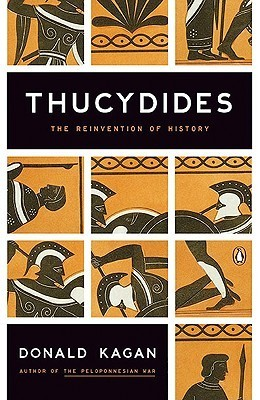
Book Review - Thucydides: the Reinvention of History by Donald Kagan

 Thucydides: the Reinvention of History by Donald Kagan

New York: Penguin Books, 2010          ISBN 9780143118299

A great book. The modern doyen of the history of the Peloponnesian War, Donald Kagan, in deep reflection on the history, and the historian, of that war Thucydides. Famously the "inventor" of the modern idea of history, Kagan shows us that Thucydides was not the dispassionate, apolitical chronicler of events that he claimed to be, but was actually engaged through his work in a revisionist interpretation of what, for him and his countrymen, was recent history.

Kagan has studied not only Thucydides' text but all the other historical artefacts that help explain what went on during the time of the Peloponnesian War, and has come to the conclusion that Thucydides' project was to change the accepted view of why the war played out as it did: to put forward his own views which, Kagan states, differed from the accepted view of the time.

By no means does Kagan suggest that Thucydides was a mere polemicist: in fact he points out that much of the evidence he uses in this book to contradict Thucydides' view actually comes from Thucydides' text. What Kagan is suggesting is that Thucydides wished to use his history to make certain points: that the democratic system in place in Athens during the time of the War was flawed, and that the passion of mob whipped up by demagogues is dangerous. While he recognizes the drawbacks of oligarchic rule, he longs for a wise leader such as Pericles. We probably shouldn't be too surprised about this attitude, as Thucydides was himself an aristocrat. Pericles is the hero, as is Nicias, while Cleon and to a lesser extent Alcibiades are the villains in Thucydides' rendition of events.

Kagan, by focusing on some key events - the causes of the War, Pericles' strategy, whether Athens was actually a democracy, Cleon's victory at Pylos and defeat at Amphipolis and the Sicilian Expedition - dissects Thucydides' account and shows us that he wasn't giving his readers the full story, but only what he wanted to emphasize.

On the causes of the War, Thucydides feels that it was inevitable, as Athens' power grew and its quest for empire became greater and greater. Kagan points out that the War was not in fact inevitable, but came through a series of misunderstandings and provocations that needn't have occurred. While Thucydides bemoans Athens ditching the strategy of Pericles to wait out Sparta, Kagan shows fairly conclusively that this strategy was doomed to fail on all fronts, including economically. He also shows us that Thucydides must have known this, but by only recording one side of the argument he avoids the obvious conclusion. Thucydides uses this "trick" again when discussing Pylos, Amphipolis and the Sicilian Expedition: he emphasizes his version of events while downplaying or avoiding alternate narratives altogether.

It is the story of the Sicilian Expedition where Thucydides' interpretation of events is the most confusing. Kagan, using the evidence provided by Thucydides, convincingly argues that the failure of the expedition can be sheeted home almost exclusively to the actions (or lack of action) of Nicias. He repeatedly made tactical and strategic errors, and certainly seemed to value his own reputation and life over what was best for Athens and the troops under his command. Thucydides provides copious evidence for this point of view, but then comes to the conclusion that it was not Nicias at fault, but the Athenians themselves. Truly confounding.

What Kagan posits, I think acceptably, is that Athens was very democratic, and by no means monolithic in its outlook. Neither Pericles nor Cleon could get their own way by merely wishing it to be so - they had to have support from the Athenian citizens for their strategies. If Cleon was a demagogue, then so too was Pericles. That most of us don't think that is a testament to the power of Thucydides' work, which Kagan acknowledges.

What Kagan does in this work is to remind all of us that one should never necessarily take one person's view on why history happened the way it did as the only truth. We need to balance all the evidence to come to a conclusion. Thucydides claimed to give the unvarnished truth, but like all of us he had a barrow to push, and Kagan very skillfully teases that out in this book. A great read.


Cheers for now, from

A View Over the Bell


Wednesday, 24 January 2024

Book Review - The Peloponnesian War by Donald Kagan

 The Peloponnesian War: Athens and Sparta in Savage Conflict 431-404 BC by Donald Kagan

London: Harper Perennial, 2005 (first published 2003)             ISBN 9780007115068 

There is little doubt that Donald Kagan is one of the pre-eminent historians of Ancient Greece, and particularly the Peloponnesian War, about which he wrote a magisterial four-volume history. The book I am reviewing here is a distillation of that work and his scholarship, to provide a more easily digestible history for the non-academic reader. He has succeeded mightily in that task - this book is a wonderfully concise, yet at the same time comprehensive, narrative of the nearly thirty years of war between the two greatest Greek states, and the two ideologies that they represented.

Kagan has written a very readable history, adding his and others commentary on why events transpired as they did. There are a few things the reader can draw from this, things that reverberate throughout history. Athens, the democracy, and Sparta, the oligarchy, both had strengths and weaknesses that came from their method of governance. Athens had the benefit of support from its population for the war, support that was demonstrated each time a vote was taken. The flip-side of that support is that the polis could be swayed by demagoguery, as it was on occasion throughout the war. Kagan explains clearly that the doomed expedition to Sicily became so when Nicias tried to counter the demagoguery of Alcibiades by trying the rhetorical trick of expanding the expedition beyond what he thought the polis would accept. They did accept it, and the failure of that sortie was the beginning of the end for Athens.

The key to Athens' strength was its navy, which relied on two factors. The first was tribute from the Athenian Empire - most subject states paid for protection from the Athenian navy - money which paid for ships and sailors. The second factor were the crews themselves, members of a democracy, which gave them a stake in the outcome of a battle. These factors not only meant that Athens mostly had the biggest navy, but they also were better trained and more aggressive. Given that the Peloponnesian War was mostly a maritime venture, Athens had the upper hand most of the time. Therefore when they lost  men and ships  it was a disaster, and the final battle of  Aegospotami when the fleet was destroyed, and there was not the funds to replace it, meant the end of Athens.

Sparta's strength was that it was willing to do deals with whomever might help them, including the Persians. It was Lysander in league with Cyrus who finally brought about the defeat of Athens.

What else do we learn in this book? That war has not changed in thousands of years: atrocities, betrayals, both over-confidence and cautiousness bringing about defeats, and failure to think strategically bringing down a state. Kagan notes in his conclusion the irony that shortly after the end of the war and Spartan victory Athens once again became a democracy, and Ancient Greece as it had been was overtaken by Persia and Alexander the Great....the futility of war...

Kagan deals with all of this very well - obviously Thucydides looms over the history of these events like a giant, but Kagan is not afraid to disagree with him when he feels the evidence shows that the great historian got it wrong.

The apparatus of this book is quite good - decent maps and index, a short but interesting bibliographic essay, useful notes and an interview with Kagan.

So in short, if you want an up-to-date, well written account of the Peloponnesian War I think it would be hard to go past this volume. Great to read alongside Thucydides.


Cheers for now, from
A View Over the Bell


Thursday, 14 December 2023

Book Review - Backfire: a History of Friendly Fire from Ancient Warfare to the Present Day by Geoffrey Regan

 Backfire: a History of Friendly Fire from Ancient Warfare to the Present Day by Geoffrey Regan

London: Robson Books, 2002 (First published 1995)               ISBN 1861055013

This is a somewhat disappointing book about a fascinating subject. Many years ago (before the internet) I was doing some family research on my Great-Grandfather and his brothers, all of whom served in World War One. My Great-Grandfather was killed in action on 20 September 1917, during the Battle of Menin Road. Trying to find out more, I headed naturally to C.E.W. Bean's Official History where it is mentioned that during the course of forming up for the battle the Australians suffered considerable losses due to the artillery barrage falling short. I hadn't considered the concept of "friendly fire" before that time, but since then have found it peeping through the curtains of many a memoir or history of wartime events.

So, when I found this book, I took it up with some interest. Regan has skimmed the surface of the concept of friendly fire, and expanded the concept beyond what I think most people would think it to mean. He skips between generalizations and "how it must have been" to specific details of other incidents. One gets the feeling that he was trying to write this book with limited time to research and think about the project.   

It seems to me from the Introduction that Regan was moved to write this book after the friendly fire incident that killed six British soldiers during the first Gulf War, but he begins the book proper with a description of Ancient Greek warfare, and a discussion of how there must have been much "friendly fire" in the phalanx, purely through the way the formation was structured. He continues the theme into Medieval warfare, noting along the way that the lack of uniforms caused much confusion as well. The problem with this section of the book is that Regan provides little actual evidence for the theories that he puts forward.

Moving to the early modern period, Regan begins to draw more on written accounts of friendly fire incidents during the Napoleonic Wars, and start to elaborate on the main cause of friendly fire - confusion. The development of tightly drilled infantry (squares etc.) was an effort to try and reduce confusion, but of course war is confusion, so much of the drill went out the window after a couple of volleys, or if officers were early casualties of the action. Confusion was often the cause of incidents in the armies opposing the French - allies often engaged other allies owing to lack of knowledge of their whereabouts, or even what their uniforms looked like.

These observations set the scene for the major part of Regan's book, concerning World War One and Two, and later conflicts. It's these sections of the book that I found most disappointing. In all probability, and as Regan suggests, mis-directed artillery fire was the cause of most friendly-fire casualties during World War One. Regan in my opinion skates over the reasons why such fire might be mis-directed, and focuses instead on the outcomes of the few incidents which he writes about.

There are two reasons for this, in my opinion. Firstly, Regan has chosen to write a journalistic style of book rather than a more academically focused one. And the second, which comes from the first, Regan has used mostly secondary sources for his information (and to be fair he admits this).

In World War Two it was aircraft that were at the centre of the main friendly fire incidents that he discusses. Aircraft dealt out a lot of friendly fire (Operation Cobra), and also received a lot (Invasion of Sicily). Regan, in describing both World Wars, uses mostly material about the Entente and Allied forces - I assume because he was tied to English language material. The result is that we know a lot about the inadequacies of the USAF in particular, but not so much about the Axis forces (although he does mention Operation Bodenplatte).

I remember reading or hearing the following phrase, about bombing in World War Two "When the Luftwaffe flies over the battlefield, the Allies take cover, when the RAF flies over, the Germans take cover, when the USAF flies over everybody takes cover!" Regan doesn't use that quote, but he does imply in his book that is was the US that seemed to be the worst offender...even bombing Switzerland several times.

Again, sometimes, confusion and lack of information led to tragedy. Often vehicles on the ground were showing appropriate identification symbols, but the fliers were not told about them. Often, aircraft were flying fixed routes at fixed heights at fixed times, but the Flak gunners were not notified. As Regan points out, often these problems could have been and should have been fixed.

My main problem with this work is the patchy nature of it - the lack of detail on the why, the intense focus on a few events, the lack of an overview. However, there are another few annoyances.....the chapter on execution of troops for various offences gets quite a few pages in this book, but I really don't think this issue comes under most commonly thought of definitions of friendly fire: there are other books that cover this much better. There is an interesting chapter on "fragging", but again, not enough detail, evidence or statistical information to be more than frustrating for the reader.

The final bone I have to pick is with language, specifically Regan's use of the term "amicide" as a synonym for friendly fire. While friendly fire is in itself an ungainly term for what is being described, amicide, to me, is completely misleading. Genocide, suicide all imply the deliberate taking of life, whereas ("fragging" aside), friendly fire incidents are not deliberate - they are tragic errors. This book is the first time I have come across the term - I hope it is the last, although with the way the English language is increasingly mauled as the years go on, I fear it won't be.

So, for me, not a lot to recommend here.


Cheers for now, from

A View Over the Bell


Sunday, 15 May 2022

Book Review - The Ulysses Voyage by Tim Severin

 The Ulysses Voyage : Sea Search for the Odyssey by Tim Severin, drawings by Will Stoney, Photographs by Kevin Fleming

London: Arrow, 1988 (first published 1987)                            ISBN 0099544202


We tend to forget in these days of computers, drones and 3D imaging, that it was not long ago that archaeology was a field of study that occurred just as much through reading as through digging, and almost never through what is now known as "experimental archaeology". In fact that phrase is not even mentioned in The Ulysses Voyage - Severin I think would have balked at the idea that he was an archaeologist - but certainly his voyage in the Argo shows us  how much of Homer's poem can be tied to real places in Greece.

With his re-enactment of Odysseus' voyage home from Troy, Severin laid to rest some of the theories that had abounded that much of the action of the poem occurred in Italy or points west. As he explains in the final chapter of the book, many of these flawed ideas can be laid at the feet of Strabo, who knew Italy (and Georgia, where he correctly deduced the voyage of the original Argo), but didn't know Greece at all and so moved much of the action of the Odyssey to places that  he knew. The fact that some of his theories were taken seriously at all shows how the field of archaeology quite often can allow itself to be led in circles.

Severin starts out with a simple theorem - if I was Odysseus, how would I travel home from Troy? With that in mind, he proceeds along the coast of Greece, using the poem as a guide. Severin explains that in Ancient Greece, galleys proceeded at  slow pace, and only when weather conditions were favourable. Severin also shows us that while the course of the Odyssey takes ten years to return to Ithaca, the actual sailing part of the story could be completed in one season. He then posits that the Odyssey is a conglomeration of many sailors stories turned into a narrative. Severin constantly discovers as he sails that much of the Odyssey that refers to the techniques and realities of sailing a Bronze Age galley is surprisingly accurate.

Some of the descriptions of localities are very accurate as well, and Severin discovers plausible sites for the lair of Scylla and the Cyclops, the island of Circe and of the Laestrygonians. He backs his theories with descriptions from Homer, and explaining how the sailing times would match from previous waypoints, and also on many occasions explaining how local legends have been used by Homer (the Cyclops a case in point), which also help to pinpoint locations.

The Ulysses Voyage reminds the reader to be wary of both complicated explanations for myths, and of putting current thinking onto the past. Greek galleys did not sail as far or as fast as later ships, for example - sailing stages of hundreds of miles simply weren't plausible for these vessels, and so some of the wilder theories could be fairly easily discounted. Likewise, deciding that a place must be part of the story, and then trying to bend reality to fit is not a way forward - Severin is very careful to try and not do this, which means that the island of Ogygia remains elusive. After all, the Odyssey is a poem, and not strict geography.

I found this book very enjoyable - it's easy to read, and neatly blends Severin's voyage with the ancient poem, and brings new light to the voyage of the wily Odysseus, and reaffirms his good sense (most of the time). If you are a fan of Homer (and if you aren't, you should be!), this is well worth reading.


Cheers for now, from

A View Over the Bell

Monday, 1 February 2021

Book Review - The Trial of Socrates by I.F. Stone

 The Trial of Socrates by I.F. Stone

London: Pimlico, 1997 (First published 1988)        ISBN 0712673148


This book was nothing like the book I expected it to be, which was an accounting of the trial and subsequent execution of Socrates. While it does deal with that event, this book is itself a re-trial of Socrates, undertaken by Stone, who comes down with a verdict of guilty. The Trial of Socrates is also a polemic against both Socrates and Plato, and a spirited defence of democracy and the Athenian republic.

Stone - an investigative journalist who ran his own paper in the US and then turned to classical studies in his retirement - was intrigued by the trial and death of Socrates and so went back to the sources that have come down to us to try and reconstruct why it was that he was found guilty of the charges laid against him, and why it could be that Athens would execute one of its most famous sons.

Stone was not a philosopher, frequently becoming frustrated with Socrates' questioning and theorizing, and forcefully putting the notion that he should have spent more time working within Athens' institutions, rather than pointing out their flaws. Stone was also a fierce democrat, and had very little time for Socrates' and Plato's denigration of this model, and their praise of an enlightened ruler.

While Stone writes interestingly and with vigor on democratic Athens, his treatment of Plato and Socrates, and the story of his trial is, to me, unsatisfactory. Using his skill as an investigative journalist, he looks at the sources to try to reconstruct what happened. The problem that I have in his use of such sources is that he relies far too much on Plato, who used the life of Socrates and the story of his trial to advance his own philosophical teachings, which means that, as a factual source of events, his writings should be taken with some caution. Stone is too quick to take Plato's writings at face value, especially when they confirm Stone's opinions. Plato had an agenda, and so while we know from his works the outline of the trial, and no doubt some of the the things Socrates may have said in his defence, it is certain that Plato doesn't give us the whole story.

The most interesting chapter of the book for me deals with why the Athenians decided to try Socrates when they did - he was seventy years old, and had been philosophizing in his own way for nearly a lifetime before he was hauled before a jury. Stone has much to say of interest here, to do with the rule of the Four Hundred and the rule of the Thirty  causing upheavals in the stability of Athens that led to the populace placing some of the blame for the uprisings on Socrates, especially given his connexion to Critias, the leader of the Thirty. Of course there is no proof that this is the case, but I think Stone has proposed an argument that makes some sense.

On reflection it seems to me that Stone may have spent his life thinking that Plato and Socrates were part of the greatness of Athenian democracy, and was shocked on reading their works that in fact they were highly critical of Greek and Athenian society, politics and religion. His shock has led him to write this book, in which he writes as a journalist rather than a true historian or philosopher. His approach means that while there is much of interest in the book, ultimately the reader leaves the work with a one-sided view of the philosophy of Plato and Socrates, and with the ultimate mysteries of the trial (why was he charged when he was? why did he prefer to die than flee?) unresolved.


Cheers for now, from
A View Over the Bell


Wednesday, 25 November 2020

Book Review - Travels with Herodotus by Ryszard Kapuscinski

 Travels with Herodotus by Ryszard Kapuscinski, translated from the Polish by Klara Glowczewska

London: Allen Lane, 2007 (first published in Poland in 2004)     ISBN  9780713998481

This is a wonderful little book. Written toward the end of Ryszard Kapuscinski's life, it's a memoir: a memoir of himself, of Herodotus, and of The Histories themselves. Kapuscinki weaves a description of The Histories around his postings in India, the Middle East and Africa as a reporter for the Polish newsagency PAP.

Like Herodotus himself, Kapuscinski had an urge to see what was over the horizon. Eventually, through his experiences, and through the guidance of Herodotus, he realises that the important information to gather is not necessarily about the great events of the day, but the information that lasts is that you gain from talking to ordinary people, wherever they might be.

He wonders in his book about the lengths Herodotus went to in gathering his information, wondering what drove him, what experiences he had in his life, and how his stories were received by those who (Kapuscinski guesses) initially heard his work rather than read it. Kapuscinski also wonders about the people described in the book: the Persians, the Athenians, the Spartans, the Scythians, and so on. He muses, as Herodotus did as well, about what it is to want world domination, and what it is to fight for freedom. He does this in a way that obliquely reflects the struggles of his own country in his lifetime.

And I think that is one of the main things Kapuscinski finds in his relationship of a lifetime with The Histories - that there is nothing new in the world.

As well as discussing Herodotus (if you haven't read The Histories, this book is a great introduction), the reader gets a taste of the life of a foreign correspondent during the great era of de-colonization. He sees at first hand the blooming of African independence, witnessing great things without fully understanding them. He uses his experiences to muse on the experiences of those who suffered under the yoke of the Persians, and to try and imaging the fervor of the Greeks for their own liberty. He also finds times and places where he can almost reach out and touch his "friend" - for that was what Herodotus had become for him - by the end of his life.

I initially picked this book up after reading a review of it in The New York Review of Books, intrigued by what the reviewer wrote. I'm so glad that I hunted it out. It's now sparked an urge to re-read Herodotus after many years, for as Kapuscinski writes, "one must read Herodotus's book - and every great book - repeatedly; with each reading it will reveal another layer, previously overlooked themes, images, and meanings. For within every great book there are several others." and one of those others is Travels with Herodotus.


Cheers for now, from
A View Over the Bell

Monday, 22 June 2020

Book Review - From Solon to Socrates: Greek History and Civilization during the Sixth and Fifth Centuries by Victor Ehrenberg

From Solon to Socrates: Greek History and Civilization during the Sixth and Fifth Centuries by Victor Ehrenberg

London: Methuen, 1973                                                            ISBN 0416777600

Ancient Greek civilization is the bedrock of culture in the Western World: our philosophy, poetry, theatre, art, democracy, medicine and science all spring from the first efforts made in those fields by the Ancient Greeks. The beginning of those beginnings occurred during the period Victor Ehrenberg focuses on in this book.

The centrepiece of this period of Greek history was what has become known as the Pelopponnesian War, which was in reality a series of wars between Athens and Sparta that raged on and off for thirty years. Ehrenberg begins his narrative with an introduction to both Sparta and Athens, setting the scene for their political development over the centuries in question. With its martial structure and perpetual risk of revolt by the helots, Sparta maintained a rigorous oligarchical structure. This contrasted to Athens, where the need for many men to serve in her navy moved the polis to democracy. The beginning of this period saw the combined might of Hellas - including Athens and Sparta - defeat the Persian invasion. This was the last time until the rule of Alexander that most Greeks joined together against a common enemy. Even though they shared a language, gods, and festivals, each Greek polis felt no need to be a part of a larger Greek state, and over the course of the period covered by Ehrenberg, there were myriad shifting alliances between and invasions of cities and states.

The two major strategic rivals were Athens and what was to become its empire, and Sparta at the head of the Peloponnesian League. The wars between these states that led to the destruction of Athens and the impoverishment of Sparta were particularly brutal. Politically Athens veered from extreme democracy - rule of the mob - to types of tyranny by one man or a group, before their final subjugation. Sparta similarly had great political upheavals, even if on the surface their political system did not change.

Ehrenberg steers a narrow course through the known facts, acknowledging the gaps and not engaging in too much speculation beyond what can be supported by what we know. We do know that the democratic states and cities could very easily fall under the sway of a demagogue, and we see the decline of the idea of the polis over this period through figures such as Pericles, Alcibiades, and Critias. Ehreneberg ties this in with developments of the mind; the development of the concept of the individual as distinct from the polis, epitomized in the life of Socrates. Democracy inherently assumes a social contract and certain rights, and the reader sees how Athens battled over the distribution of those rights between classes. Ehrenberg also shows us that the idea of democracy as a force for peace is not correct. It is Athens that is the aggressor, the imperialist power, the state unwilling to compromise. However, it is Athens that drives the Greeks forward, artistically and politically. While Sparta may have ended up victorious, they are only remembered now for the 300, and their cruel social structure. The ferment that was Athens created great misery and destruction, but also created the basis of Western Culture.

For a detailed look at how that occurred, From Solon to Socrates is worth picking up.


Cheers for now, from
A View Over the Bell

Thursday, 22 February 2018

Book Review - The Light Garden of the Angel King by Peter Levi

The Light Garden of the Angel King : journeys in Afghanistan by Peter Levi

London: Collins, 1972

I mentioned in my review of Peter Levi's book of travel and archaeology in Ancient Greece, The Hill of Kronos, that Levi had travelled to Afghanistan with Bruce Chatwin. This book, The Light Garden of the Angel King, is the record of that journey, from Levi's perspective. It is a journal of archaeology and travel, rather than a journal of personalities. It is a journal of a poet, collecting images and events to mull over and use (the poems Levi composed whilst on the journey are in an appendix at the back of the book).

The aim of the journey, for Levi, was to investigate whether the ancient Greek influence on Afghanistan was discernable through its archaeology, and how much of it still remained. Much as Levi does in The Hill of Kronos, he and Chatwin travel through areas where archaeology abounds, but the knowledge of it was minimal or non-existant. Travelling in Afghanistan has always been dangerous from a human and geographical point of view, and Levi has guns pointed at him, sleeps through an earthquake and suffers both extremes of heat and cold during his journey through the rugged hills and valleys of the country.

In this book he gets around quite a bit of the country, from Helmand, to Kandahar, Kabul, through Nuristan and to within sight of the Oxus River, he describes to us ancient citadels, ruined cities, nail-biting 'plane trips and interesting characters met along the way. There are some highly technical sections in the book about the finds Levi makes archaeologically, and these are well supported with footnotes. But, for me, it is his descriptions of the Afghan countryside, in its starkness and beauty, that are the best parts of the book.

Much like The Hill of Kronos, The Light Garden of the Angel King somewhat falls between two stools as a book, neither being a proper archaeological study, nor a full-on travel book. It is, however a good book.


Cheers for now, from
A View Over the Bell

Monday, 13 November 2017

Book Review - Anabasis of Alexander by Arrian

Anabasis of Alexander by Arrian. English translation by P. A. Brunt (in 2 Vols, including Indica)

Cambridge, Mass. : Harvard University Press, 1976

Have you ever had that strange feeling when you drive past the site of a recently demolished building in your neighbourhood and you can't remember what was there? That makes it even more amazing to me that we still know so much about the life of Alexander the Great. The fact that we do so is due to the survivial of this work of Arrian, amongst others.

The Loeb Classics two volume edition, which also includes the Indica is a fine edition on many levels. For the properly educated, one can compare the Ancient Greek to the English translation, and for us lesser mortals, the copious notes, appendices and informative introduction ensure we know what to make of the text, and where controviersies arise in comparing this work to other surviving sources. There is also a useful index.

All of us know, or think we know, the story of Alexander's conquest of most of the known world, so it's fascinating to go back to authors such as Arrian and Curtius and see what they wrote. Arrian saw himself as writing the definitive history of Alexander, combining all sources available to him and choosing the most reliable, sometimes putting down all he'd found out when he couldn't decide where the truth lay. What is interesting is that he obviously didn't know of Curtius' history, even though the scholars think it was written a hundred years earlier than Arrian's work.

The image of Alexander's army rampaging through the Near East is in fact only partly true - much (most?) of his conquests were peaceful, in the sense that cities and kingdoms surrendered without a fight, rather that risk defeat under arms. The reason so many took this option was that Alexander was often magniminous to those who surrendered, and could (and did) destroy utterly those who bore arms against him.

Things that stand out for me on reading Arrian is how few actual Macedonian troops Alexander had for much of his conquests: as he moved further away from home he relied more and more on local levies of troops and on arrogating to himself troops that once fought for Persia. The other point that I feel I hadn't adequately considered before reading this was just how Alexander ran the lands he conquered. He appointed trusted generals as satraps and on occasion even local rulers got to continue their rule, after paying obesiance and tribute to Alexander. It is interesting how often Arrian (who on the whole is a supporter of Alexander) describes how recently conquered territories had risen in revolt against Alexander, and needed to be repressed. The idea of Alexander rolling across the Near East and crushing all resistance is in some ways a false one.

The sense of Alexander one is left with after reading Arrian is of a man who was perhaps not interested in the art of governing. He was interested in conquering and winning battles, and as long as someone was keeping the rear in check and getting enough money for him to keep his army on the go, he was happy with that. Certainly after his death the empire quickly crumbled, as each kingdom quickly reverted to local rule, apart from some exceptions (Ptolemy in Egypt, for example).

One gets a whiff from Arrian (something which is more emphasised in Curtius), that Alexander's conquests eventually debauched his character: he moves from being a great and noble commander into an "Oriental tyrant". Whatever the thoughts about his character, none can detract from his deeds - a hero to some, a monster to others.

The Loeb edition also includes Arrian's Indica, which is a narrative of Nearchus' voyage from India to Persia. This perhaps is more interesting as a historical document, and would have been even more so when Arrian wrote it, as much of that part of the world was a mystery to most Greeks.

I've enjoyed reading Arrian, perhaps more than I expected.


Cheers for now, from
A View Over the Bell

Thursday, 7 January 2016

Book Review - The Symposium by Plato

The Symposium by Plato, translated by W. Hamilton

Harmondsworth: Penguin, 1951                     (Penguin Classics Series)


Love, that most mysterious of emotions, is the theme of The Symposium. So many philosophers and religions have dealt with this subject, and it is amazing how all conclusions tend to merge. Plato, writing nearly 400 years before Christ, comes to conclusions that are not so different from those of other belief systems.

Sometimes referred to as The Dinner Party, The Symposium is constructed by Plato around the after-dinner speeches of a group of men at a dinner party, speeches they give in lieu of the usual musical entertainment that would be normal for the after-dinner drinking session. The dinner party guests include Pausanias, Phaedrus, Aristophanes, Agathon and of course Socrates. These are the main protagonists in the discussion, initiated by Agathon, on the nature of the God Love.

The discussion takes the form of each member of the symposium delivering a panygeric on Love, and what they see as the most important features and factors in the makeup of Love. Plato arranges the speeches in a way that leads the reader from the outer surface of Love (Love is noble in that it leads the Lover to show the best of themselves), through to Socrates' contribution, which goes beyond the love of fellow man, to Love being an all-encompassing emotion that can be seen in everything.

Plato leads the reader through several phases - it's hard to disagree with any of the speaker's ideas about what is great about Love, but as each speaker adds more depth, the reader's mind is opened yet more to how Love engenders all that is good in the World.

Socrates himself structures his talk as reporting on a conversation with one of his teachers, Diotima. By the time that Socrates rises to speak we have looked at how love grows, how it brings out the best in men, and how Love is the desire for beauty - at first external beauty, but then the discussion moves on to the desire for the beauty within. Socrates rises to dismiss the notion that Love is the desire for beauty, rather that it is the desire for good.

According to Diotima (and by inference Socrates and Plato) Love transcends the merely physical, it is the desire to propagate the Good, and to achieve immortality by doing so. This can be done in a physical way by producing offspring, but as a man grows in wisdom from love of physical beauty in particular to physical beauty in general, from love of another's soul in particular to love of souls in general; to love of all beauty everywhere "absolute, existing alone with itself, unique, eternal, and all other beautiful things ... partaking of it, yet in such a manner that, while they come into being and pass away, it neither undergoes any increase of diminution nor suffers any change", he has reached the ultimate goal of Man.

Alcibiades then enters the dinner party drunk, and eschews the discussion on love for a panygeric on Socrates himself. Acibiades, in the story of his failed seduction of Socrates, shows the reader that Socrates himself is someone who has reached that ultimate goal.

A short work, there is much to ponder here, as would be expected from Plato. It is interesting to compare Socrates' view of the power of love to the expressions of Christian and Buddhist writings. While Ancient Greece is very different to today, as indeed is shown in The Symposium, human thought on the big questions shows amazing consistency over time.


Cheers for now, from
A View Over the Bell

Tuesday, 19 August 2014

Book review - Alexander the Great by Peter Green

Alexander the Great by Peter Green

London : Weidenfeld and Nicolson 1970.                                            ISBN 0297000071


Alexander the Great - the fascination he holds for us has never dimmed, right from the moment he died through to the 21st century - as I write this in 2014 there is a six-part television series being broadcast, hosted by an Australian, looking for the remains of Alexander's Asian empire. This is the latest in many television documentaries, films, and untold books about the man who has variously been seen as a liberator or a devil, and who was indisputably one of the finest military commanders of all time.

Peter Green, in the book under review, has written a concise, well-reasoned account of the life of Alexander as it has come down to us, emphasising Alexander's military prowess, his leadership skills, and also his increasing slide into megalomania and perhaps even madness.

It's incredible to think that by the time he died at the age of 32, Alexander had risen from being the King of Macedonia, considered one of the backwaters of Ancient Greece, to being the major figure in Greece, the Pharaoh of Egypt, the King of Persia and the King of Asia, with an empire that spread from Macedonia in the North, Egypt in the South and as far east as Indus River. The achievement is so amazing it can hardly be believed, and in fact might go some way to explaining why Alexander at the end thought of himself as a God.

There is no doubt that Alexander was a driven man - initially driven to surpass his father (whom he may have had killed), his ostensible reason for war against Persia was to revenge the Persian defeat of Greek forces the century before Alexander's rise to power. Once he defeated the Persians at the Battles of Issus and Gaugamela, he had to think of new reasons to cloak his increasing thirst for conquest - these were various and not very convincing.

Green points out that money was one thing that drove Alexander on. War has always been expensive (look at the billions upon billions recently spent in Iraq and Afghanistan by the United States of America) and Alexander financed his by looting conquered territories of their treasure - treasure he needed not only to feed, equip and pay his troops, but to bribe potential enemies and his Macedonian levies, who grew increasingly bitter about being away from home for so long.

Green is at his best when he writes about the internal workings of Alexander's army - we see that far from being a homogeneous unit, the army was riven with factions and hatreds, which only grew worse as Alexander introduced more and more troops from the Persian Empire into its ranks. In fact Green suggests that Alexander was working on a project to rid his army of Macedonians entirely, in a move to become King of Asia and not merely a Greek conqueror. His adoption of Persian ways of living and ruling estranged him from his most loyal companions, and yet did little to endear him to his conquered peoples.

While Alexander was a brilliant military tactician and strategist, he was a poor administrator. He tended to let his appointed governors and satraps run his conquered territories, with more or less garrisons assigned to them as he saw fit. The amount of treasure embezzled by these men was fantastic, enough for them to employ armies of their own. While Alexander lived these men were kept in check, but as soon as he died they squabbled over the spoils, and in less that a lifetime after his death, Alexander's empire had fallen apart.

His legacy though, is incalculable: one wonders if the Roman Empire would have become what it did without the model of Alexander to show what was possible: he joined East and West in ways that had never occurred before, and even in seemingly simple ways - such as the introduction of cotton to the West - his life changed the way the World lived, and lives.

Green's book is a good introduction to Alexander and his world - relatively short and to the point, with a good bibliography, this edition is in a larger quarto format with plenty of good photographs and some useful maps.

Enjoyable.


Cheers for now, from
A View Over the Bell


Tuesday, 29 July 2014

Book Review - The Hill of Kronos by Peter Levi

The Hill of Kronos by Peter Levi

London : Arena, 1987                                                              ISBN 0099331500


Peter Levi, poet, archaeologist, scholar, Jesuit Priest, was one of those people who were on what I call the "literary periphery". Someone you've vaguely heard of, usually in relation to someone else. Levi was good friends with the Greek poet George Seferis, and of Patrick Leigh-Fermor, and in more recent years was possibly even better known as the travelling companion of Bruce Chatwin during his journeys in Afghanistan, retracing Robert Byron's route in the Road to Oxiana (in fact Levi wrote a book about that trip The light garden of the Angel King : Journeys in Afghanistan, which has been reprinted several times - each reprint seemingly with more emphasis on Chatwin's photographs).

The Hill of Kronos is an autobiographical work - written later in life, Levi looks back on his various journeys to Greece, a land that meant a lot to him. His first visit took place when he was still studying to be a priest, as both the Seminary and Levi thought it would be good for him to take a break from his studies. Levi had gone through school with a love of Ancient Greek, and his first trip to Greece was as a budding archaeologist, travelling by foot over legendary landscapes in search of places mentioned by Pausanias' Guide to Greece.

As an archaeologist, it soon becomes clear in the narrative that Levi is a dilettante in the original meaning of the word - he is too interested in everything to be focussed enough on the task, but broad enough in his interests to see much that might have been overlooked until that stage. Reading in 2014 about his trip in 1963 it's amazing to realise just how much of the ancient world had yet to be studied and recorded at that time - Levi made trips to several places that had been untouched until then.

During this first trip Levi also sought out Greek poets - Seferis in particular, but also Odyseus Elytis and Nikos Gatsos. The generosity of these poets to Levi had an important effect on him and in some ways his writing about them is a eulogy for their nobility, and for a time in Greek letters that was coming to an end.

The highlight though, for Levi and the reader are his travels through the Greek countryside, and his interactions with local Greeks. His earliest trip occurred before tourism became a major influence in many of the places he visited, so he was something of a novelty to many of the locals, who were unfailingly generous in their hospitality. In 1963, many of the locals remembered the British from the War, and Levi met many who fought against the Germans for their freedom.

That makes the second part of the book - Levi's time in Greece under the Colonels - all the more heart-rending. He is witness to (and a minor player in) the slow constriction of Greek society under dictatorship, and of the increasing attempts to break the hold of the Colonels on political life. Levi's small part in the drama of the resistance earns him attention from the Police, which is in parts hilarious and in parts terrifying. He is eventually banned from the country for a time.

The final section of the book is his re-visitation, many years later. Levi is definitely a changed man - no longer a priest, he is married, and his wife and step-son accompany him on a trip that finds old friends dead, the landscape changed and scarred by modernity and tourism, but some of the old truths surviving.

This short book is elegaic in tone in almost every way - Levi has written a paen for an older way of life in Greece, and he himself was one of the last of a certain type of writer, writing the type of book that we will see less and less of in the future. Educated but not overbearing, democratic but not prescriptive, informative but not preaching, inspired but not demagogic, stylish but not overwrought, this book contains a type of writing that flourished in the nineteenth and twentieth centuries, but is no more, I fear (I hope wrongly).

As someone who can in no way approach the style and intelligence of this kind of work (as evidenced by this review!), I recommend this book.


Cheers for now, from
A View Over the Bell