Showing posts with label Classical History. Show all posts

Sunday, 28 September 2025

Book Review - Jerusalem: the Biography by Simon Sebag Montefiore

 Jerusalem: the Biography by Simon Sebag Montefiore

London: Phoenix, 2012 (first published 2011)      ISBN 9781780220253

One of the blurbs on my edition of this book calls it "a tour de force", and there is no doubt that Jerusalem lives up to that particular piece of praise as well as all the others that it has gained since publication. It is the story of Jerusalem for sure, but along the way the reader learns much of Judaism, Christianity and Islam, of the Arabs, Romans, Ottomans, Russians and British, of Crusader Kingdoms and Sultanates, and of modern geopolitics.

Like all great works of non-fiction, Montefiore has woven much more into his story than the bare bones. The reader comes away from this work with a much broader knowledge of Western and Middle Eastern history than they would have a right to, given the books ostensible subject matter. The reader does of course gain an intimate knowledge of the development and trials of Jerusalem itself, as well as wonderful little titbits of other information such as the origin of the phrase "Bob's your uncle", the fact that Rudolf Hoess, Franz von Papen and Rudolf Hess were all in Jerusalem at the same time, and that the future King George V got tattooed when there, in the same place as his father.

These little nuggets of information are the cherries on top of the wonderfully rich dessert of history that Sebag Montefiore serves up. Thankfully his style, and the easily digestible short chapters make it both easy to read, and easy to absorb the information.

Sebag Montefiore writes in the last pages of the book that "for 1,000 years, Jerusalem was exclusively Jewish; for about 400 years Christian; for 1,300 years, Islamic, and not one of the three faiths ever gained Jerusalem without the sword, the mangonel or the howitzer."

The history of this city is a history of rapine, destruction, and war. It is also a history of worship, ecstasy and wonder. It is a story of immigration, emigration, and cosmopolitanism. It is the story of a city that on many occasions threatened to die, but is in many ways the most important city on Earth. The origins of Jerusalem are obscure and biblical, although recent archaeology has proven that King David did in fact exist.

Until the arrival of the Romans, and sometimes even after, Jerusalem was a backwater. Holy to the Jews, it was of small interest to others apart from being an attractive place to loot, owing to the gold that was held in the Temple.

Rome and Herod brought some stability to Jerusalem, although religious fever often led to riots, and there was also a continuous underground of Jewish rebellion against Roman rule. This was mainly driven by Jewish fundamentalism; a belief that gentiles could not rule God's chosen people. Jesus was part of this milieu.

The disaster of AD70 when the Romans sacked the city and destroyed the Temple after yet another Jewish rebellion, signalled the end of any Jewish control of the city for nearly 1,900 years. Jews were expelled, and Jerusalem once again became a backwater.

After an interval of Byzantine rule, the Arabs took the city in AD630. Soon after came the building of the Dome of the Rock, which raised Jerusalem to a holy site for its third religion (and which has led to many of the trials and tribulations the city has suffered down the years). Montefiore explains that this move was partially political, as the ruler of Jerusalem, Abd Al-Malik did not control Mecca and so needed a counterweight to the shrine there.

While the Muslims tolerated both Christians and Jews, life was not easy for them under Islamic rule. The Crusaders however were worse. The Crusader Kings, who were essentially freebooters looking for land, were often dangerous to each other, but not as much as they were to both Jews and Muslims.

Saladin's relatively enlightened rule was but a short interlude between the Christian crusaders and the Mamluks and Ottomans, who ruled Jerusalem for 400 years. For most of that time the city was again a backwater - Jews were forbidden the Temple Mount, and Christian worship was heavily circumscribed (although the Christians seemed to rank ahead of the Jews in the eyes of the Pashas and Sultan).

As the Ottoman Empire sank into sloth and corruption, Western countries began to influence what happened at the centre of Christendom. Kings, Czars and Emperors vied with each other to endow churches, fund pilgrimages and gain the upper hand in the machinations to do with the operation of the Church of the Holy Sepulchre.

The rise of millenarian ideas in the USA and Britain led to a push to allow Jews back to Jerusalem so that biblical prophecies of the Armageddon could be fulfilled. Montefiore clearly explains how these ideas led to massive changes on the ground in Jerusalem (one of Montefiore's ancestors funded Jewish settlement there) and on policy. The Balfour Declaration was a ground-breaking change in geopolitical thinking, even though one of the major reasons it was made was to mobilise Jewish support for Britain's fight in World War One.

Montefiore brings the history up to the present with descriptions of the internecine terrorism performed by both Jews and Arabs during the British Mandate and beyond, and explains how so many chances to find a workable peace have been missed: when one side felt politically strong enough to offer terms, the other side was too weak to accept them.

The uneasy state of peace that currently entails in Jerusalem has come at the cost of almost total segregation of Jews, Muslims and Christians from each other, and the destruction of what was a unique culture. It seems that we humans have not learnt a thing from the history of this holy and benighted place.

There is so much more in this book than I have noted here - it is an accessible wonder, and well worth reading. You will learn a lot.


Cheers for now, from

A View Over the Bell

Thursday, 14 August 2025

Book Review - The Gnostic Gospels by Elaine Pagels

 The Gnostic Gospels by Elaine Pagels

London: Penguin, 1990 (first published 1979)       ISBN 0140134689

The discovery in 1945 of a series of religious texts that had been buried for over a thousand years caused a sensation in the world of religious scholarship. The so-called Nag Hammadi library contained all sorts of texts and fragments of Gnostic teaching including Gospels and other treatises. They were translated from the original Greek into Coptic, and the best speculation is that they were buried in the sand by monks afraid of punishment for holding condemned texts in their library.

Elaine Pagels is probably the greatest known English speaking scholar of these texts, and in this book she explains the differences between the Gnostic and Orthodox view of Christianity. It is a fascinating peek into the early days of the Christian Church and Bible as we know them today. In a series of chapters dealing with subjects ranging from views of the Resurrection, Persecution, what makes a true Church, to whether God is male and what Gnosis (knowledge) actually means in Christian life and belief.

Before 1945, all we knew of any Gnostic texts were what had come down to us from those Orthodox who had written condemnations of them, and Pagels compares those denunciations with what we now know through access to the Nag Hammadi texts.

As Pagels points out in the book, the modern concept of separation between religion and politics would have been unknown in the time of the creation of these texts. What we see in them is a way of searching for truth, but not a way to be organized into an institution which could grow and face the vicissitudes that the Christian faith were suffering at that time.

For to be a Gnostic was to reject the hierarchies and strictures of the Orthodox Church. Gnosis was much more a personal issue - the texts consistently reinforce a believer's duty to engage in a personal relationship with Christ to find the secret of faith. In fact the idea that Gnostics (those that know) had access to secret knowledge was key to their movement. As Pagels writes it, it seems that many Gnostics felt themselves to be superior to others who were not 'spiritual' in their religious outlook and activities. Through quotation from the Nag Hammadi texts, Pagels shows that there was contention within the Gnostic world about whether those that merely observed the rituals of Christianity were indeed true Christians at all. Some said no while others thought yes, but they had yet to reach the fullness of faith.

Gnostics were essentially exclusive, while the Orthodox were essentially inclusive. The Gnostics, believing that only the truly spiritual or initiated were true believers, were forever questioning each other. Schisms and splits are a given if there is no agreed way to determine who is in and who is out. The Orthodox, on the other hand, simply required from an adherent a profession of faith (the Creed), participation in the rituals of the Church, and obedience to Church hierarchy. There is no need, if one is Orthodox, to reach within oneself to find the truth - the Bishop gives it to you.

As well as discussing the political implications of the Gnostic movement, there is also in the book much discussion of the theological differences between Gnosticism and Orthodoxy, and these differences are fascinating.

Gnostics held - for the modern Christian - quite unorthodox views about the Crucifixion and Resurrection of Christ, and indeed the figure of God. Gnostics, with their spiritual view, actually denied that Christ physically died and came back - they explained it was all part of a spiritual manifestation. The Gnostics also dance dangerously close to ditching monotheism, with the idea that the creator (or demiurge) was beholden to another ultimate deity. This theory led to a school of thought where the physical world was to be ignored and deprecated, as it was only the world of the spirit which has validity. So while these Gnostic texts were suppressed early in the Churches history, these ideas continued, driving heresies such as Bogomilism, Catharism and other sects.

The great fighters against Gnosticism, Irenaeus and Tertullian are well represented in this book, with many of their most telling criticism still carrying weight today. They went hard particularly at the Gnostic idea of an individual searching for Christ by themselves. The Orthodox countered with questions such as how does a searcher know when they have found what they are looking for? On what basis or authority do they base their findings? Why would God keep the gift of salvation secret, only to be revealed to a few?

The other thing to keep in mind when reading this book is that the Bible as we know it was being compiled at the time of the creation of these texts, so potentially any of the Gnostic texts could have found their way into it. Pagels forwards the view that the Bible was collated by those that were Orthodox in part to 'win' the political and religious battle against the Gnostics. The books chosen for the New Testament certainly favour the Orthodox interpretation of the life and teachings of Christ, and Paul's Letters specifically re-affirm the kind of Church we know now, as well as putting women in their place (Pagel's chapter on the masculinity of God is fascinating and shows that the Gnostics were more enlightened on that front, not only being happy for women to be fully involved in worship, but also emphasising the role of Mary Magdalene in Jesus' story, as well as explicitly pointing out the feminine side to the Godhead).

Pagels has packed a lot into what is quite a short book, so while it's not long, it is dense. It's a great introduction to Gnostic thought and writing, and a good primer on the Orthodox reaction to what became a heresy. I'm going through my shelves of books on religion with a view to thin the herd - this one is a keeper.


Cheers for now, from

A View Over the Bell

Thursday, 24 April 2025

Book Review - The Fall of the Roman Empire by Michael Grant

 The Fall of the Roman Empire by Michael Grant

New York: Collier Books, 1990 (rev. ed. first ed. published 1976)   ISBN 0020285604

This is a serviceable book that describes in broad terms the author's view on how the Western Roman Empire came to collapse in the Fifth Century AD. Unfortunately I have to state at the beginning of this review there are much better books covering the subject. Grant's style is workmanlike at best, his lack of footnotes is annoying given how many quotations are used in the text, and he can tend to some post facto explication of the fall of the West, especially when it comes to the influence of Christianity on the fall of the Empire.

After an introductory chapter, which focusses on the events of the last hundred or so years of the Western Empire, Grant then catalogues the factors that went into causing the fall. The headings for the sections of his book The Failure of the Army, The Gulfs between the Classes, The Credibility Gap, The Partnerships that Failed, The Groups that Opted Out, The Undermining of Effort, cover his main themes. The first two in particular are crucial to the final downfall of the once great institution that was the Roman Empire.

It's clear that as time went on, the Roman Empire became more and more militarized as the "Germans" pressed more heavily on their frontiers. As Grant explains in an appendix, the Western Empire with its much longer "barbarian" border, had to provide a much stronger military force than the Eastern Empire. This led to a requirement for a very large army, and the high taxation required to keep it running. In earlier times, service in the army was a path to Roman citizenship, but after Caracella decreed that all free people in the Empire were automatically citizens in AD 212, that encouragement to service was removed. Each province of the Empire needed to provide a certain number of recruits for the army, but many bought their way out of service: their money was used to pay for German soldiers. The dilution of the Roman portion of the army led to a less professional force, a less reliable force, and a smaller force. Grant point out that evidence suggests that in the last century of the Empire, it seems the biggest offensive forces to deal with breaches in the Empire struggled to reach ten thousand men, a far cry from the huge Roman armies of earlier times.

Grant also explains how the Empire crumbled from within - the crippling taxes levied particularly on agricultural production were inequitably enforced, with wealthy citizens able to evade or reduce their taxes more than middle classes. This type of activity led to what Grant calls the "Credibility Gap", where the disconnect between the vital middle classes and the government meant that when the Empire needed their citizens, those citizens were often not too interested in helping.

Grant also points out that while Rome was happy to have Germans come into the West to fight or farm for the Empire, it did little to embrace those Germans or make them feel welcome. The aggressive suppression of any religions other than Roman Catholicism in the West also did little to encourage people to feel like they were part of something bigger than their own group or sect. The East and the West also gradually drifted apart, failing to support each other, and developing differing interpretations of religion.

Grant makes much of the rise of Monasticism and asceticism, suggesting that the call to turn away from the earthly life to a life of contemplation and peace was a factor in the fall of the Empire. I think his theory is problematic on a couple of fronts. Firstly, much of the evidence he provides is from a period later than the fall of the Western Empire, and he extrapolates that evidence backwards, which is risky. He also fails to convince me that the numbers of people who would actively turn away from the earthly life would be significant enough to affect army recruitment, for example. Where he does make a valid point in my opinion with regards to clerical expansion is that many people who could have become good imperial administrators instead turned to the church. This change seems due to laws that meant that civil servants were often responsible for raising taxes, or covering the costs of the taxes they failed to raise. The Church was a less stressful career.

The lack of footnotes is a real concern to me in this book - whenever I wondered at a quotation or a point, there was nothing for me to go back to and check. This book seems to want to rise above a popular history, but it doesn't quite get there. When I got to the end of the book I felt that I knew a lot about Grant's thinking about the fall of the Empire, but somewhat less as to why he came to the conclusions that he did. I would recommend other books before this if  you are interested in the fall of the Roman Empire.


Cheers for now, from

A View Over the Bell

Tuesday, 27 August 2024

Book Review - A History of the Jewish People by James Parkes

 A History of the Jewish People by James Parkes

Harmondsworth: Penguin Books, 1964

This is a handy little crib on the history of the Jewish people, rather than the Jewish faith. Of course, it can be difficult to separate the two; as Parkes writes in his introduction, "[t]he history of the Jews is the story of a people inextricably interwoven with that of a religion. Neither can be told apart from the other. It is obvious that there would be no story of Judaism if there were no Jews; but it is just as true that Jews would not have survived the long centuries of their total dispersion had there not been the cement of a religion moulded to their need either to transform or to tolerate the conditions of their corporate and individual lives."

Parkes' history shows a long tradition of a people trying as much as they can to accommodate themselves to the situation in which they existed at any one time. From the earliest days there were geographically diverse groups of people practicing the religion of Judaism, with more or less oppression from the powers of the time. There have only been very short periods of time when Jewish people have had the capacity to control their own polity - very early and very late in their history.

The story of the Jews after Classical times is one of interaction with both Christendom and Islam, and the changing fortunes of those relationships. Christendom very quickly began oppressing the Jews, as they saw them as a threat to the growth of their own religion. The Jews were, in Christian eyes, apostates, Christ-killers, and subverters of fellow Christians. Islam initially treated Jews much better than did Christians, but as the Muslim world shrunk in the face of Western Christian dominance of Europe and Africa, and Islam withdrew into itself, that relationship too became poisoned and died. During the secular age, rather than religious scares, the route of anti-Semitism runs along the lines of finance and conspiracy - the forged Protocols of the Elders of Zion and Nazi rantings about Jewish control of finance took the place of older tropes of Blood Libel and miscegenation.

Parkes explains how the Jews developed their faith and ideas in separation from each other - the Sephardic Spanish versus the Ashkenazi Central Europeans. While non-Jews were the people's biggest enemy, they were not averse to internecine conflict either. The destruction of the Temple and exclusion from Jerusalem meant that the old ways of Jewish worship had to change, through a "democratic" system of congregationalism, through to a "professional" structure of paid Rabbis. This is not gone into in great detail, but is fascinating to a non-Jewish reader such as myself.

The final section of the book deals with the horrors and hopes of the twentieth century - the Holocaust, and the creation of Israel. Parkes focusses on the British Mandate in Palestine, how something that began with such high hopes ended in disaster, with the British washing their hands (a la Pilate) of the problems they had created with a poorly thought-out plan to let Jews come back home. Written in 1964, this book doesn't cover much of the ongoing disaster that has come out of this recent history.

If you are a person who doesn't know much about Jewish history this book, although dated,  isn't the worst place to start.


Cheers for now, from

A View Over the Bell

Tuesday, 30 January 2024

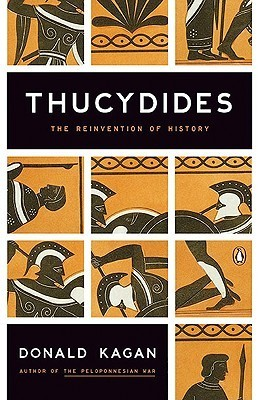
Book Review - Thucydides: the Reinvention of History by Donald Kagan

 Thucydides: the Reinvention of History by Donald Kagan

New York: Penguin Books, 2010          ISBN 9780143118299

A great book. The modern doyen of the history of the Peloponnesian War, Donald Kagan, in deep reflection on the history, and the historian, of that war Thucydides. Famously the "inventor" of the modern idea of history, Kagan shows us that Thucydides was not the dispassionate, apolitical chronicler of events that he claimed to be, but was actually engaged through his work in a revisionist interpretation of what, for him and his countrymen, was recent history.

Kagan has studied not only Thucydides' text but all the other historical artefacts that help explain what went on during the time of the Peloponnesian War, and has come to the conclusion that Thucydides' project was to change the accepted view of why the war played out as it did: to put forward his own views which, Kagan states, differed from the accepted view of the time.

By no means does Kagan suggest that Thucydides was a mere polemicist: in fact he points out that much of the evidence he uses in this book to contradict Thucydides' view actually comes from Thucydides' text. What Kagan is suggesting is that Thucydides wished to use his history to make certain points: that the democratic system in place in Athens during the time of the War was flawed, and that the passion of mob whipped up by demagogues is dangerous. While he recognizes the drawbacks of oligarchic rule, he longs for a wise leader such as Pericles. We probably shouldn't be too surprised about this attitude, as Thucydides was himself an aristocrat. Pericles is the hero, as is Nicias, while Cleon and to a lesser extent Alcibiades are the villains in Thucydides' rendition of events.

Kagan, by focusing on some key events - the causes of the War, Pericles' strategy, whether Athens was actually a democracy, Cleon's victory at Pylos and defeat at Amphipolis and the Sicilian Expedition - dissects Thucydides' account and shows us that he wasn't giving his readers the full story, but only what he wanted to emphasize.

On the causes of the War, Thucydides feels that it was inevitable, as Athens' power grew and its quest for empire became greater and greater. Kagan points out that the War was not in fact inevitable, but came through a series of misunderstandings and provocations that needn't have occurred. While Thucydides bemoans Athens ditching the strategy of Pericles to wait out Sparta, Kagan shows fairly conclusively that this strategy was doomed to fail on all fronts, including economically. He also shows us that Thucydides must have known this, but by only recording one side of the argument he avoids the obvious conclusion. Thucydides uses this "trick" again when discussing Pylos, Amphipolis and the Sicilian Expedition: he emphasizes his version of events while downplaying or avoiding alternate narratives altogether.

It is the story of the Sicilian Expedition where Thucydides' interpretation of events is the most confusing. Kagan, using the evidence provided by Thucydides, convincingly argues that the failure of the expedition can be sheeted home almost exclusively to the actions (or lack of action) of Nicias. He repeatedly made tactical and strategic errors, and certainly seemed to value his own reputation and life over what was best for Athens and the troops under his command. Thucydides provides copious evidence for this point of view, but then comes to the conclusion that it was not Nicias at fault, but the Athenians themselves. Truly confounding.

What Kagan posits, I think acceptably, is that Athens was very democratic, and by no means monolithic in its outlook. Neither Pericles nor Cleon could get their own way by merely wishing it to be so - they had to have support from the Athenian citizens for their strategies. If Cleon was a demagogue, then so too was Pericles. That most of us don't think that is a testament to the power of Thucydides' work, which Kagan acknowledges.

What Kagan does in this work is to remind all of us that one should never necessarily take one person's view on why history happened the way it did as the only truth. We need to balance all the evidence to come to a conclusion. Thucydides claimed to give the unvarnished truth, but like all of us he had a barrow to push, and Kagan very skillfully teases that out in this book. A great read.


Cheers for now, from

A View Over the Bell


Wednesday, 24 January 2024

Book Review - The Peloponnesian War by Donald Kagan

 The Peloponnesian War: Athens and Sparta in Savage Conflict 431-404 BC by Donald Kagan

London: Harper Perennial, 2005 (first published 2003)             ISBN 9780007115068 

There is little doubt that Donald Kagan is one of the pre-eminent historians of Ancient Greece, and particularly the Peloponnesian War, about which he wrote a magisterial four-volume history. The book I am reviewing here is a distillation of that work and his scholarship, to provide a more easily digestible history for the non-academic reader. He has succeeded mightily in that task - this book is a wonderfully concise, yet at the same time comprehensive, narrative of the nearly thirty years of war between the two greatest Greek states, and the two ideologies that they represented.

Kagan has written a very readable history, adding his and others commentary on why events transpired as they did. There are a few things the reader can draw from this, things that reverberate throughout history. Athens, the democracy, and Sparta, the oligarchy, both had strengths and weaknesses that came from their method of governance. Athens had the benefit of support from its population for the war, support that was demonstrated each time a vote was taken. The flip-side of that support is that the polis could be swayed by demagoguery, as it was on occasion throughout the war. Kagan explains clearly that the doomed expedition to Sicily became so when Nicias tried to counter the demagoguery of Alcibiades by trying the rhetorical trick of expanding the expedition beyond what he thought the polis would accept. They did accept it, and the failure of that sortie was the beginning of the end for Athens.

The key to Athens' strength was its navy, which relied on two factors. The first was tribute from the Athenian Empire - most subject states paid for protection from the Athenian navy - money which paid for ships and sailors. The second factor were the crews themselves, members of a democracy, which gave them a stake in the outcome of a battle. These factors not only meant that Athens mostly had the biggest navy, but they also were better trained and more aggressive. Given that the Peloponnesian War was mostly a maritime venture, Athens had the upper hand most of the time. Therefore when they lost  men and ships  it was a disaster, and the final battle of  Aegospotami when the fleet was destroyed, and there was not the funds to replace it, meant the end of Athens.

Sparta's strength was that it was willing to do deals with whomever might help them, including the Persians. It was Lysander in league with Cyrus who finally brought about the defeat of Athens.

What else do we learn in this book? That war has not changed in thousands of years: atrocities, betrayals, both over-confidence and cautiousness bringing about defeats, and failure to think strategically bringing down a state. Kagan notes in his conclusion the irony that shortly after the end of the war and Spartan victory Athens once again became a democracy, and Ancient Greece as it had been was overtaken by Persia and Alexander the Great....the futility of war...

Kagan deals with all of this very well - obviously Thucydides looms over the history of these events like a giant, but Kagan is not afraid to disagree with him when he feels the evidence shows that the great historian got it wrong.

The apparatus of this book is quite good - decent maps and index, a short but interesting bibliographic essay, useful notes and an interview with Kagan.

So in short, if you want an up-to-date, well written account of the Peloponnesian War I think it would be hard to go past this volume. Great to read alongside Thucydides.


Cheers for now, from
A View Over the Bell

Sunday, 15 May 2022

Book Review - The Ulysses Voyage by Tim Severin

 The Ulysses Voyage : Sea Search for the Odyssey by Tim Severin, drawings by Will Stoney, Photographs by Kevin Fleming

London: Arrow, 1988 (first published 1987)                            ISBN 0099544202


We tend to forget in these days of computers, drones and 3D imaging, that it was not long ago that archaeology was a field of study that occurred just as much through reading as through digging, and almost never through what is now known as "experimental archaeology". In fact that phrase is not even mentioned in The Ulysses Voyage - Severin I think would have balked at the idea that he was an archaeologist - but certainly his voyage in the Argo shows us  how much of Homer's poem can be tied to real places in Greece.

With his re-enactment of Odysseus' voyage home from Troy, Severin laid to rest some of the theories that had abounded that much of the action of the poem occurred in Italy or points west. As he explains in the final chapter of the book, many of these flawed ideas can be laid at the feet of Strabo, who knew Italy (and Georgia, where he correctly deduced the voyage of the original Argo), but didn't know Greece at all and so moved much of the action of the Odyssey to places that  he knew. The fact that some of his theories were taken seriously at all shows how the field of archaeology quite often can allow itself to be led in circles.

Severin starts out with a simple theorem - if I was Odysseus, how would I travel home from Troy? With that in mind, he proceeds along the coast of Greece, using the poem as a guide. Severin explains that in Ancient Greece, galleys proceeded at  slow pace, and only when weather conditions were favourable. Severin also shows us that while the course of the Odyssey takes ten years to return to Ithaca, the actual sailing part of the story could be completed in one season. He then posits that the Odyssey is a conglomeration of many sailors stories turned into a narrative. Severin constantly discovers as he sails that much of the Odyssey that refers to the techniques and realities of sailing a Bronze Age galley is surprisingly accurate.

Some of the descriptions of localities are very accurate as well, and Severin discovers plausible sites for the lair of Scylla and the Cyclops, the island of Circe and of the Laestrygonians. He backs his theories with descriptions from Homer, and explaining how the sailing times would match from previous waypoints, and also on many occasions explaining how local legends have been used by Homer (the Cyclops a case in point), which also help to pinpoint locations.

The Ulysses Voyage reminds the reader to be wary of both complicated explanations for myths, and of putting current thinking onto the past. Greek galleys did not sail as far or as fast as later ships, for example - sailing stages of hundreds of miles simply weren't plausible for these vessels, and so some of the wilder theories could be fairly easily discounted. Likewise, deciding that a place must be part of the story, and then trying to bend reality to fit is not a way forward - Severin is very careful to try and not do this, which means that the island of Ogygia remains elusive. After all, the Odyssey is a poem, and not strict geography.

I found this book very enjoyable - it's easy to read, and neatly blends Severin's voyage with the ancient poem, and brings new light to the voyage of the wily Odysseus, and reaffirms his good sense (most of the time). If you are a fan of Homer (and if you aren't, you should be!), this is well worth reading.


Cheers for now, from

A View Over the Bell

Friday, 28 May 2021

Book Review - The Jugurthine War / The Conspiracy of Cataline by Sallust

 The Jugurthine War / The Conspiracy of Cataline by Sallust, translated with an introduction by S.A. Handford

Harmondsworth: Penguin Books, 1963 (read copy a 1983 printing)     ISBN 0140441328

I really enjoyed this book - I had of course read some of Cicero's speeches against Cataline, when struggling with my Latin studies many years ago, but I have until now never read Sallust, and, in this translation by S.A. Handford he gives the reader a very vibrant and opinionated account of both the war against Jugurtha (112-106 BC), and the Cataline conspiracy.

Gaius Sallustius Crispus was a supporter of the plebian parties against the nobility and the Senate in Rome, and this bias comes across in both works (it seems that despite his championing of the lower classes, Sallust was not above enriching himself when he had the chance - as governor of Numidia his oppression and greed gave him not only enough money to build the Gardens of Sallust, but, very nearly a condemnation from the Senate, only avoided through the patronage of Caesar). At the end of his career in public life, Sallust retired to become an author. The two works under review are the only ones we have of his in their entirety, as well as fragments of his history of Rome.

As Governor of Numidia, Sallust would have been in a good position to discover details of the war between Rome and Jugurtha, and he provides the reader with a rollicking story of battles, intrigue, and betrayal. While Jugurtha is clearly the enemy in this book, Sallust has little good to say about the Roman elite and senatorial class. In fact the first section of this work is an extended harangue against the Roman governing class, their cupidity and corruption, and how the hard-won peace that they had gained after the defeat of Carthage  was wasted.

Sallust writes the Jugurthine War as a kind of morality tale: when Jugurtha, the illegitimate son of King Micipsa, arranged to have his two co-heirs of the kingdom killed, he aroused the enmity of Rome (who was an ally of Micipsa while he was alive). Jugurtha had been led to believe that the Senate was infinitely corruptible, so he endeavoured to bribe his way to exoneration. Here Sallust again, through the Thucidian trope of placing this thoughts in the mouths of historical actors (in this case Metellus), describes the descent of Rome from probity to corruption - in the speech Metellus shames the Senate, and stirs the plebs, so that an army is sent from Rome to Numidia to defeat Jugurtha.

Jugurtha however, is a wily opponent. By the use of his considerable wealth, and clever guerrilla-style tactics, he leads Metellus a merry dance across the deserts of North Africa. Meanwhile, in the Roman camp, Marius - Metellus' second-in-command - desired the top job, and stirred up Rome against Metellus' failure to win the war.

The war, however, was being won. Marius gains control of the armies just as the tide was turning against Jugurtha, who, in his paranoia, had started turning against his friends and allies until finally he was betrayed.

Sallust is fast-paced yet pithy in his writing, and had interesting things to say about leadership and warfare - he put the following into the mouth of Metellus "You [Jugurtha] have now a splendid opportunity... of concluding a friendly alliance, which will be preferable to war. In spite of your confidence in your strength you should not throw away a certainty for an uncertainty. It is always easy to begin fighting, but the man who starts may find it exceedingly hard to stop; for while anyone - even a coward - can open hostilities, only the victor can decide when they shall cease." Quite.

The Cataline Conspiracy tells the story of the second Catilinarian Conspiracy, and is a story of a lust for power gone bad. Cataline had once been a servant of the Roman republic, fighting alongside Pompey and Cicero in the Social War, although his personal character was under a cloud, thought to have murdered his first wife, and to have committed adultery with a Vestal Virgin (he was acquitted in court of the adultery charge, although there is a belief he bribed the court to achieve that outcome).

When he was passed over for election to Consul, he determined to gather together like-minded souls and overthrow the Republic. Sallust's version of the story shows Cataline bringing the lowest types under his umbrella, with promises of debts forgiven, booty, plunder, positions and power. Unfortunately for Cataline and his fellow conspirators, he is found out, and while Cataline escapes Rome to meet up with his troops, his fellow conspirators led by Lentulus are captured and imprisoned. The centrepiece of Sallust's work are the speeches in the Senate of Caesar and Cato, where Caesar puts the case for the banishment of the prisoners, and Cato for their execution. It is interesting to read that Sallust had good things to say about both of these men, who were to become deadly enemies not too many years after the events here described.

Before I picked up this text, I knew nothing of the Jugurthine War, and only the outline of the Catalinarian Conspiracy. Not only do I now know more, I have been highly entertained on the way. Recommended.


Cheers for now, from
A View Over the Bell