Showing posts with label Italy. Show all posts

Wednesday, 16 September 2026

Book Review - M: Son of the Century by Antonio Scurati

 M: Son of the Century by Antonio Scurati, translated by Anne Milano Appel

London: Harper, 2021 (original Italian publication 2018)    ISBN 9780062956118

Wow. What a book! The first book in a five-part series of novels that deals with the political life of Benito Mussolini, M: Son of the Century is a massively gripping (as well as being, at over 700 pages, simply massive) description of Mussolini's rise to power, beginning with the first meeting of the fascists, and concluding with him gaining a total grip over parliament after the murder of Giacomo Matteotti in 1924.

While this is a novel, it has a very documentary feel, with the short chapters evoking real events, with interspersed newspaper reports, telegrams and other archival material. The effect is a little like a kaleidoscope, each chapter (from a different character's viewpoint) adding a piece to the chaotic picture that was Italy after World War One, and on into the 1920s.

 And chaotic it was - Scurati evokes the turmoil of a country that "won" the war but gained no dividend from the peace that followed. Veterans particularly were disaffected, as socialism gained ground - Mussolini had been a high ranking socialist before the War, but left precisely because they didn't support it. 

The violence of the rise of Fascism, the ineffectiveness and fatal factionalism of the Socialists, and Mussolini's constant shifting of his alliances and strategies are what drives this book forward. The internecine power plays within the Fascists, especially when power beckoned, and Mussolini's struggle to control his party are especially well described. The characters of the main protagonists are also well drawn; not only the Fascists such as Mussolini himself, but also Balbo, Dumini, Marinetti and Rossi, but also Fascism's political opponents such as Bombacci, Turati, Croce, Salandra and of course Matteotti. Mussolini's lover Margherita Sarfatti is a major character in the novel - mentor and perhaps even eminince grise in the early part of the novel, but discarded once Mussolini ascends to the Prime Ministership, she becomes somewhat of a tragic figure, as does Rachele, Mussolini's wife, who is not much more than a cipher in the book.

If you are interested in Italian history and literature, I can recommend this book - there is also an Italian television mini-series that is worth catching up with.


Cheers for now, from

A View Over the Bell

Monday, 23 March 2026

Book Review - A Sicilian Man by Caroline Moorehead

 A Sicilian Man: Leonardo Sciascia, the Rise of the Mafia and the Struggle for Italy's Soul

by Caroline Moorehead    London: Chatto & Windus, 2026      ISBN 9781784745042

I have read a few books by Sciascia, and have found his allusive and cryptic style very appealing. His fictional chronicling of the truths of a Sicily dominated by the Mafia led him to become in some senses the conscience of decent Italians, in opposition to the forces that led the country into financial, political and moral corruption.

In this easy to read and well-written book, Caroline Moorehead traces Sciascia's life, both public and private, along with the development, growth and exposure - via the activities of some brave people - of the Mafia in Sicily and beyond.

Sciascia was a man of Sicily and so not only understood the Mafia mindset, but shared in it. A quiet and observant child, Sciascia closely watched the world around him in Racalmuto: listening to the gossip of his aunts, observing how residents interacted with each other, and the glaring inequality that was exacerbated by the control the Mafia had over society.

Moorehead explains how Sciascia's left-wing views were formed by these early experiences, as well as through the anti-fascist views of his family, and witnessing at first hand the lives of the sulphur miners of his local area both as a teacher of their children and through his father's work as a mine accountant.

Sciascia's time as a teacher was hard for him. He tried but mostly failed to instil a love of literature and the Enlightenment into his pupils, many of whom were going hungry because their parents could not afford to feed and clothe their children. Sciascia had always had the desire to be a writer, and his first major foray into literature, The Day of the Owl, set the tone for his early career. A story where a "man alone" works against society and the State in the pursuit of justice, only to be thwarted.

Sciascia's stories exposed the rotten heart of the Italian State, where corruption ruled, and nothing positive was ever achieved for the people of the country. Sciascia spent some time in political office, both in Sicily and in Rome, and on both occasions his terms ended with him fearing that Italy in many respects was a failed state, with the apparatus of government only there to support those with their snouts in the trough, whether that was the politicians themselves, businessmen, or the all-pervasive Mafia.

Sciascia, through his fiction, came to be seen as an expert on the Mafia. He became a kind of Twentieth Century Italian Cassandra: all of his predictions came true, but no-one ever believed his prophecies. Moorehead tracks the public Sciascia's feuds and polemics, mostly run and delivered through newspaper articles - she does this well, with enough information to put them in context for the English  language reader.

She does likewise with her tale of the Mafia through Sciascia's life. From the crackdown during the Fascist years, to the accommodation with the Americans during the War, also explaining how it managed to intertwine itself with the government and the Christian Democrats, Moorehead lays out how the Mafia did everything Sciascia said it would do, how it, rather than the government, police or judiciary became the "truth" in Sicily.

She tracks Sciascia's views of the progression of the Maxi-trial, which finished just before his death, and how the aftermath fulfilled the prophecies of a man who by the end of his life had become very pessimistic about whether Sicily could ever drag itself out of it's predicament. As he famously stated he could neither live in Sicily or outside of it.

About Sciascia's personal life, Moorehead does not say much - perhaps because there is not much to say. He was happily married with two daughters, and a wife who was his helpmate and to whom he was devoted. He was a great friend and a great enemy in that true Sicilian way - if he felt betrayed by any of his friends he cut them off completely. For someone who was famously taciturn he was much valued as a friend to spend time with, enjoying wandering through art galleries or antiquarian booksellers, or sitting around a table at a publishers or newspaper office. Many of his best friends were artists - he seemed to enjoy their company more than his fellow novelists.

The idea behind Moorehead's book is a clever one: a slightly different take on the Mafia to many, and a decent biography of one of the best Italian writers of the Twentieth Century. It didn't quite reach the heights for which I was hoping, but it is informative and interesting.


Cheers for now, from
A View Over the Bell


Tuesday, 27 February 2024

Book Review - The Land where Lemons grow by Helena Attlee

 The Land where Lemons grow: the story of Italy and its Citrus Fruit by Helena Attlee

London: Penguin Books, 2015 (first published 2014)        ISBN 9780241952573

When my wife bought this book several years ago I was intrigued by the sub-title. I know the mafia germinated in the lemon groves of Sicily (excuse the pun), and thought that this book might give me some insight into that snippet of Italian history. It didn't really do that, but it has given me so much more, and is a fascinating insight into the story of citrus fruit and how it has intertwined with the Italian lifestyle for more than five hundred years.

Attlee's book is a combination of her experience travelling around Italy's historic citrus growing areas, sprinkled with the history of the fruit, and the social milieu of the growers over time, focusing mainly on history from the Renaissance. The book is full of interesting snippets of history, information about the fruits and how they were used, and fills the reader with the desire to go and see these scenes themselves.

There is lots of interesting information about citrus. Attlee explains that the entire citrus catalogue sprang from three original fruits - Pomelo, Mandarin and Citron, from Malaysia, China and the Himalaya. A curious feature of the citrus family is that cross-pollination is not only possible, it happens incredibly easily, so if you plant different types of citrus together they will continually hybridize.

And so we have Oranges, Lemons, Bergamot and Citron, which along with smaller references to Sour Orange (a fruit which is now pretty much a historical oddity), form the framework of this book. Attlee seeks out the places in Italy where they are still grown, explains their origins in the country, their expansion, decline and regrowth.

The fruits were originally brought in by others (the Citron to Calabria by Jews in c. AD 70 and the Lemon to Sicily by Arabs in approximately 900), and through hard work, the climate of Italy did the rest. Attlee is at pains to point out that for some reason the citrus grown in Italy is superior to those grown in other climes. The Citrons of Calabria are still valued by certain Jewish sects to use in their ceremonies. The Bergamot is valued in perfume. The Lemons of Sicily are world famous, and made many (particularly the Mafia) rich on the back of supply contracts with the Royal Navy.

But it's not only Southern Italy where citrus flourished. The Medici and other Italian nobility had great collections of citrus in the Sixteenth Century - in the colder climes of Tuscany and Lake Garda the citrus was potted and moved into glasshouses to survive the winter, or, if planted at Lake Garda, had greenhouses built around them to overwinter. 

Once the Nineteenth Century moved into the Twentieth, the citrus boom died off. The Lemons of Lake Garda disappeared during World War One, when the timber of their temporary greenhouses was used for trenches - the aristocratic citrus gardens of Florence had long since withered. The Royal Navy had turned to "British" limes (from the West Indies) for its vitamin C (about half as good as Sicilian lemons as it turns out), and the world had found cheaper and closer places to source citrus.

Attlee explains all this in just enough detail to be interesting, but not so much that the reader gets lost. She also describes how some entrepreneurial Italians are trying to rebuild the great traditions of Italian citrus growing, becoming artisan producers, with a focus on quality to try and recapture the glory years.

The Land where Lemons grow is a wonderful book in so many ways - highly recommended.


Cheers for now, from
A View Over the Bell


Wednesday, 1 March 2023

Book Review - The City of Falling Angels by John Berendt

 The City of Falling Angels by John Berendt

London: Sceptre, 2005                                                       ISBN 0340840617

Expectations are funny things aren't they? Those that read my reviews will know that Midnight in Sicily is one of my favourite books. So when I saw the blurb on this book - "behind the exquisite facade of the world's most beautiful historic city, scandal, corruption and venality are rampant, and Berendt is a master at seeking them out." - I was excited...I thought perhaps Berendt had done with Venice what Peter Robb had done with Sicily.

Alas, expectations can often be disappointed, and in this case, that's exactly what happened to me. The City of Falling Angels is mere reportage: good reportage, but not the expositions of the inner workings of Venetian society that the blurb hints at.

Berendt arrived in Venice in February 1996 to spend some time in La Serenissima without tourists. He just happens to arrive in the month that the Fenice Opera House burns to the ground. He uses the fire, the investigation and trial, and the eventual rebuilding of the Opera House as the scaffolding of his story.

Unfortunately the story is very.....American. Berendt, even though he is told many times of the subtleties of Italians, and Venetians in particular, writes with little of the sophistication that would be required to get to the bottom of exactly how society works in such a place. And while the story is based in Venice, Berendt writes too often of fellow Americans to really take the reader into the heart of the city, a heart that - despite his access to people and places that most of us could never hope to meet or be - he fails to penetrate.

So, what do we have here? We have chapters dealing with things as diverse as the Save Venice Fund, Ezra Pound, the Curtis family, and occasional vignettes of characters of Venice such as the poet Mario Stefani, and the glass blower Archimede Seguso. Whereas Robb got under the skin of Sicily, and realised that what isn't said is just as important as anything anyone might say, Berendt has a naive (dare I state American) faith in the truthfulness of his interlocutors. I kept waiting for him to understand that what he was showing us was merely the surface of his stories. He seemed continually baffled that he gets different stories from different people about the same things - he fails, in my mind, to understand that these interstices are exactly where the story lies. I say again, there is little subtlety in this book.

Which is not to say that the book is without interest. The internecine feuds between members of the Save Venice Fund, the shenanigans about Olga Rudge's will, with the Rylands' (directors of the Guggenheim Museum) playing a murky role, and the twists and turns of the Curtis family and how they deal with their inheritancce, the Palazzo Barbaro, are interesting and well-written anecdotes. 

The narrative of the Fenice is also well-written, if a little workmanlike in the vein of a good story in the Atlantic or New Yorker magazine. In fact, I get the feeling that The City of Falling Angels is specifically written with the sort of people that read those magazines in mind. It's a bit too careful, and, just a bit, unbelievable: despite the protestation at the beginning of the book that nothing is made-up and that all characters exist as real people, the chance encounters Berendt has, and the particular way certain people tell him exactly what he might need to know about the history of a certain building, or the background of a certain person, seems to me to be a little forced.

So, we come back to expectations. If you are expecting something (like I was) like Robb's amazing flight through history and culture, you'll be disappointed. If you are looking for an interesting and slightly exotic read this might be worth your time.


Cheers for now, from
A View Over the Bell


Monday, 9 May 2022

Book Review - Mussolini's War by John Gooch

 Mussonlini's War: Fasicst Italy from Triumph to Collapse 1935-1943 by John Gooch

London: Penguin, 2020                                                              ISBN 9780141980294

This is a tale of woe: a case of a country that didn't have the means to undertake a war of conquest, but owing to a prideful dictator and generals who were too scared to say no (and who were fond of glory), embarked not only on colonial expansion in Africa, but also fought in Europe and Russia. The result, as John Gooch shows in this wonderful book, was never in doubt. Italy could never have won, even if they had limited their greed to the Balkans, let alone Greece, Russia and their African empire.

Mussolini's War is at base a military history of Fascist Italy, which shows quite clearly that it was not necessarily the military efficiency of Italy that was the problem (although it was a problem), it was the paucity of Italy's economic and natural resources that crippled all efforts by Italy on the battlefield. This paucity combined lethally with the personality of Mussolini, who was determined to re-create Italy as a great power, not only with his African empire, but also as a power to effect changes in the body politic of Europe.

Gooch begins this book with the invasion and conquest of Abyssinia, and shows that even in this military adventure, the Italian military and economy struggled to keep the army in the field. His adventure in Spain drained the well even further, without much to show for it. Economists explained to Mussolini and the generals that the country could in no way take part in a general European war until at least 1944, as it would take that long to get enough equipment made to equip the army. Mussolini not only agreed with that assessment, but assured his generals that nothing would happen in Europe until at least then, because it would take Germany that long to equip as well. Of course, Hitler could not contain his aggression, and war came much earlier in 1939.

At first Italy kept aloof from the conflict, based on its inability to equip itself. However after the quick German victories, Mussolini began to worry that an Italy that hadn't participated would be left out of any reckoning after a German victory. This led Italy to get involved in the Balkans, where they had already taken Albania after a war that didn't go entirely their way. Greece and Yugoslavia not only exposed the poor equipment of the Italian army, but also the lack of an effective officer corps. Needing Germany to help finish the job did nothing for Mussolini's ego, and led directly to him offering troops for Hitler's invasion of Russia.

The lack of equipment for Italian troops was chronic from the start, and never got better - the industrial capacity of Italy could from 1940-1943 barely keep pace with losses of Army equipment, let alone build up the Air Force and Navy. Italy spent almost its entire war going cap-in-hand to Germany to ask for raw materials and equipment to enable it to fight. The lack of equipment actually crippled Italy's ability to fight effectively : its armies couldn't maneuvre owing to the lack of transport, and when it did fight it struggled with ancient artillery and a lack of automatic weapons. The Air Force did not have enough aircraft to complete the tasks assigned to it, and the Navy didn't even have enough fuel oil to participate in the War at all in 1943.

The logistic problems did not end there - the capacity of the ports in North Africa was too small to enable proper re-supply of the Italian forces in Tripolitania and Cyrenaica, and Italy had no means to supply its East African colonies. Abyssinia was left to its own devices, and was destroyed by the Allies, and in North Africa Italy once again suffered Germanic take-over of their military effort. While Italy supplied most of the men in North Africa, men were not enough, especially when faced with the increasing all-arms co-operation that the Allies were perfecting.

While we may think of Italy as "Germany - lite", Gooch explains that, in the Balkans, Italy was not beyond massacring the local populace and burning whole villages. Both in the Balkans and Greece Italy was a ruthless conqueror, depriving Greece of food and leaving thousands to starve, and ruling its Balkan provinces with a first of iron. While it can be shown that Italian rule was not quite as disastrous for local populations in these areas as was German, it was far from benevolent.

Mussolini's adventurism finally caught up with him in 1943, when the Allies attacked Italian soil for the first time. While the Generals and the King had been sanguine about their relationship with Germany up until now, they realised that their future lay in surrender and a change of sides, something that would have been impossible with the Duce at the helm. Once they had got rid of him, the problem then became how to deal with a Germany that was determined to fight on in Italy, no matter what the government thought.

As a well-researched and well-written account of all these events, I think it would be hard to find a book in English that would surpass Mussolini's War. As someone who thinks they know quite a bit about World War II, I learnt a lot more from reading this book. While the maps in this book are merely serviceable, the other apparatus in this book are excellent - comprehensive notes, wonderful bibliography and good index. Recommended.


Cheers for now, from

A View Over the Bell

Friday, 18 February 2022

Book Review - Rome and Jerusalem by Martin Goodman

 Rome and Jerusalem: the Clash of Ancient Civilizations by Martin Goodman

London: Penguin, 2007                                                     ISBN 9780140291278


What a book! This magisterial work is so much more than the title and prologue might suggest. Using the destruction of Jerusalem in AD70 by the Roman Empire as a focal point, Martin Goodman has written a book that takes the reader through both Roman and Jewish society before and after the cataclysm of the destruction of the Temple during the Roman sack of Jerusalem.

With wide-ranging and deeply researched chapters on how both Rome and Jerusalem saw themselves (and others), how they governed, how family life was lived and more, this book is a compendium of what life was like in Rome and its Empire in the First Century AD. The amount of detail is staggering:  this book is like a rich dessert after a big meal - delicious, but to be partaken of in small servings (it took me nearly two months to get through, which is about 4-5 times longer than I would usually take to read a book of this size).

Goodman makes a case that the destruction of Jerusalem was not initially due to any great Roman hatred of Jews, or the Jewish faith, but more an unfortunate by-product of Roman political maneuvering, especially Vespasian's rise to power after the death of Nero and the year of the four emperors. 

In the first section of the book, where Goodman gives the reader the detail of both Roman and Jewish lives and activities, he makes it clear that both the Romans and the Jewish sides did not have a natural enmity. From the Roman side, the Jews and the Jewish faith were seen as exotic and quaint, perhaps more so than other conquered peoples, but not in a threatening way. In fact some Romans took up some of the Jewish ideas, including resting on the Sabbath. While there were wobbles in the relationship when Caligula ordered that a statue of himself be installed in the Jewish Temple, fortunately Caligula died before his order was implemented. While the Romans thought it odd that the Jewish people only had one God, they generally let them alone. From the Jewish side, they were happy to pray to their God for the health and good fortune of the Emperor, but not to worship him.

So how did the peace collapse? Like most revolutions, the core problem was taxation. This led to a raid on the Temple, which caused a more widespread uprising. Nero sent Vespasian to quell the province, initially avoiding Jerusalem. Vespasian was called back to Rome, which was in disarray after Nero's death, and he left his son Titus in Judea to continue the campaign. The  Jewish side was in disarray after factional fighting, and Titus launched an assault on Jerusalem to provide a triumph for his father, as that was felt to be politically necessary after his accession to power. Titus assaulted the city, causing many casualties, but initially avoided destroying the Temple. There is a school of thought - one that Goodman is inclined to believe - that it was never the Roman's intention to destroy the Temple, and that its destruction was an accident. The fact that Roman troops rarely desecrated shrines of other peoples they fought lends weight to this theory.

However once the Temple was destroyed it was politic for Titus and Vespasian to tell the story that the destruction was always intended. Of course that also meant that the Jewish people in the Empire were under persecution, not necessarily for things they'd done (other groups rebelled from time-to-time under the Empire but weren't persecuted in the same way), but to assist in the projection of Imperial power. The end of the war in AD70 was not the end of Jewish suffering - they were forced to pay a yearly tax, and of course they were not allowed to rebuild. In fact Jerusalem was made free of Jews, another punishment. While the Jews for many years held out hope of rebuilding the Temple, to this day it remains a ruin.

Goodman shows us that it was the political shenanigans in Rome, from Vespasian all the way through to Constantine, that kept the Jews as a repressed and un-loved people. These political issues led to the Christians moving from seeing themselves as a sect of the Jewish faith, to something in opposition to Judaism. With the power of Rome directed against the Jews, early Christians did not want to be associated with them. Thus the birth of Antisemitism can be seen to have occurred through the need for Vespasian to have a triumph to cement his new-found imperial stature, and the Jews being the unfortunate victims at the time.

This book is an absolute treasure-trove of information and thinking on Rome, Jerusalem, the Jewish faith and early Christianity. It has been for me both eye-opening and mind-widening.

Highly recommended.


Cheers for now, from
A View Over the Bell


Sunday, 13 June 2021

Book Review - Operation Victory by Francis de Guingand

 Operation Victory by Major-General Sir Francis de Guingand K.B.E., C.B., D.S.O. Chief of Staff, Eighth Army, 1942-43, Chief of Staff, 21st Army Group, 1944-45

London: Hodder and Stoughton, 1947 (book read was fifth impression, 1949)

We all remember the saying that "behind every great man is a great woman". This book, by Montgomery's Chief of Staff, leads me to re-work the saying to state "behind every great General is a great Chief of Staff". De Guingand's book is not just a re-telling of the battles and campaigns he fought with Montgomery, the Eighth Army and the 21st Army Group, but is also an insight into what it takes to get armies equipped and in place to achieve those victories, and an evaluation of some of the personalities of the leadership of the Western Allies through defeat onward to victory.

Operation Victory is not really an autobiography - de Guingand does refer to his earlier military career in a chapter devoted to Montgomery, who was instrumental in getting de Guingand into the Staff College at Camberley - as the book begins with de Guingand's appointment as Military Assistant to Leslie Hore-Belisha, who was Secretary of State for War at the outbreak of World War II. De Guingand provides an insight into Hore-Belisha's personality, and a different view of the controversy that lead to his downfall: a case of misunderstanding, long-held grudges and preciousness by the military leading to the downfall of someone who, while trying to do what was right, did not have the diplomatic skills to achieve outcomes without friction.

Leaving the service of the Secretary of State after Hore-Belisha was dismissed, de Guingand ended up in the Middle East, firstly at the staff college at Haifa and then in the planning section in Cairo, going on to head up Military Intelligence for a time before moving onto the staff of the Eighth Army when Auchinleck was in charge. These were hard times for the British, with little equipment, few men and lots of territory to defend. De Guingand discusses the yo-yo-ing advances and retreats in the Western Desert, explaining that it was supply, rather than any particular military prowess, that was the cause of such movement. One side advanced until their supply-line became too stretched to be able to supply material in the amounts needed, while at the same time the other side was getting closer to its bases and therefore could be resupplied more quickly and efficiently. The British also suffered at this time owing to their great inferiority in armour - the early British tanks were no match for the German Panzers.

 While he liked Auchinleck, de Guingand thought that he was too easily swayed by others, which led to confusion in planning, and he was too quick to agree with his political masters when they wanted the army to do something, which brings us to the Greek Campaign. De Guingand, from a military point of view, explains that he thought the excursion to Greece was pretty much doomed to fail, and was a poorly thought-out political action, rather than any real attempt to foil an Axis invasion. While he does his job, it seems to de Guingand that the terrible earthquake he survived while in Greece portended what in fact came to be - the fairly quick defeat of the Allied troops in that country. Crete he sees as a continuation of that defeat, although those who have read Antony Beevor's book on that battle may have a different view of General Freyberg's abilities than does de Guingand.

In 1942, when the yo-yo left the Eighth Army at Alamein, a new character came onto the scene - Bernard Montgomery. Although de Guingand knew Montgomery quite well as they had crossed paths in the service between the wars, he describes his first meeting with the General - at a cross-roads outside Alexandria - in dramatic terms and was told by Montgomery "as you know, I will be making some changes shortly. If you happen to be one of them I will see that you get something good." De Guingand had expected to be let go by Montgomery, so this statement did not come as a surprise. Montgomery never mentioned it again, and the two stayed together until the end of the War.

In his description of the fighting in the Western Desert, de Guingand focusses on two things, which were the two most important from his point of view: supply, and co-operation with the Desert Air Force. Both of these activities were starting from a low base in Africa, and de Guingand, through his own drive, and through the selection of talented junior officers, had by the end of the campaign a very smoothly operating logistics branch, and had achieved a whole-of-force battle arrangement, with the Army and RAF closely co-operating to ensure victory. This arrangement continued into Sicily, and the Italian campaign.

Some of the most interesting parts of Operation Victory for me are when de Guingand discusses his view on the campaign plans that were devised at Supreme Headquarters, Montgomery's changes to the plans, and the discussions that occurred before a final agreement was reached. Sometimes he agreed with Montgomery, and sometimes he didn't. They were both in agreement that the initial plan for the invasion of Sicily was on too broad a front, but de Guigand disagreed with the British landings in the toe of Italy, feeling that it would have been more effective to land further up and cut off the Axis forces to the South. The Eighth Army found the going in Italy much harder than in the desert, with flanking opportunities limited by the geography, and the weather playing a much greater part in planning and execution of battles.

De Guingand left the Eighth Army along with Montgomery to begin the planning for the invasion of France. This was a huge logistical problem, which de Guingand describes well. Not only gathering the troops and training them, but working out what they needed, and as importantly when they needed it. This planning had to be undertaken without knowing for sure what the logistical arrangements could be: not knowing how many ports would be available to shipping and when they'd become available, likewise with airfields. Once ashore and advancing, the requirements of each army often meant that what may be desirable tactically had to wait until supply caught up with what was happening on the ground.

De Guingand downplays the disagreements between the high commanders, and has much praise for Eisenhower and Bedell Smith's handling of the invasion force. De Guingand disagreed with Montgomery's narrow thrust policy of invading the Ruhr, agreeing with Eisenhower and his broad thrust strategy. As de Guingand points out, there was no guarantee that a narrow thrust would bring about the surrender of Germany, and there was much risk in such a thrust actually being defeated. He does however see the thrust to Arnhem as a worthwhile attack - he never thought (as Montgomery did) that it would end the war more quickly, but it did drive a dagger into the German forces west of the Rhine, and made the push to that river easier. 

Towards the end, de Guingand met with Seyss-Inquart to organise humanitarian aid to the Dutch people, and to try and organise a surrender of German forces in Holland. While agreeing to the aid drops, Seyss-Inquart would not surrender. It was moot however, as it was not long before Germany collapsed, and de Guingand, from organising logistics for armies, was organising logistics for displaced peoples, German prisoners-of-war, and released Allied prisoners.

Operation Victory is a fascinating insight into the workings of some of the great Allied armies of World War II, from the technical and personal point of view. There are interesting portraits of many of the great leaders of that time, and I can see why it was a bestseller when it was published. Worth a look.


Cheers for now, from
A View Over the Bell


Tuesday, 19 May 2020

Book Review - El Alamein to the River Sangro by Field Marshal Montgomery

El Alamein to the River Sangro by Field-Marshal the Viscount Montgomery of Alamein

London: Arrow Books, 1960  (First Published 1948)

Like many of the Allied Generals of World War II, "Monty" has become a controversial figure. Many deride his character, and his caution, but there is little doubt as to  his popularity with the troops under his command. He is mainly remembered now for his leadership of the Eighth Army in the Desert Campaign against Rommel, which is dealt with in the first half of this book.

While Montgomery's memoirs were very outspoken about those he didn't like (he managed to make many enemies during the war, and they weren't all German or Italian), El Alamein to the River Sangro is a very understated and factual account of his command of the Eighth Army. It is very much a description of the disposition of his forces, his development of battle plans and the changes he made on the run during battle, and some forays into the difficulty of what we now call logistics (Montgomery uses the term "administration").

And it was the logistics that Monty was determined to get right before committing to battle at El Alamein in 1942. The war in the Desert to that stage had seen the front yo-yo from Libya to Egypt and back again, as either the Allies or the Axis reached the end of their supply tether. Montgomery's emphasis on ensuring adequate supply, reserve troops, and also insisting on close co-operation between ground and air forces meant that he could attack knowing that he could keep pressing forward.

The Desert war in particular suited Montgomery - set piece battles, followed by movement, with the battle ground being of a size and shape that meant only one General was needed. There were more difficulties for him in Sicily and Italy, where he became second-in-line to the American forces: something he suffered for the rest of his war, to his chagrin.

I was somewhat disappointed by this book - I was hoping to feel more of Monty's character shining through the pages, but I guess I'll have to read his memoirs to get that. I think a reader with a general interest in both the Desert and Italian Campaigns would do better reading a broader history, and those wishing to understand the man himself would do better to read his memoirs.


Cheers for now, from
A View Over the Bell

Monday, 3 June 2019

Book Review - Zero Zero Zero by Roberto Saviano

Zero Zero Zero by Roberto Saviano, translated from the Italian by Virginia Jewiss

New York: Penguin, 2015                          ISBN 9781594205507

I have previously reviewed Gomorrah, the book that made Saviano's name as a writer. That polemic against the Camorra, written with the heart-felt rage of a local who saw its effects on the city and the people he knew, was a deserved best-seller.

Zero Zero Zero takes a wider view, at the World-wide epidemic of cocaine. Starting where else but in Colombia, Saviano shows us how the big cartels were created, and then overtaken by their Mexican middle-men. As always the Italian connection is not too far away, with the 'Ndrangheta most involved in the trade in Europe. However, Saviano shows us that everyone's involved in the trade in cocaine, from El-Salvador to Spain, Russia to Australia.

The trade is a river of gold to those who can manage it and who are ruthless enough to corrupt and kill. Saviano is adept at providing a list of murders, kingpins (and queens), stings and prison sentences. He also shows the reader how money and drugs eats its own, with cartels, mini-cartels and micro-cartels being created, warring and being destroyed all the time, either through the work of law enforcement agencies or other drug groups.

The reader of Zero Zero Zero is at turns horrified, disgusted, and lost in the minutiae of this history. The one theme that comes through is just how enormous the trade is, driven by an insatiable demand on the streets for Cocaine.

There is no doubt that Saviano is driven by a need to uncover this criminal activity - to his own detriment - and after more than three hundred pages of exposition  the reader comes to the same conclusion as Saviano: the only solution is legalisation, but that is the wrong solution.

A powerful book, and worth reading.

Zero Zero Zero

Cheers for now, from
A View Over the Bell

Tuesday, 3 October 2017

Book Review - Benito Mussolini by Christopher Hibbert

Benito Mussolini : the rise and fall of Il Duce by Christopher Hibbert

Harmondsworth: Penguin, 1965

Although in the Twenty-First Century Mussolini has faded from view somewhat, he was for a time a significant actor on the World stage, as well as being the founder of the Fascist ideology that found its dreadful apotheosis in Hitler's Germany. Mussolini sought to change Italy, to turn it into a corporatised, twentieth-century state, into an empire, and into a military power. He failed on all three counts. And yet there are those groups of Italians - apart from the greedy and corrupt hangers-on of the regime - for whom Mussolini's rule improved their lives, and for whom, until the onset of war, he was a hero.

Mussolini started out as a socialist, and to the end that was his claim; that he was always for the worker. He was also for the State, and if the Fascist Party that he founded had one policy, it was that the State trumped all, and that the individual, industry, government and even the Church were subordinate to it. Mussolini saw himself as the embodiment of the State, and as he gained power, he lost touch more and more with what was going on in the country.

Christopher Hibbert, a professional historian and writer who is probably better-known for his books about English history, served in Italy during the War. Benito Mussolini is a well-written, serviceable account of Il Duce's life, although it centres too much on the War years and Mussolini's relationship with Hitler to be classed as a definitive biography. In fact there is very little discussion of politics or economics in this book at all. While we get an insight into the character of Mussolini, the reader will finish this book with little idea of how the Fascists were run, how Italy was financed, or how opposition to Mussolini grew.

Hibbert has drawn for us a Mussolini who was vain and insecure, who was out-of-touch most of the time, and who for much of the time was more concerned with his legacy than with governing. Unfortunately for Il Duce, the people he had around him were ineffectual, greedy or corrupt (or all three) and so a period of rule that began with some promise (Fascist Italy was lauded by many international politicians including Churchill) ended in shambolic disarray.

It was Mussolini's vanity and pride and his desire for glory, which led him to the disastrous decision to invade Greece, over the objections of his advisers. It is in descriptions of these decisions where Hibbert's lack of an economic or political viewpoint lets his biography down. Italy just could not afford to be a major military power. In fact during the War she relied on Germany for the raw material and industrial equipment with which to fight.

Hibbert's book is most effective in demonstrating Mussolini's ineffectiveness, especially after Germany came to his aid in Greece. Hibbert describes Mussolini alternating between fury and resignation as his power to act became more and more circumscribed. His description of Mussolini's last few weeks contains some good and dramatic writing. It's worth noting here the Hibbert wrote this book in 1960, and he was one of the first English-language writers to map out the final months of Mussolini's life, and so perhaps it is natural that he focuses more on this matter than he perhaps should.

I'm not sure if I recommend this book - I have yet to read the award-winning biography by Bosworth, which is probably the go-to book in English on Mussolini's life as I write. However, Benito Mussolini is a good read and interesting in it's own way.


Cheers for now, from
A View Over the Bell

Tuesday, 18 July 2017

Book Review - Street fight in Naples by Peter Robb

Street fight in Naples : a book of art and insurrection by Peter Robb

Sydney: Allen & Unwin, 2010             ISBN 9781741754124

Peter Robb is a unique voice in Australian letters. From his first book Midnight in Sicily, he has delved into odd corners of the murkier side of human nature by looking at art, food, and the other vices that beset us. From the title it's obvious that this work's focus is that Queen of Cities, Naples. Robb lived there for many years although it was only after he returned to his native country that he could write this book, which in true Robb fashion combines his own memories with snippets of history and speculation to create a great work of literature.

As it is for the rest of Robb's oeuvre, it is hard to briefly describe this book . A type of history, mostly of Spanish Naples; a critique of Neapolitan artists both famous and less so; with the climax a retelling of the rebellion led by Masaniello in 1647. The book is much more than this, all anchored by Robb's reflections on his own experiences from his time there.

What Robb is really writing about is human nature, and the character of the Neapolitans themselves: ever-adaptable; proud; foolish; and violent. Robb describes how the painters of the seventeenth century not only were daring in their use of the poor as subjects for their religious paintings, but that they also resorted to threats, violence and perhaps even murder to ensure that no outsiders came in and took commissions away from them and their studios.

The natural beauty of the city and its surrounds barely hides the squalor of many of its inhabitant's existence, something that has not changed for millennia. Another constant is outside control of the city: Greeks, Romans, Normans, Spanish, French have lorded it over the city and surrounds, and even the Italian State at times is seen as an occupying power. Naples has rarely been master of its own destiny, except for brief periods of rebellion, which were mostly crushed within a short period of their outbreak.

Robb however is uninterested in giving the reader a mere narrative history. As is often the case in his work, he explains by allusion and side-tracks: we may learn the history of fishing in the Bay of Naples through his description of a painting of the marketplace, or the legend of the founding of the city via his description of a sweaty train journey to a popular beach. The reader can never be sure in Robb's work just where he's leading, or what might be imparted by the end of the book.

It is this style of exposition, and the exact choice of words used to "expose" (I use the word deliberately), that makes Robb a unique writer. While I love his work (even his lighter-weight magazine pieces are great), I can readily understand why some people may find his work wordy, obtuse and almost deliberately obscure.

I think that, to Robb, the way he layers these stories and snippets is how he feels he can get to the real kernel of what Naples is, now and 350 years ago. The way he juxtaposes his subjects shows how much has stayed the same even in the midst of revolutionary change. The reader's mind is drawn into this web of stories - as labyrinthine as the streets of Naples themselves - and is never sure whether what is being discussed is an historical event or a painting; something that happened in 1400, 1647, or 1980. But it doesn't matter, as it is one story, of a city and that city's people.

There is no doubt that Robb has a deep and abiding love for Naples, even as he shows us the corruption and venality of those who have governed it. He also has a deep respect and affection for the workers and peasants, even as he acknowledges their vices and foolishness.

Like Midnight in Sicily and A Death in Brazil, Street fight in Naples is a work of massive craftsmanship, created by a unique mind.

This rather pedestrian review does it no justice whatsoever.

Highly Recommended


Cheers for now, from
A View Over the Bell

Friday, 17 March 2017

Gomorrah by Roberto Saviano

Gomorrah by Roberto Saviano, translated from the Italian by Virginia Jewiss

London: Macmillan, 2007             ISBN 9780230703674

This book is a personal cry of rage, a fulfilment of a vendetta in words. After 300 pages of clinical and highly readable description of how the Camorra not only kill, but corrupt and pollute Italy's land and people, Roberto Saviano screams "Hey, you bastards, I'm still here!".

While it is the Mafia that have received most of the press over the years, it is the Camorra that was the most active criminal entity in Italy in the ten years before Saviano wrote this book. A native of Naples, Saviano finds himself drawn to document not only the activities of the Camorra, but it's effect on his hometown and its people.

He describes in detail how the Camorra clans became involved not only in drugs, illegal rubbish dumping and counterfeit fashion: he shows us that they also engage in "legitimate" business - the same sweatshops that produce the counterfeits also make the real stuff! The clans get these legitimate contracts via criminal means, by forcing competitors out of business or often by controlling the logistics chain so that they can do things more cheaply than anyone else.

Saviano makes clear through the book how young men (and women) get drawn into the clans: "These same regions [Campania, Sicily, Calabria] head the list for the largest criminal associations, the highest unemployment rate, and the greatest number of volunteers for the military and the police forces." The feeling of power that comes with being a member of a clan is something, even if it is often also a death sentence.

And what of Camorra power? Saviano notes that no clan lasts as a power for more than ten years or so; they either get destroyed by the police, or a beaten in a war by another clan. Often the capos spend their lives on the run or in hiding, so they rarely get to enjoy the massive amounts of cash they generate. It is the power, the respect they get from their position , that is the most important to them. In Campania, to be a Camorrista is to be someone, On several occasions in this book, Saviano is asked by people he knows why he doesn't join the clans, as his intelligence would be an asset - there is no moral difference to some local people between the clans and other professions.

As in the rest of Southern Italy, what people say, who they say it to, and how it is said is important. Saviano shows us how the Camorra uses murder to besmirch innocent people, and people who speak out against the clans - if someone is executed by a clan the automatic inference is that they must have been guilty of something. So not only are the clans omnipotent, they are infallible.

Saviano's rage, like the rage of most people who are opposed to Italian organised crime, is also directed at the government, which, time and time again, fails in its duty to the people. Quite often this is because those in government are part of, or compromised by, the Camorra. There seems to be no way to permanently break this nexus of evil.

Gomorrah was a bestseller in its native land, and across the World. While it shone a light on the inner workings of the Camorra, it did little to change what goes on. Saviano became a marked man, and has lived under police protection since he wrote this book.

As an armchair consumer of books on Italian organised crime, I can recommend Gomorrah as an excellent work, and well worth reading.


Cheers for now, from
A View Over the Bell

Tuesday, 22 November 2016

Book Review - The wine-dark sea by Leonardo Sciascia

The wine-dark sea by Leonardo Sciascia, translated by Avril Bardoni, Introduction by Albert Mobilio

New York: New York Review Books, 2000       ISBN 0940322536

In an author's note at the end of this collection, Sciascia writes "These short stories were written - together with a few more that seemed to me not worth collecting and reissuing - between 1959 and 1972." He goes on to write that this collection came about owing to requests from his readers, who wished to have the stories collected into one volume.

And what a great little volume it is - stories that give us the flavour of Sicily in bite-sized pieces. Some of these stories are a moment in time extrapolated to show the nature of a place: Philology for example, where a discussion about the origins of a word (mafia) tell us in ten pages what the Mafia is, how it works, and how it continues to thrive in Sicily. Some stories speak of the clash of cultures, such as The test where a Swiss businessman cannot grasp what he is being "told" by his Sicilian counterparts, because the Sicilian way is to talk in metaphor around an issue, rather than with the Teutonic directness of their Northern neighbours. Many stories are about love, and how families can come to regret thwarting true love when it is deemed not to their benefit, even when the payoff can be years later, as in The ransom.

All of the stories are human stories, stories of love, of revenge, of stupidity and avarice. The are all written in the spare, ironic style that Sciascia is known for, which leaves the reader thinking.

Well worth dipping into.


Cheers for now, from
A View Over the Bell

Wednesday, 22 June 2016

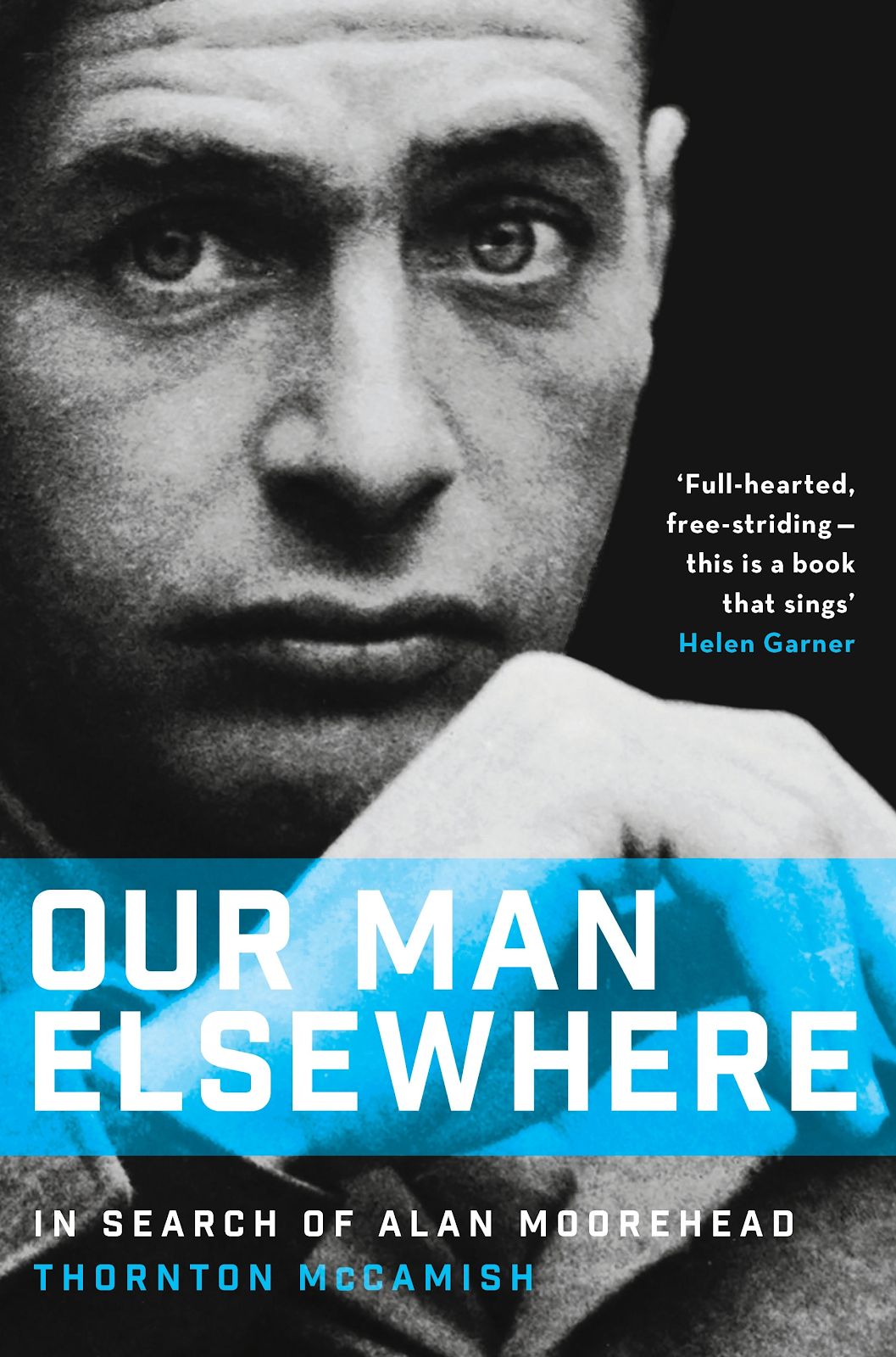
Book Review - Our man elsewhere by Thornton McCamish

Our man elsewhere : in search of Alan Moorehead by Thornton McCamish

Carlton: Black Books Inc., 2016                  ISBN 9781925203110


In the acknowledgements at the end of this book, Thornton McCamish calls his effort a "sort-of biography", which I guess is true, but sells this well-written and entertaining book short. Part detective story, part hagiography, part travel diary, this book about one of Australia's most well-known post-war writers begins by trying to understand a mystery, a mystery that has also intrigued me a little over the years, and a mystery that drove McCamish to great lengths.

Alan Moorehead, at the peak of his powers in the early 1960s, was one of the best-known writers in the English-speaking world, mentioned in the same breath as Hemingway (they were friends, of a sort), and whose latest tome was eagerly awaited by both publishers and readers alike. His version of history as travel, with a bit of himself thrown in, had no equivalent in his own time, and few equals since, and there have been many who have tried to capture the essence of his writing in their own, and failed.

The mystery that McCamish outlines at the beginning of Our man elsewhere is how someone like Moorehead could - half a lifetime after he stopped writing - now incite a response of "Alan who?" if mentioned in conversation, particularly in his home country of Australia (McCamish too is Antipodean).

Like McCamish, I have a deep affection for Moorehead's work. Unlike McCamish, I came to him first through his later books such as The White Nile and Cooper's Creek. McCamish first came across his war writing in the African Trilogy and was instantly swept up by the power of his prose, and the seemingly effortless way he transferred experience to paper. This began a multi-year process of trying to track Moorehead down in archives and on the ground. It seems that at some stages this activity became almost an obsession for McCamish, rather than merely research for a book.

As McCamish gets further into his subject, the reader travels with him across Europe, experiencing his personal reaction to the various revelations he has while walking in the footsteps of his hero. We learn that Moorehead was desperate to leave Australia, and when he did in the mid 30s, his luck landed him on the doorstep of the opening salvos of World War Two.

McCamish, even though he clearly has great respect for his subject, is not averse to describing his less-than-perfect traits, one of which was his pushiness. This characteristic - much unloved by the Englishmen around him - enabled Moorehead to get on the ground in Egypt to witness the Western Desert fighting. When he arrived there he was a working journalist, unknown outside his newspaper, and one of many war correspondents assigned to the theatre. By the time the campaign ended with Allied victory, his byline alone was selling papers, and his successful war books were being put through the presses.

While he was covering the war, he was also having a good time. McCamish conveys the almost University College-like feeling of men being together all for a common purpose, with the danger and discomfort adding to the cameraderie. For Moorehead, it was also like the University education he never received, spending much time drinking and arguing with his contemporary English correspondents, and learning much about the world, literature and history.

At the end of the war, Moorehead was determined to make his mark as a writer, but floundered for the next decade, producing several poor novels (McCamish, ever ready to praise Moorehead's writing, can find little good to say about these efforts - I'm glad he read them so I don't have to), and surviving on articles for magazines such as the New Yorker and others.

He gradually came to realise that his forte as a writer was non-fiction, and over the period from his highly praised book about the Gallipoli campaign to the release of The White Nile he found his true metier - narrative history with an "I was there" feel. His ability to describe places, imagine a place in time and to sketch character, all developed in the crucible of war, were now put to good use, and both The White Nile and The Blue Nile were bestsellers.

As well as these successful books, Moorehead continued to write articles for magazines, and tried (and failed) to get into writing for films. He travelled constantly, but his home base was a house he built in Porto Ercole in Tuscany, and on his brief soujourns there he hosted a constant stream of writers, actors and other members of high society who came and spent time with him. It was a good life.

Writing the book about Gallipoli brought Moorehead back to Australia: when he left in the 30s, he cast aside his home country, to the extent that he even changed his accent. In the early 50s he returned for a short period to write a book aimed at the overseas market (Rum Jungle), which did little to endear him to the Australian literary scene, as it was then. After he finished the Nile books, he was searching around for a new subject, and his friend Sidney Nolan (Moorehead was on friendly terms with many artists) suggested the Burke and Wills story as suitable. The result was not only Cooper's Creek (still the best treatment of the Burke and Wills expedition), but a realisation by Moorhead that his home country did have a lot to offer a writer. True, it had no long human history in the European sense (which is why he left in the first place) but it was a country that was still in the process of creating its (white) mythic stories, and those stories contained much that was of interest to a writer.

This homecoming for Moorehead was therefore a physical and a psychic one, and he was finding his endless wanderlust was passing (his other desires however were another story; an inveterate womaniser, McCamish deals with Moorehead's numerous affairs and flings with honesty and tact).

Then tragedy struck - the stroke he suffered at the end of 1966 stopped his writing for the rest of his life, and meant that his final 15 years were one of limited horizons: he couldn't really communicate much verbally, was essentially unable to read and could not write (he could however, paint, with his left hand). The fact that he published two further books is down to his wife Lucy, who managed to gather together and edit material that emerged as Darwin and the Beagle and A late education. Lucy comes through  in this book as an equal partner in the Moorehead "business" - since the war she had been essential in his output - typing, editing, dealing with publishers and making sure business was finished, as Alan was travelling and writing.

All of this is related by McCamish in an easy-to-read way; interspersing his own story of tracking down his hero and revisiting places Moorehead stayed or visited and comparing the now to the then. Once into the book the reader realises that what McCamish is doing is writing a Moorehead book: a narrative history with a present-day "I" at the centre. It is a touching tribute to Moorehead, and a successful one too - many books of this type fail because the "I" becomes too intrusive, but invariably in Our man elsewhere McCamish's appearances add to, rather than detract from, the story.

The quibbles I had with the book were few - a couple of editorial mistakes (Frank Clune, not Cluny, and I couldn't find the article in Horizon  magazine that was mentioned) and a very occasional slip in McCamish's evocation of the past (in Melbourne in the early 60s they would be drinking Claret and listening to the wireless, not Fruity Lexia with a radio). McCamish has a wonderful way of expressing what it's like to research thoroughly for a book; I loved how he hated to see the name Morshead in the index of books because it meant there was no mention of his pet subject (resonating with me because I'm often looking  for Morshead and am annoyed at Moorehead appearing!).

McCamish also had problems with Moorehead's view on topics such as native Africans and Australian Aboriginals, wondering why Moorehead wasn't more progressive, but he was certainly a man of his time, and a man of Empire toboot, so it would seem to me that his views were of a piece with that. Where Moorehead was ahead of his time was in his views on conservation, with No room in the Ark and The fatal impact years ahead of their time in their description of man's impact on other life. It would have been interesting to see how Moorehead's writing developed in that area if he hadn't had his stroke.

As with all good biographies of writers, Our man elsewhere reminded me of what I should revisit, told me things I didn't know (i..e. that he didn't die until 1983!), and has driven me to some of Moorehead's work that I hadn't read. By the end of the book, as McCamish revisits the Moorehead archive at the National Library of Australia for one last time, he himself seems to reach the end of his obsession, and can comfortably close the cover on what is an interesting biography of an interesting man.

Highly recommended.


Cheers for now, from
A View Over the Bell

Friday, 10 June 2016

Book Review - The Day of the Owl / Equal Danger by Leonardo Sciascia

The day of the owl / equal danger by Leonardo Sciascia, with an afterword by Frank Kermode

Manchester: Carcanet, 1984                           ISBN 0856355666

Sicily is a unique place, historically, geographically, and socially. Those three aspects have intertwined to give the world some of the most horrible (mafia) and wonderful (cuisine) things. It has also given us some very good writers over the years, Leonardo Sciascia being one of them.

What he writes about in these two novellas is a state of mind, a culture, that is Sicilian. Nothing is as it seems, and the honest man is at a disadvantage not necessarily because he is honest or principled, but because no-one else can believe that he can be honest and principled.

In both these novellas, the main protagonist is a detective who is investigating multiple murders, and in both stories the detective is the only person involved who is disinterestedly searching for the truth of the matter.

What Sciascia lays bare in both books is the workings of the mafia system, which pervades all layers of society, including the pillars of the law. Both the mafia and the judicial system have their own mores, and those that don't fit in are excluded, via exile or the dreaded lupara. Bellodi, the police captain investigating the murder of a businessman in The day of the owl, causes much consternation because he doesn't follow the "script" - the police want the easy way out and a quick conviction, regardless of the facts, and those politicians in Rome that help the mafia become more and more concerned as Bellodi's investigation begins to get too close to home. As the story unfolds we see that Bellodi has cleverly got to the truth, but, being a "mainlander" and not well-versed in the ways of Sicily, we see his work fall apart through the machinations of those higher than him, and the story ends with him back in Parma as his case dies, yet he is determined to return to the island "Even if it's the end of me.".

In Equal danger Inspector Rogas has a very illuminating discussion with the President of the Supreme Court, where the President espouses the view that judges can by definition never be wrong: like priests delivering communion no matter how flawed, the fact that justice has been dispensed makes it right. This, well into a story where state powers are doing everything to move the investigation of the murders of several lawyers and judges in the direction that they want it to take to fulfill their pre-arranged narrative.

"But Rogas had principles, in a country where almost no one did." Those principles lead Rogas to investigate these crimes based on the facts, rather than pre-suppositions. What the reader sees in Equal danger is how power can subsume those with principles, and eventually drive them mad.

So these are "detective novels" with a difference. The social comment is severe, yet ironic and elusive, two factors heightened by the cryptic author's notes at the end of each work. It is the language - even in translation - that is the highlight of Sciascia's writing: his desriptions of the sere, bare landscape and people, the allusive language of hint, metaphor and suggestion, all add to the sense of foreboding and inevitable failure that hangs over the protagonists of these stories.

Sciascia has an excellent reputation, and reading these it's easy to see why.

Recommended.


Cheers for now, from
A View Over the Bell

Wednesday, 24 June 2015

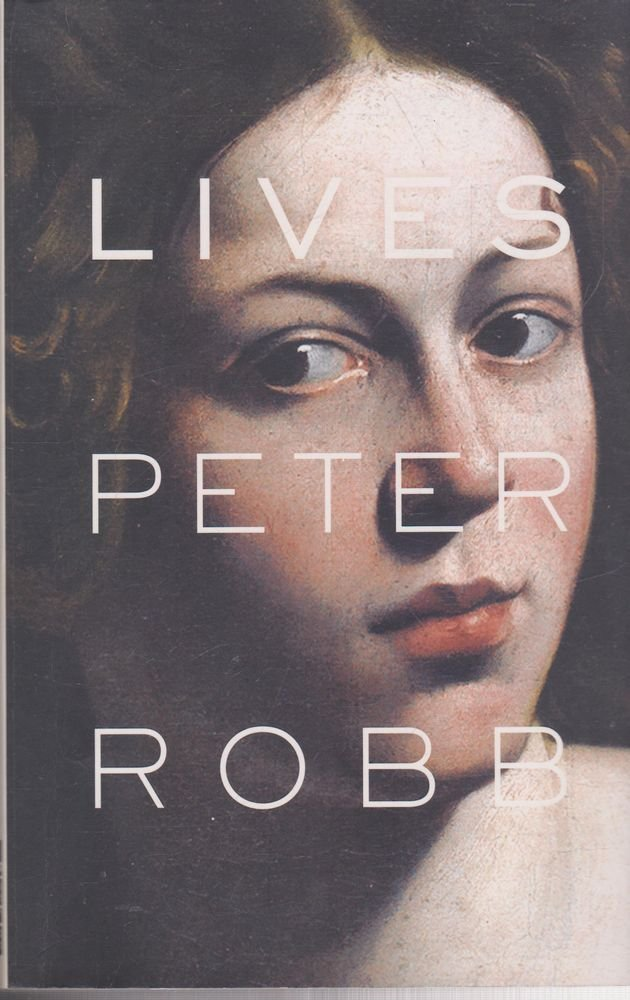
Book Review - Lives by Peter Robb

Lives by Peter Robb

Melbourne: Black Inc., 2012                      ISBN 9781863955638


Those who have read my review of Midnight in Sicily will know that I rate Peter Robb very highly as a writer. The works of his that I've read have certainly weaved a web in my brain - they have been hard to forget, mainly due to Robb's limpid style, within which the reader is afloat on a sea of words, beautiful even when describing horror. Robb tends to write about ambiguous or mysterious situations, and it's clear that he is fascinated by things that fall through the cracks, or are not quite what they seem.

Lives is a collection of Robb's shorter non-fiction; as his thankyou note in the beginning of the book elaborates, most of these pieces made their first appearance in magazines and newspapers. Thankfully - for the most part - Robb's facile yet deep style is unaffected in a shorter format. The book is divided into three sections: Australia, Italy, and Elsewhere. While these groupings are obviously geographic, there is nothing really homogeneous in the lives that are investigated within these pages. Many of the pieces are to do with people working in the arts (actors, film-makers), some are book reviews, and some are reportage. Some articles give the reader a new view on a person they thought they might know fairly well, some introduce the reader to a person they'll want to know more about, and some give the reader the complete picture.

Interesting pieces for me in the Australian section were on Julian Assange: a double book review, but also a psychological insight into the man himself, an extended piece on Marcia Langton, and a wonderful combined travelogue, interview, political commentary and film discussion revolving around a road trip with Ivan Sen.

As you would expect, the section on Italy covers everything from the wonderful Baroque art in Rome to the machinations of the Mafia. These musings are covered in articles ostensibly about Robert Hughes' Rome, The Leopard, and articles about Fellini, Pasolini, and other less well-known figures in Italian art and law.

The Elsewhere section is even more eclectic, running from Joseph Conrad to Gary Gilmore; the Gilmore piece being a perceptive appraisal of Norman Mailer's work, and another reminder to me to add Executioner's Song to my to-read list.

Perhaps the piece I liked best was the one entitled Jilly, which consists of extracts from Robb's diary, mostly about the comings and goings within the block of units in which he lives. As with all Robb's work, it's hard to know what's real and what isn't, what is observed fact and what is imputation - an insight into an author who is always trying to look under the surface, and make connexions between people and events.

Well worth picking up and reading, even if only in part. Recommended.


Cheers for now, from
A View Over the Bell

Monday, 23 February 2015

Book Review - Mafia brotherhoods by John Dickie

Mafia brotherhoods : Camorra, mafia, 'ndrangheta: the rise of the Honoured Societies by John Dickie

London: Sceptre, 2012.                         ISBN 9780340963944

As any reader of my blog may have surmised, Italian organized crime is a reading interest of mine. I've reviewed both Midnight in Sicily and Mafia Republic in the last couple of years; the latter work also by Dickie, covering the history of organized crime in Italy since World War Two. Mafia brotherhoods is Dickie's history of the three main criminal societies from their birth up until the War. It is a highly engaging book, packed with incident and characters, based on sound scholarship.

Dickie explains that of the three societies he deals with, it was the Neapolitan Camorra which appeared first, in the prison network - the prisoners ran the jails, and the Camorra controlled where you slept, what you ate and wore, all for an appropriate fee. Dickie explains that the upheavals that occurred during the Risorgimento that allowed the Camorra and Cosa Nostra to enmesh themselves in the outside world. All three societies major crime was that of running protection rackets, with the Camorra also engaging in pimping.

It was Cosa Nostra in Sicily who were the first to realise the importance of entwining themselves with the forces of government for their own protection, and had a better idea of when to keep their heads down. In Naples, the different structure of the Camorra led to it being more exposed to law and order activities. Meanwhile, back in Calabria, the 'ndrangheta learnt a thing or two from jail time spent with other mafiosi, and set up a society that in some ways was more rigid than the other two.

Dickie builds his narrative around stories of law enforcement and trial transcripts, which lead the reader to ask themselves two questions. The first is why it has taken Italy so long to come to grips with these criminals when right from the earliest times the powers of law gathered enough information to know a lot about these groups: how they were structured, the crimes they committed, even on occasions their member's identities. It is clear from Dickie's history that the various mafia societies pulled in their favours, and at times lay low for a time, as they knew the body politic would soon move on. They also assiduously fostered the myths about the mafia; that it was a way of looking at life rather than an organized criminal syndicate, or that it was a product of prejudiced Northern Italian imaginations.

What is harder to grasp is why the state so quickly forgot what it found out, often at great cost. Did they just not see it as important, or could they not bear to face the truth of the cancer at the heart of their state? Or was it something more insidious?

As the citizen of a country that has a fine tradition of British law, I found Dickie's reference to trials interesting. Obviously Italy's legal system is different, but Dickie's continued reference to historians happening on trial transcripts, or of them being non-existant, seems odd, and disturbing. These trials all occurred less than 150 years ago, and many of them after World War One. It seems amazing that there is no index of cases or some other device for the judiciary to see what's gone on before. So, rather then building a body of knowledge about the mafia, the legal system started from scratch each time - Dickie describes the depressing detail that the diagram of the mafia that was proudly shown to the world in 1992 during the trial initiated by Tomaso Buscetta's confession was identical to a diagram included in a 1938 report prepared by the Fascist government. The continual change of governments after World War Two did not help in the task of keeping pressure to bear on these groups. As Dickie points out, while crime-fighting was a tactic of various governments, mafia societies have a long term strategy, which put them in a position to defeat whatever cane against them.

It seems that the glory years of the mafia finally may have passed, with the Italian and other governments finally taking a long-term view of the problem, and disrupting these societies more regularly and more successfully in recent years. Taken together, Dickie's books (which also include Cosa Nostra), provide the reader with a comprehensive history of the mafia in Italy.

Recommended


Cheers for now, from
A View Over the Bell

Tuesday, 24 June 2014

Book Review - Mussolini's Italy by R.J.B. Bosworth

Mussolini's Italy : life under the Fascist Dictatorship, 1915-1945 by R.J.B. Bosworth

New York : The Penguin Press, 2006                                         ISBN 1594200785


It's no surprise that such an interesting and thought-inspiring book about Italian Fascism has been written by Richard Bosworth, who wrote an acclaimed biography of the Duce several years before he wrote this work. What is a little more surprising (to me anyway), is that Richard Bosworth is a history academic from Perth, Western Australia.

Be that as it may, the book under review is a fascinating and enlightening approach to the history of Fascist Italy. It is not a book for someone clueless about that period in that country - I thought I knew a fair bit about the subject, but still found myself occasionally referring to other texts while I was reading this book. That is because this is not a standard narrative history, but one historian's view of events as they related to the "average person" who was living through these events. Bosworth has skillfully used records from the Italian secret police archives to flesh out the social and political issues of the day.

The problem Fascism had throughout it's time in Italy was two-fold....they weren't sure what they stood for, and they failed to impose themselves into the strong and ancient fabric of Italian society.

Those of us who live in the "ancient" democracies, such as the USA, Britain and Australia, can have a tendency to forget that democracy in other places can have shallow roots. Italy was one of those places - as a country Italy was barely 50 years old at the beginning of the First World War. The Italian society and polity were not prepared for the slaughter that came to them at battles such as Caporetto, and the Liberal government's decision to enter the war for essentially shallow reasons of territorial greed left them bereft in the nation's eyes when the gains did not come. The war had instilled in those who served a sense that the Italian state could be much more than it currently was, if only the current system disappeared.

And so began the early post-war years, when ex-servicemen joined together in fasces, which varied from what were basically armed gangs to groups of people who wished to change the direction of politics. This idea that the original Fascists were a mixture of thugs and pseudo-intellectuals is in Bosworth's eyes more-or-less accurate, and the birth of Fascism as knowing what it was against, but not necessarily what it was for, led to the path of demagoguery and corruption.

Mussolini emerged as the Duce, but as dictators go, he seemed to have a fair sense that he was not fully in control of things in Italy. He was right. Many of the Fascist fellow-travellers started to fill their own pockets, and those of their connections, once power was in their grasp. The concept of raccomandazione - or seeking favour with those in power via your connexions or through sycophancy - was in Italy as old as the Roman Empire, and, despite early attempts by the Fascists to eradicate it, became firmly entrenched in Fascist life.

The one thing that the populace might have hoped to gain from Fascism was a better standard of living. The shambolic nature of the system meant that even this did not happen - the poor remained poor (and got poorer), the rich came to their accommodations with the regime (as the regime did with them), and life went on pretty much as usual; although there were more parades, and you could shop someone to the secret police at any time (although raccomandazione used well could get a sentence reduced or even quashed).

The problem of what Fascism stood for gnawed at the regime as well - the corporatist nature of Fascism as we understand it now developed slowly in Italy - the "socialist" word was used south as well as north of the Alps - although the anti Bolshevik nature of the movement existed from the beginning. The one thing Fascism needed was to be seen to be continually moving forward - owing to its corruption and lack of ability that couldn't happen on the Peninsula, so the regime started to push its colonial and war-like nature. All the colonial adventures gave the regime in reality was the approbation of the World, more corruption, and additional drains on the already extended national exchequer. In the minds of those that mattered, unfortunately, it made them think they were stronger than they in fact were - which led to the disastrous decision to enter the Second World War.

The under-prepared and ill-equipped Italian armed forces became easy prey for the Allies (including Greece), and the War showed the shallow roots that Fascism had propagated in Italian society. Led by Nazi Germany (once they had committed to the Axis, Italy had little say in overall strategy), Italy declared war on the United States: given the strong connexions between Italy and that country, the (rather poorly planned) propaganda now lost all reality to the people, who had their own sources of information from overseas.

The inevitable collapse of Mussolini in 1943 had all the hallmarks of Fascism's ultimate effect on Italy - a populace who didn't want war, a ruling elite looking for a way out without disturbing their lives, and a Duce who was tired and cynical. In some senses it was a velvet revolution as no one was "liquidated", and Mussolini headed off to an internal exile.

This didn't suit the Germans at all, so they flew in and whisked Mussolini away to become the puppet ruler of the bit of Italy the allies didn't control. His heart wasn't in it, and this led to the Salo Republic being much more viciously Fascist, in the German sense, than the earlier regime ever was.

What Bosworth shows well is the eternal cynicism of the Italian populace. With a history of well over a thousand years of dealing with more-or-less dictatorial regimes, they were past masters at doing enough to get by and keep out of trouble, of working the system to their advantage, and hopping off the bandwagon when the time was ripe. This book in many ways is a history of the Italian people as much as it is of Fascism, showing as it does the regional differences, the divided loyalties and the networks that flowed strongly under the surface.

And my recommendation of this book is as an insight into Italy than specifically as a history of Fascism - although as an insight into how the ideology began, continued and stuttered, and how the roots of its eventual failure were embedded in its beginnings, there is much here of interest.


Cheers for now, from
A View Over the Bell