Showing posts with label Aboriginal History. Show all posts

Friday, 19 June 2026

Book Review - To the Islands by Randolph Stow

 To the Islands by Randolph Stow

Harmondsworth: Penguin Books, 1975 (first published 1958)     ISBN 0140700013

There can be little doubt that Randolph Stow is in the top tier of Australian novelists. His works are in turn spiritual, allusive and wonderfully descriptive. Tourmaline is one of the best Australian books I have ever read, and The Merry-go-Round in the Sea is universally recognised as a great coming-of-age novel. To the Islands is another remarkable book, and it's astonishing he wrote a novel with such insight into aging and the approach of death when he himself was only in his mid-twenties.

(Before I go any further I'll mention that Stow heavily revised his novel for the 1982 re-publication: this review is of the first version of this book, published by Penguin in the 1970s.)

Stow quickly sets the scene in this book: a remote mission settlement in the north of Western Australia, where the long-serving superintendent Heriot has lost his faith in the ability of the government or the church to improve the conditions of the native inhabitants. We learn that he lost his wife and pregnant daughter over the years, believing his daughter was killed by her husband Rex. We learn in the first pages that Rex has just returned to the mission for the first time since Heriot's daughter's death.

When Heriot hears of Rex's return, his bitterness and anger overflows, and in a fit of anger confronts Rex during a cyclone and leaves believing he has killed him. He flees the mission during the storm, but is followed by one of the natives, Justin. Heriot had intended to commit suicide, which Justin's presence prevents, and so they journey through the country together. The journey, for Heriot is physical, mental and spiritual. He by turns strips away the layers of his personality, his grief and his anger. He is assisted in the process by Justin's presence - Justin's purity of spirit and focus on what is important in life help Heriot to move to a place of peace, where he no longer is angry with what has happened to him, or at the petty injustices that occurred during his life. At the end, by the sea, almost in sight of the Islands (the mythical Islands that the dead travel to in the native beliefs of the area), he is ready to pass on, acknowledging that "my soul is a strange country."

Interspersed with Heriot's journey is the story of the search for him undertaken by staff and natives from the mission. It turns out that Heriot's attack had not killed Rex, who joins the search, reflecting on what he has done wrong and hoping for a reconciliation, which does occur after a fashion.

To the Islands is many things, one of which is a foray into and an examination of the ethics of white colonialism in Australia. As the narrative develops, we learn that Heriot originally joined the mission to expiate the racial guilt he felt over not being able to forestall a massacre of the local black population which occurred in the 1920s. Heriot was the first of a new generation of whites that entered the black story at that time, determined to help Aborigines rather than kill them, even if that help was paternalistic and ineffective. Now, at the time described in the book, Heriot is the last man standing of that generation, and dealing with the ascent of the next generation: moving from paternalism to a more partnership-based relationship. The Aboriginals too, embodied in the character of Rex, are becoming more assertive in that relationship, beginning to demand to be heard, and to have agency in their own lives.

Heriot has spent so long and put so much into the mission that it has hollowed him out - he cannot connect with the new generation of white residents, but because of the approach the mission took with the natives he has no true and meaningful friendships with them either, even though Stow makes it clear during Heriot's journey that Justin, with his uncomplicated loyalty and love, could have been such a friend.

Stow captures and describes many things in this book - the tragedy of the circumstances of the native peoples, the experience of a man losing his reason to live and suffering a complete breakdown, the feeling of despair that comes when there is nothing to be done. The simple depth of this story is wonderful - I emphasise that Stow was only about 23 when he wrote this, which takes my breath away.

Stow's skills in descriptive writing are immense - this is a big story in a short book, with description of the physical world and the mental world within concise, but with a limpid clarity that makes you go back to try and work out how he did it.

This is a marvellous book. Highly recommended.


Cheers for now, from

A View Over the Bell

Saturday, 7 February 2026

Book Review - Wings of the Kite-Hawk by Nicolas Rothwell

 Wings of the Kite-Hawk: a Journey into the Heart of Australia by Nicolas Rothwell

Melbourne: Black Inc., 2009* (first published 2003)               ISBN 9781863954457

Recently, in a book of essays by Tim Parks, I read of his contention that all great literature is trying to come to terms with death, and that all great writers tend to return to one great over-arching theme throughout their works, however varied they may seem to be on the surface.

If that is the case, then Wings of the Kite-Hawk is great literature, and Nicolas Rothwell is a great writer. Many years ago I read his book Quicksilver and felt I didn't really grasp what he was getting at, but after reading Wings of the Kite-Hawk I feel that I have moved closer to what Rothwell is trying to express in his writing.

Rothwell enters the desert country of Australia on a search for meaning: "... the desert always gives those who search in its emptiness the dream, at least, of their desires." Rothwell's dream is to reconcile his life with the never changing rhythms of the desert. He wishes the desert to enter him (as all those who have spent time there wish).

Particularly, as an emigrant to Australia, he tries to find his way into the country through his fellow emigrants, the explorers. Through long meditations on the lives and explorations of Leichhardt, Sturt, Strehlow and Giles, Rothwell muses on life, on dreams of success and the reality of failure, and on the certainty of death - "[y]ou're much closer to death out here than in the city; you can feel it bending humanity to its will." 

The four explorers Rothwell chooses to focus on had a desire for death haunting their lives: Leichhardt, that strange visionary who has haunted the minds of white Australia for over a century and a half, actually did meet his demise in the back country - a demise that one feels he was actively seeking.

Sturt's voyage to the Inland Sea - a romantic folly that ennobled those that undertook it - was a doomed voyage that seemed made for the times. What was Sturt seeking? It surely wasn't an actual sea, which it seems he knew wasn't there: in leaving his wife and child, what was he doing? Rothwell speculates - "[w]here was he bound? Like every noble or beautiful thing, to the kingdom of death - that kingdom he longed to see with his own eyes, to endure, and to return from, with golden words upon his lips." He of course did return, unsuccessful, and with no golden words for recompense.

Strehlow was an explorer of culture rather than land, famously working his way through the traditions of the Aranda people. He eventually saw himself as the keeper of their traditions and (in)famously collected and photographed many sacred objects and events. He spent his life amongst the Aranda, but in the end completely failed to understand the culture he felt he was a part of. Rothwell describes in his recollection of the sale of the Strehlow Collection how Strehlow's efforts to preserve a people and their culture led only to fracture and decay. 

Rothwell himself as represented in Wings of the Kite-Hawk mainly interacts with white residents of the Outback, all the while understanding that it is the Aboriginal people who fully understand the country and its dreaming. In the cast of characters that cross his path, it is those who have absorbed some of the ancient learning that connect most with the spirit of the country which, for Rothwell, is embodied in the Kite-Hawk.

These birds permeate the story of Rothwell's journey: from being a sign of good fortune to a presager of death when his colleague Esterline hits and kills a Kite-Hawk with his car and bewails the bird's and his own demise (when he perished in the desert soon after killing the bird).

I think it is in the story of Giles that Rothwell finds a character most in tune with his own quest. Late to the country, Giles never gets to make a discovery that others would recognise as great or useful "...for in its last phases exploration, like life, becomes a retreat, a silence, a turning in."

In the end, despite his hopes, Rothwell does not find the answer to his quest in the lives and deaths of the explorers as he had hoped. Like him, they traversed across the country rather than into it. It is rather the encounters that Rothwell has on his journeys with those that have embedded themselves into the desert that show him the way. Enlightenment and peace will come if you let them, but not if you chase them.

A deservedly praised book: history, philosophy and a life-lesson. Highly recommended.


* The 2009 edition of this book has new foreword by Pico Iyer and preface by Rothwell that both shed light on what Rothwell was hoping to achieve with this book

Cheers for now, from


Tuesday, 23 December 2025

Book Review - A Concise History of Australia by Stuart Macintyre

 A Concise History of Australia by Stuart Macintyre

Melbourne: Cambridge University Press, 2016 (4th edition)        ISBN 9781107562431

About a third of the text in this book covers events in my lifetime, which I guess says two things - one, that I am getting old, and two, that this book is a "front-forward" history. Macintyre is a well-known Australian historian, who was part of the famous "History Wars" that occurred in this country early this century.

This book, part of a series of concise histories commissioned by Cambridge University Press, breezes through thousands of years of Aboriginal occupation of the country before covering the history of the European conquest, colonization and development of the country.

This book is mostly a political history - it glosses over the social - I felt as a reader that I didn't get a sense of how people were living on a day-to-day basis. For instance, the central role of sport in the social make-up of the country is hardly mentioned, and the churches are more often mentioned as sources of division than of inclusion and provision of welfare.

As a political history, it seems to me that Macintyre's personal politics are on display too much in what is meant to be a general history for the average reader. One comes away from this book feeling that there is and has been nothing good produced by the conservative side of politics, or by business interests, and that the left, and the working class, have been nothing but noble in their pursuits.

This bias cruels the history in a few ways: Macintyre gives too much emphasis on events and movements that were peripheral to mainstream Australia, such as the Unemployed Workers Movement and the New Guard in the Depression. He also fails to explain why the conservatives have been so successful throughout Australia's political history if they were such a reprehensible group of people - is he suggesting that Australia's polity is irredeemably stupid? Or could it be that the majority of people, for the majority of the time have on the whole preferred what the right has to offer them? This seems to be a conclusion that Macintyre cannot accept.

Generally speaking, Macintyre's history paints Australia as a plaything of Empire (Britain or the USA) or of greedy elites, either Liberal or Labor. He seems to belittle the hard work of those everyday people who actually built the country that we know today, and who sacrificed themselves in so many ways to create a better life for their successors. While he details the many mis-steps that have been made along the way, he does not describe the successes in as much detail.

If I was someone who knew nothing of Australian history and I had only read this book, I would look around at today's Australia and wonder how we got to where we are, given what Macintyre has described. This is not a history that can be read as a stand-alone tome. Alternative views must be sought to get a rounded view of the singular history of this country.


Cheers for now, from
A View Over the Bell


Wednesday, 15 October 2025

Book Review - Frontier by Henry Reynolds

 Frontier: Aborigines, Settlers and Land by Henry Reynolds

Sydney: Allen & Unwin, 1996 (first published 1987)       ISBN 1864481919

Henry Reynolds has been working in the field of Aboriginal History for a long time, and was a force in the push to gain recognition for Aboriginal land rights in Australia. His book The Other Side of the Frontier was one of the first histories to investigate interactions between Aboriginal Australians and the first settlers. Frontier, the book under review, is a look at not only the settlers view, but a dive into how it came to be that Aboriginal rights to land had (at the time of its publication) never been recognised here.

It's mainstream knowledge now that the colonization and settlement of Australia by the British came at the expense of the blood of Aboriginals, and that land was expropriated from them in the process. However, when Reynolds began publishing, the opinion held generally in the wider Australian polity was that Aboriginals didn't have a concept of land ownership, and that any loss of life was due to regrettable incidents of misunderstanding.

Reynolds clearly shows from the European perspective that the early settlers knew quite clearly that Aboriginals did have a concept of ownership of the land, and that they were prepared to fight for their right to continue to live on and utilise their tribal territories. Many of those early settlers and Government officials also knew that the settlers were in many cases killing the inhabitants of land they were taking up rather than acknowledging that it was they that were stealing.

Reynolds shows how notions such as the "noble savage" and "Social Darwinism" were used as a post facto justification of dispossession and murder. He also explains how the British idea that property was sacred under law and was seen as inalienably arrogated to the owner - totally counter to Aboriginal ideas - led to Aboriginals being sidelined in their own land.

Some people tried to ameliorate the situation, and indeed tried to ensure that the original inhabitants of Australia could have rights to access and continue to own the land that was theirs, but were stymied time and time again essentially by the land greed of the settlers.

What is surprising to the reader of this work in 2025 is that for a large period of White Australia's history much of this had been "forgotten" in the official narrative of settlement and colonization of the country. Reynolds shows that the concept of "terra nullius" was not ever espoused by the first settlers - in fact there was very little official documentation of land rights, and what little there was recognised Aboriginal rights to use land, at least for traditional activities. He points out that other colonial jurisdictions had worked through the implications of settlement in law, but Australia for many reasons never did.

Of course it was not long after this work was published that Australia finally did acknowledge the concept of continuing Native Title to land, and there has been much development in that area since.

This book is pretty easy to read - it is a polemic in some senses, but rooted in sources, although I found the way the notes were printed in this edition somewhat hard to follow. There is a good bibliography.

Many other historians have built on Reynold's legacy - while Frontier might have been seen as ground-breaking in its day, much of what is discussed in this book is now a commonplace of discussion in the history of this country.


Cheers for now, from

A View Over the Bell

Friday, 27 September 2024

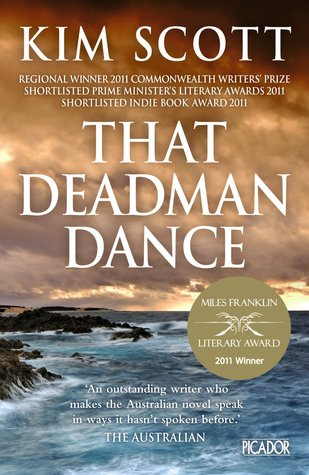
Book Review - That Deadman Dance by Kim Scott

 That Deadman Dance by Kim Scott

Sydney: Picador, 2011 (first published 2010)               ISBN 9780330404235

The blurb on the front cover of this paperback edition, (from a review in The Australian newspaper) gushes "An outstanding writer who makes the Australian novel speak in ways it hasn't spoken before." Alongside this quote is information telling the reader that not only was this book shortlisted for the Prime Minister's Literary Awards and shortlisted for the Indie Book Award, it was the regional winner of the 2011 Commonwealth Writers' Prize and won the 2011 Miles Franklin Award.

So the question needs to be asked - does it live up to the hype? Well....it's a much better book than some other Miles Franklin winners that I have read, but I really don't think the book "... makes the Australian novel speak in ways it hasn't spoken before." In fact in some ways I think That Deadman Dance travels a well-worn path in Australian literature, albeit with a slightly different focus.

After all that preamble, I will state up front that this is a good novel. It's well written, well paced, and evocative. The story it tells is interesting and how it is told adds to that interest. I found the ending unsatisfactory and a bit formulaic, but others may not see it that way.

Simply put That Deadman Dance is a story of the early settlement by white men of the southern coast of Western Australia (Kim Scott is an indigenous man of that area). The story is told mostly through the lens of "Bobby" Wabalanginy, who begins the story as a precocious orphan taken under the wing of the military surgeon of the initial British party to land in Bobby's tribal area, setting up the settlement of King George Town. The surgeon, Dr. Cross, is careful to treat the Aboriginal people well, fully understanding that without them and their assistance the white men cannot hope to survive. The passage of time that occurs during this novel shows the unravelling of this initial partnership, where give-and-take between the two cultures changes to the whites taking from the blacks without any recompense.

Scott's tracing of Bobby's life, from being an indispensable bridge between black and white as well as an important worker for the settlement in their efforts to expand pastoralism and whaling, to him ending up a tourist attraction telling his stories after leading what was effectively a rebellion against the white takeover of his land, contains pathos and humour.

Geordie Chaine, who befriends Bobby after the death of Dr. Cross, is the white man who builds King George Town and the surrounding area up from "nothing", to the thriving settlement it has become by the end of the book, is a sympathetically written character. The reader knows that he thinks the blacks are a lower order of people than white, but he is happy for them to live alongside his world as long as they are "useful". He is genuinely sad when Bobby leads his people in stealing food, but completely fails to understand, unlike Cross, that he had stolen everything from Bobby's people when he fenced the land for his stock, killed all the wildlife to feed the whalers who were overfishing the seas. When imprisoned for stealing stock and provisions, Bobby explains how he must feed his people, and when Dr. Cross and the white men came Bobby's people shared the land, and he is merely doing the same now with the white man's stock and stores, given the land has been stripped bare of traditional food by Chaine and his compatriots.

Scott suggests in the novel that it could have been different. Jak Tar, a deserting whaler, partners with Binyan, a local Aboriginal woman, in a loving relationship. While their love transcends their cultural differences, it is not only the white people who spurn the two of them: the elders of the tribe do as well. It seems that mutual understanding can only reach so far.

This area of Western Australia, as Scott notes in an afterword, is sometimes known by historians as the "Friendly Frontier", as there was very little fighting between black and white. As Scott makes clear though, even without such skirmishes many indigenous people died from disease (as did whites), and the resulting dispossession was no different to other areas.

Scott is skilful in his characterizations. Bobby is a wonderfully drawn character, interested in everything and everybody, and everybody interested in him and what he does. He is a joyful and positive presence even when things are going badly. Dr. Cross and his good friend Wunyeran represent first contact in a positive light, while Menak and Chaine well represent the respective feelings of both sides as settlement became more permanent. Chaine's daughter Christine, who grows up with Bobby, is also well-drawn, in her confusion of her place in the world, and Bobby's. Each of these characters along with the ex-soldier Killam and the ex-convict Skelly represent a part of a wider narrative, but none are cardboard cut-outs - Scott writes well.

So, has this novel broken new ground, as the blurb on the cover might suggest? No, not really. But, it is certainly a good story well written, and one that will stay with me for some time. Recommended. 


Cheers for now, from
A View Over the Bell


Tuesday, 2 February 2021

Book Review - To Ayers Rock and Beyond by W.E. (Bill) Harney

 To Ayers Rock and Beyond by W.E. (Bill) Harney

London: Robert Hale Limited, 1963

If you are thinking of travelling to Uluru (Ayers Rock), it would be worthwhile to read this little book before you go. Written by Bill Harney, who by the time he wrote this was a well known author of books about Central Australia and Aboriginal life and lore, To Ayers Rock and Beyond is a book written about aspects of his time as the first appointed Ranger of the Ayers Rock-Mount Olga National Park. While the book talks about the antics of the early tourists to the park, and some of the problems of transport and so-on that came with opening up the area to tourists, the book is mostly about the Aboriginal story of the area.

While Harney had spent a lifetime in Northern Australia, until he was appointed Ranger he had never been to Uluru, and he was determined to find out as much as he could about the Aboriginals of the area, and their stories and traditions. Like many white northern bushmen, Harney had a deep respect for Aboriginal Australians and their way of life, and he soon was able to spend time with local men, in particular Minyinderri, a Loritdja (Luritja) man, who could describe for Harney the dreamtime stories to do with Uluru and its immediate surrounds.

Harney spends a few chapters of this book writing about the mythical meaning of many of the features of Uluru, which has much to do with fertility and the beginning of man in that area. He describes how Minyinderri and his tribesmen, who had been living at a Mission Station some distance from their traditional lands, took some time to re-aquaint themselves with the Rock, before beginning to sing to the country, allowing Harney to transcribe some of their chants and ask as to the meaning of what they were singing. As with much Aboriginal mythology, there are many layers of meaning in their chants and singing, and what Harney describes is, I'm sure, the version that is allowed to be told to non-initiates of the tribe.

The latter part of the book describes a journey made by Harney to the Petermann Ranges, where he not only traverses the spectacular country, but learns from Djuwerri some more about the mythology of the area. Djuwerri had not been on his home country for many years, and the raw emotion that overcame him when they arrived on country is well described by Harney.

As with many books written about Central Australia in the late 1950s and early 1960s, there is an inherent sadness at the passing of one phase of Aboriginal life in the Centre. Much has been destroyed by the white man, and yet Harney can rest in the knowledge that the culture is hanging on, and even rebuilding.

This is the first book of Harney's that I have read: I had in my mind that he was a mere teller-of-tales, but this book is much more than that. It is a celebration of Aboriginal culture, as much as a white man of his generation could write. It is also a reflection on the clash of cultures; of white and black; what was passing; and some musing on what was yet to come (Harney was concerned about the commercialization of the Rock in the 1950s - imagine if he could see it now!). I will finish this review by quoting the last few lines of this book - 

"To me he [Djuwerri] epitomized the Australian aborigine. People who  helped us freely in the past, yet because of their colour and nomadic way of life, were on the scrapheap in our social structure.

Yet Welfare is moving on. Obstacles are overcome slowly. The pressure is on from both sides. When the day comes that we understand them as they understand us I hope they will have it in their hearts to forgive us our trespasses against them."


Cheers for now, from
A View Over the Bell


Tuesday, 16 July 2019

Book Review - My Country all gone the White Men have Stolen it by Fred Cahir

My Country all gone the White Men have Stolen it : the Invasion of Wadawurrung Country 1800-1870 by Fed Cahir

Ballarat: Australian History Matters, 2019            ISBN 9780646801780

This book is, as far as I know, the first attempt to provide a history (from the white man's point-of-view) of the contact between the colonial settlers of Victoria, and the members of the Wadawurrung tribe of Aboriginals, whose traditional lands ran from approximately Airey's Inlet to Learmonth, and east to Bacchus Marsh, including the areas now occupied by the cities and towns of Ballarat, Geelong, Ballan, Meredith, and Beaufort.

And a fascinating book it is. Cahir has searched through the archives to find reports of interactions with the Wadawurrung, from the earliest explorers, through to the height of the gold rush and after. The story is not a happy one for the Wadawurrung, nor for many of the white people who interacted with them, with dispossession and early death awaiting the Wadawurrung, and, depending on the person, guilt, anger or violence awaiting the whites.

The way any particular white person or family treated the Wadawurrung seemed to determine the way the Wadawurrung treated them. For squatters who aggressively kept them off their selections, the Wadawurrung may have responded with violence, but for those who understood that the land actually belonged to the Wadawurrung, and who treated them as fellow human beings, the partnership could be mutually beneficial - many Wadawurrung proved excellent pastoral workers, and the rations and care that those particular whites gave to the Wadawurrung helped them cope with the loss of their traditional hunting grounds, and the increasing scarcity of traditional food sources.

The other theme that runs through the extensive quotes from the primary sources that Cahir provides is that of cultural mis-communication, springing from the totally different social and legal frameworks that the Wadawurrung and the White (British) worked under. The Wadawurrung lived a traditional Aboriginal life of mutual obligation and kinship, and Cahir shows us through his quotations that they attempted to bring the early white settlers into this system, letting the settlers use the land, and offering assistance to them, but expecting reciprocity - that the settlers would give them food, clothing and equipment in exchange, and that they would give equally to the whole tribe. This idea clashed with the British concept that only those who "worked" got rewarded with "pay". Many correspondents Cahir quotes fail to understand why the Wadawurrung they interacted with were upset when only the men were given food if they had worked, rather than the whole clan.

The Wadawurrung did to some extent participate in the White economy, providing game for food, possum-skin rugs for warmth, and corroborees for entertainment. They soon moved beyond bartering to requiring to be paid cash for these items, although much work that they did on the stations was still for rations rather than money.

The discovery of gold changed Victoria hugely in a short time, and was not good for the Wadawurrung. By 1850, there was some kind of working arrangement between at least some of the squatters and the Wadawurrung, where the squatters provided food, and allowed some small depredation to their flocks, in the knowledge that the Wadawurrung could be called upon to help with herding and shearing. The Wadawurrung knew which squatters to avoid, and who were more friendly. The early violent interactions between Black and White - of which there had been a few - had ceased to occur in any way that could be considered a war over land. In fact there was beginning to be a push for the government to allocate land for Wadawurrung use, with the more enlightened settlers realising that they had stolen the land, and owed the Wadawurrung something more that they were being given.

After 1851, much of that was forgotten.  The influx of hundreds of thousands of gold-seekers in a very short time changed the face of Victoria forever. The towns that sprang up on the goldfields were dens of vice, which had a huge effect on Wadawurrung culture, and on the health of individual Wadawurrung people. It's fair to state that the moral and intellectual character of many of those on the goldfields was not high, and the mistreatment of the native inhabitants of the country was often appalling. The depredations that gold seeking made to the environment also took a heavy toll on the Wadawurrung, with many of their traditional camping grounds overtaken by prospectors.

The final destruction of any capacity to live in their traditional way, coupled with the temptations of alcohol and a sedentary life, had a deleterious effect on the Wadawurrung, with birthrates plummeting and death rates rising. From being an integral part of the country and economy of pastoral Victoria, the Wadawurrung became a quaint afterthought in goldrush Victoria. Cahir documents the continued lack of action from Government to assist the Wadawurrung to adapt and thrive in the new reality, despite advice from many whites on ways to help.

What is missing from this book, as Cahir notes in the introduction, is the unalloyed voice of the Wadawurrung themselves. Even when we "hear" them in the text, it is via their white interlocutors and reflected through the prejudices and proclivities of the writer, rather than being the true voice of the Wadawurrung. Cahir has skillfully dissected the white voices to try and get to some of the thoughts of the Wadawurrung, which I think is summed up in the title of the book. The British came, and took the Wadawurrung's land, and, from the quotations provided, Cahir shows that most of the settlers knew very well that they were taking land that belonged to someone else.

This is an important addition to the history of Aboriginal/White interaction in Victoria, and should be read by every person who lives on Wadawurrung land.


Cheers for now, from
A View Over the Bell
Thursday, 4 April 2019

Book Review - Sea of Dangers by Geoffrey Blainey

Sea of Dangers: Captain Cook and his rivals by Geoffrey Blainey

Melbourne: Penguin Australia, 2010         ISBN 9780143204893


The blurb in the front of this book points out that Geoffrey Blainey is "one of Australia's best-known historians." With over 30 books to his name, he has also been one of our most prolific. His academic career initially started in the field of Economic History, but he soon branched out into more general topics, with Mining being a particular interest, before in his late career writing some broad histories such as A Short History of the World, which sold very well.

Sea of Dangers is a return to the more specific, a history of Cook's "discovery" of Australia - mostly. The book is mainly about Cook's first voyage (1768-1761), but Blainey has intertwined the journey of Jean-Francois-Marie de Surville across the Pacific in the Saint Jean-Baptiste with Cook's story. Why has he done this? Because, although Cook was on a scientific mission and de Surville on a trade mission, they shared a similar goal - to find the "missing continent" "Davis Land", which was purported to exist in the South Pacific.

Although the two explorers never met, they were at one stage of their voyages within a few hours of each other, at the Northern tip of New Zealand, an absolutely extraordinary circumstance. Blainey notes that de Surville was also within a few hours of the Australian coast before he turned east to New Zealand: in fact he was so close that the crew could smell land.

So the question needs to be asked - why did de Surville spend so little time investigating new lands? The key is in the purpose of his voyage - to trade. Spurred on by the belief that Davis Land existed, and by stories emanating from the voyage of the Dolphin that Jewish traders from another land were seen at Tahiti, de Surville did not want to land on the coast of Australia, which others had written about as a barren land of no water, gold, or food, and with natives who were hostile and not interested in trade.

In fact de Surville's search for trade ended up severely hampering his voyage. With no incentive to stop for a long time at places he couldn't trade, his crew never had the chance to gather and eat enough fresh food to stave off scurvy and the other ills that beset a ship-bound crew in the Eighteenth Century. On several occasions he barely had enough fit men to crew the ship.

Nor was Cook's crew immune to the effects of scurvy. Despite what we think we know, on his first voyage Cook did not fully understand how to curtail the effects of this disease, and it was only his frequent soujourns ashore that saved much of his crew. In fact Blainey suggests that the holing of the Endeavour on the Great Barrier Reef was in some ways a blessing in disguise, as it enabled his crew enough time on shore eating fresh food to face the rest of the voyage.

Blainey, using the journals of Banks and Cook as prime sources, shows us a Cook that was methodical, usually averse to risk-taking, and willing to indulge his scientists as long as it fitted into his bigger plan. Blainey points out too that it was the scientific outcome of the voyage that was the highlight on the Endeavour's return - there was no real ballyhoo about the "discovery" of a new land. That was because of course Cook did not discover Australia, or New Zealand. What he did do though, and with a remarkable degree of accuracy, is map much of the coastline of both countries (While one could claim he "discovered" much of the East Coast of Australia, he knew it was there before he arrived, just not it's extent).

Blainey carefully describes the interaction of Cook and his crew, and de Surville and his, with the native inhabitants of the lands they entered. The mutual misunderstanding is well mapped out in the text, highlighting the effect that over 100 extra mouths to feed had on the locals. This quite often led to friction and occasionally conflict. Blainey notes the difference in attitude to the Europeans between the Maori and the Aboriginals, with the former keen to barter or to steal for European items, especially steel and iron, and the latter not interested at all.

Cook came home to praise and promotion, but what happened to de Surville? An altogether sorrier tale, after sailing the Pacific and not finding the hoped-for lost continent, de Surville sailed to South America, only to drown trying to enter Chilca Harbour. His crew were then kept captive by the Spanish for three years before getting home to France, with little to show for their time away. Unlike Cook, de Surville was not an assiduous chart-maker, so his voyage added little to the knowledge of the Pacific, and his name has faded into obscurity.

Cook also met his end in the Pacific, but by that time he was already famous, and has gone on to greater glory. While he never saw himself as the discoverer of Australia, it suited the English to paint him that way, thus obscuring his true genius as a map-maker and leader of men.

Sea of Dangers does not really break any new ground, and the premise that Cook and de Surville were rivals in any real sense of the word is false (a publisher's gambit perhaps?), but as a wonderfully readable account of Cook's first voyage, and an interesting one of de Surville's, this book is worth the effort.


Cheers for now, from
A View Over the Bell

Monday, 18 February 2019

Book Review - Before the ANZAC Dawn edited by Craig Stockings and John Connor

Before the ANZAC Dawn : a military history of Australia to 1915

Edited by Craig Stockings and John Connor

Sydney: NewSouth Publishing, 2013                                 ISBN 9781742233697

So often here in Australia we think of our military history starting on the shores of ANZAC Cove on the morning of the 25th of April 1915, when actually it began at least one hundred years before, and even further back depending on how the term 'military history' is used.

This book is an interesting collection of essays that look at incidents in and themes that run through Australia's military history before that fateful April morning. The first two essays deal with Aboriginal warfare between tribes, and with the white settlers. Aboriginal societies were warrior societies, and while some of the fighting was ceremonial it was no less real for that. Historians are still peeling back the layers of evidence as to exactly how and why the tribes fought each other. Our developing understanding of the fighting between Aboriginals and the white settlers is well-covered by the second essay in the book. What was openly stated at the time and then repressed for many years is now being spoken of again, with evidence to back it up: namely that many groups of Aboriginals fought the wave of settlers - sometimes with (temporary) success - before finally succumbing to superior numbers and firepower.

The next essays in the book then go on to elaborate a few themes: firstly Britain's desire for Australia to shoulder more of the cost of their own defence, and for Australian defence assets to be at the Empire's disposal when needed. This contrasted with Australia's lack of willingness (and financial ability) to spend on her own defence, with the tangled history of rifle clubs and the cadet movement laying bare the divide between the military requirement of trained and drilled troops, and the average citizen's view that a few crack shots with their own horses would save the day with their "natural" soldierly ability, an idea that was seemingly reinforced by the Australian experience in the Boer War. The idea of citizens doing what was needed when the time came is further expounded upon in the essay dealing with the "invasion literature" that was produced in the late 1800s, spurred by the departure of English troops from the continent, and the seeming unwillingness of the Royal Navy to commit to defending Australia come what may.

Further essays discuss the issues that arose once Australia federated in 1901, which meant that she had to create her own defence forces. The Navy was ahead of the Army in professionalisation, but compulsory military training - which was instituted in 1911 - at least allowed the government to draw on men who had a modicum of training when it was time to gather troops for World War One. This was a big step from Australian's earlier involvement in the New Zealand Wars, the Sudan or even the Boer War, where units were raised by individual colonies without much co-ordination, or it was left to individuals to join up.

The final essay deals with Australia's first military action in World War One; the capture of the German radio station at Rabaul. The previous essay's description of the struggles to get a national defence off the the ground find their apogee here: the German East Asiatic Squadron was too fearful to defend Rabaul owing to the superior firepower of Australia's nascent Navy, and troops were gathered and sent to fight within a month of War being declared.

Overall the essays in this book are interesting and educative: backed with comprehensive notes and useful bibliographies they are each a great starting point for entry into Australia's early military history.


Cheers for now, from
A View Over the Bell

Tuesday, 10 April 2018

Book Review - The Water Dreamers by Michael Cathcart

The Water Dreamers : the remarkable history of our dry continent by Michael Cathcart

Melbourne: Text Publishing, 2009            ISBN 9781921520648

This is a book with a very interesting premise, which in some ways doesn't quite live up to the claim of the title, but is still well worth reading.

Much more and much less than a history of White Australia's interaction with water in Australia, Cathcart has also written about how the British (and others) took possession of the country through their imaginings of what it might be, and how those imaginings have been rebuffed by the country itself.

Starting with the arrival of the First Fleet, Cathcart shows how a people used to copious rain and riverflows struggled with the erratic nature of Australia's rainfall and water catchments. He delves further into the literature of early Australia than others have to show that some of the received knowledge  that we thought we knew about what early White Australia thought of water and the interior may not be actually what we think we know.

Apart from Sturt, most early explorers soon realised that there was no great river, lake or sea in the centre of the continent. This did not stop them from over-estimating the carrying capacity of the water that was available, encouraging pastoralists to venture too far inland, and destroying many watercourses in their search for reliable water.

Cathcart chronicles two differing schools of thought that developed regarding the "Dead Heart", or "Red Heart", depending on the view taken. The centre of Australia was either a place of despair and death with no possibility of permanent settlement, or a potential food bowl and living place for millions, after man's hand was run over the countryside to provide it with water.

Cathcart chronicles much of the work and literature of the "water boosters" as he calls them, including the strange "Lemurian" literature, a kind of pulp fiction that spoke of lost tribes and ancient seas around which the "Dead Heart" was once civilized. Ever one for facts rather than fantasy, he pops the bubbles of those who would generate a history of the continent through their words, rather than from the actuality of water, or lack of it. As he writes in his introduction his book "is an investigation that returns again and again to one overwhelming fact. In Australia, the success or failure of settlement has been largely determined by rainfall."

As still happens all too often in this country, those that talk sense, such as Griffith Taylor, were hounded until he left. Taylor's commentary, that much of Australia is too dry to settle in the way that politicians hoped to, still holds up today. Cathcart pricks the "populate or perish" bubble as well - why would the "teeming Asian hordes" want to take a desert country - they are hardly going to parachute into the Western Desert and invade from the inside out...

The book finishes with a short section on the current policy of trading water rights, which, as Cathcart points out, has its own problems as a vehicle to rehabilitate our depleted rivers and wetlands.

With copious footnotes and bibliography, The Water Dreamers is an interesting viewpoint of Australia's history, and worth reading.


Cheers for now, from
A View Over the Bell

Thursday, 22 June 2017

Book Review - The Secret River by Kate Grenville

The Secret River by Kate Grenville

Melbourne: Text Publishing, 2005                         ISBN 1920885757

I kept reading this book waiting for it to "take off": it never did. I picked it up as I'd never read Kate Grenville - an award-winning writer - and the blurb seemed interesting.

Unfortunately for this book Grenville has a barrow to push, and it has affected both the story and the story telling. The book is obviously about the early destructive relations between settlers and Aboriginal Australians. The vehicle for telling the story is William Thornhill, a waterman of the Thames who is transported to New South Wales for theft. He gets his ticket-of-leave, is assigned to his wife and together they go into business in Sydney, he working for a boatman running the Hawkesbury River trade, and she as a publican. Thornhill is intrigued by the River, and soon selects one hundred acres on the River to set up his own farm.

The book then revolves around the relations of the Thornhills (and other settlers) with the local tribe, with misunderstandings leading to thefts, spearings and a terrible massacre. The massacre is the central point of the story, with the book ending decades later showing Thornhill a wealthy and successful man, sitting on his verandah searching for the Blacks that are no longer there, and contemplating his past and future.

The problem with the work is that Grenville is so set on describing the history of the treatment of the Aboriginals that she neglects to develop any of the characters. Even Thornhill himself rarely moves beyond being a cardboard cut-out, moved hither and yon by thoughts and feelings that are not clear to this reader. Portrayed as whip-smart early on, later in the work he is too dim to decipher obvious communication from the Natives. At the climax of the book, when the Aboriginals orchestrate a co-ordinated attack on the settlers farms, and Thornhill takes his speared neighbour to the hospital in Windsor, he then spends some hours in the pub while insurrection mounts and a vigilante band is formed - would he not be desperate to return to his wife and children, alone on the farm? It's unfortunate that most of the action in the book is similarly forced and woodenly written.

In some ways this book puts me in mind of the early Mad Max movies. The story is brutal, obvious and fast-moving, the landscape is beautiful, but the characters are merely figures acting in a landscape.

I think that, at approximately 350 pages, Grenville has made a bit of an error with the length of her book: it's either too long, or too short. To develop her characters more, she should have looked to Xavier Herbert. Her characters (apart from the Aborigines) are in some ways Dickensian creations, as were Herbert's, but she hasn't given them the space to fully bloom into their potential. If Grenville went down the Herbert route with her book it may have been twice as long, but would have had more to recommend it as a truly rollicking read of colonial times, while still keeping her central message intact.

If, on the other hand, Grenville cut the story back to the bone she could still get the message across by looking for inspiration from someone like Randolph Stow. She then could have produced - like he did - a polished gem of a work, where the lack of character development adds to rather than detracts from the story.

But, she didn't do either of these things, and we are left with a middle-of-the-road novel that gives us a moral, but fails to provide us with much more enjoyment than a history book. Much of the character writing is clunky, although some of the landscape description is good writing.

There is not much to like about this book, but there is little to actively dislike. It has left me flat.


Cheers for now, from
A View Over the Bell

Monday, 5 June 2017

Book Review - Culture of Complaint by Robert Hughes

Culture of complaint by Robert Hughes

London: Harvill, 1994                                       ISBN 0002730022

When this book was released in the early 1990s, during the height of the "cultural wars" of that time, it made quite a splash. Now, nearly twenty-five years later, much of what Hughes wrote seems to the current reader to be prophecy. The "culture of complaint" now seems to be dominant; turbo-driven by the advent of social media.

Hughes' book came out of a series of lectures he gave in New York, in which he discussed in turn politics, multiculturalism, and morality in art. One of the themes that weaves throughout the book describes the way in which both the Left and Right of the political spectrum are driving the breakup of US society into its constituent parts, creating ghettos of race, sex, sexual orientation and so on.

What Hughes does so well is punch holes in the idea that creating these ghettos actually "empowers" those who chose to identify with them in any meaningful way. While not for a moment suggesting that there hasn't been a hegemony of the "White West" for many centuries, the solution is not to retreat into a self-reflective circle of your own kind, or, conversly, to claim genius for works or ideas that don't deserve to be given that label. Hughes also exposes, in withering fashion, how those that would denigrate what has happened in the past use the same methods now to push their own barrows.

Unfortunately we have seen, since this book was written, an increase in the acceptance of the ideas that one can't criticise if you are not part of the "group" from which the work or history eminates, or that the idea of quality when it comes to art is a suspect notion that smacks of old-fashioned imperialism. We have now entered a world that Hughes predicted in this book: groups of artists and politicians speaking only to themselves, in a language only they understand, and blaming the "other" - whoever that might be - for their lack of success.

Hughes goes on to explain that this "culture of complaint" has also had an effect on those institutions that exhibit. Caught between the faux moral and religious outrage of the Right, and the equally prudish theorising of the Left, museums and galleries have played it safe with what they exhibit.

As one would expect from Hughes, it is the section on visual art that has the most meat. Hughes gives us a potted history of how art has been absorbed in America, and why it is in that place in particular that art is seen as something that should be morally uplifiting and therapeutic. Hughes doubts that art can ever have those properties, in fact he believes that art is justified by its beauty alone, and that any other claims it might make - particularly political claims - are tendentious. Art doesn't change history.

His final few pages explain the irony that, at the moment in history when the West has never been more open to accepting great art without any baggage of racism, sexism or homophobia, many of these previously repressed groups have retreated from the idea of entering a mainstream of cultural life. The Balkanisation of American political and cultural life does no-one any good, least of all those who were in the past marginalised.

As Hughes writes, we happily accept, in the world of sport, that there are players of genius and that a rigorous selection process leaves the best at the top. The same should occur in art: new art should always be compared to the best, and strive to be the best.

For those who wonder how we got to where we are today, this book is worth reading. It has aged well.


Cheers for now, from
A View Over the Bell

Monday, 15 May 2017

Book Review - Kennedy of Cape York by Edgar Beale

Kennedy of Cape York by Edgar Beale

Adelaide: Rigby, 1977

The story of the exploration of Australia by its white settlers is a truly fascinating one. There are tales of heroism, foolishness, endurance, luck (both good and bad) and first contact with Indigenous Australia, with all the wonder, pain and misunderstanding that followed.

The explorers themselves were a mixed bunch: seekers of fame and fortune, scientists, servants of Queen and Country, land-seekers and adventurers. Edmund Kennedy falls between the stools of servant of the Empire and adventurer. Coming to Australia with a qualification in Surveying, he was soon engaged in Thomas Mitchell's surveying department through the help of a family friend.

He was initially sent to Portland with another family friend James Tyers to conduct survey work in Victoria's South-West, following on from Mitchell's exploration efforts there. While he completed the survey work to a satisfactory standard, he did get himself in trouble by getting a young girl pregnant. They didn't marry (his daughter died at five years of age), and Kennedy found himself recalled to Sydney, if not in disgrace, at least with a cloud over his head. Fortunately for him Mitchell was impressed enough with him to take him on his expedition to try and force a way through from Sydney to the Gulf of Carpentaria in 1845/6.

He acquitted himself well on this expedition, in which Mitchell was sure that he had found a river that would lead to the Gulf, although his party was too low on provisions to follow-up his find. When Mitchell left for England, Kennedy was chosen to lead the party to return to the area to keep exploring.

Kennedy's first expedition as a leader showed him to be determined, conscientious, and brave. The fact that all the members of his this expedition were prepared to accompany him on the Cape York party shows that he must have been a good leader of men. This first foray however was to follow up Mitchell's discovery of the Victoria River, which, in Mitchell's dogmatic fashion, he had described as flowing to the Gulf. Kennedy was however to prove conclusively that the river in fact headed West and became part of the Cooper Creek system, dashing hopes of a watered route from Sydney to the Gulf.

Kennedy's aim to leave the river and dash to the Gulf was foiled when it was found that the caches of food they had left behind on their journey had been raided by Aboriginals. Kennedy always tried initially to be on friendly terms with the Native inhabitants of the land that he crossed, but relations were often fraught, as his party often consumed the water and dispersed the game the tribes relied upon.

His return to Sydney was a trial of survival, as the party nearly died from thirst in their traverse from the Warrego to the Culgoa River, and it was Kennedy's perseverance and intelligence that pulled them through. While the expedition was a failure in its primary goal, the information that Kennedy brought back was valuable in piecing together  the puzzle of the catchments of Outback Australia.

A mere twelve weeks after returning from this expedition, he was off on what was to be his last journey, which was a massive undertaking to explore both the East and West coast of the Cape York Peninsula, and then travel down to the Gulf of Carpentaria, and from there attempt the journey to Sydney from the North. He was sailed to his starting-point in Rockingham Bay, and was to meet up with the ships to re-supply at the tip of the Cape before heading South again.

The expedition became a disaster almost from the outset. The supposed traversible country - which had only been seen from shipboard - turned out to be a maze of mangroves, swamps, rivers and mountains which were hard enough to walk on foot, let alone with wagons, a flock of sheep and horses. Kennedy spent valuable weeks finding a way to get off the coast and over the Divide, all the while using up his food and energy.

He was forced to dump the wagons, and soon he had to divide the party owing to the inability of some to continue. He was then forced to divide his smaller party once again owing to accident. It remained for Kennedy and his native guide Jackey Jackey to try and reach the Cape, find the ship waiting for them and return to rescue those left behind.

The two got caught in the difficult country around the Escape River, and it was here that they were attacked by the local tribe who had a reputation for fierceness, and Kennedy was fatally speared. The fact we now know anything about this is due to the bravery and loyalty of Jackey Jackey, who made it to the rendezvous with the Ariel and led the ship to pick up the only two survivors of the remains of the expedition.

Beale has a great deal of sympathy for Kennedy, and has gone to a lot of work to reconstruct his exploits, particularly in putting together the final days of the ill-fated Cape York expedition. Beale agrees that Kennedy's work does not put him in the front rank of Australian explorers but points out that had his final expedition been successful he would have been mentioned in the same breath as Stuart, Mitchell or Sturt.

Beale has much to say about the poor survey work done by the Marine Surveyors in conveying what the country was like on the Cape York Peninsula, but surely some of the responsibility must fall to Kennedy, who after all could have made his own decisions. However, it seems from this book that Kennedy was not one to change or disobey instructions given to him by his superiors: it was that trait that Mitchell, with his towering ego, liked in Kennedy and a trait which may have led to his ultimate doom.

As Beale notes at the end of the work, while Kennedy's death was a sensation when it happened, he faded into obscurity relatively rapidly, owing to the Gold Rush and other exploration exploits looming larger in the memory of the budding nation.

As an introduction to Kennedy and his achievements, I doubt there is any other book that would do a better job than this one.


Cheers for now, from
A View Over the Bell

Monday, 20 March 2017

Book Review - My crowded solitude by Jack McLaren

My crowded solitude by Jack McLaren

Melbourne: Sun Books, 1967    (first published 1926)

I came upon this book in a batch of books belonging to one person: in fact this particular batch of books belonging to one person contained two copies of this book (different editions), which piqued my interest. That, and the fact that it was a Sun Book - with their history of publishing lost Australian texts - led me to read it.

This book is the story of Jack McLaren's eight years spent in Cape York establishing a coconut plantation. He found the location himself after some exploration, and landed in 1911 to begin work. The book contains some anecdotes of life in the jungle, but mostly deals with McLaren's relationship with the local Aboriginal tribe, on whose land he created his plantation. The tribe was mostly untouched by white men until McLaren's arrival, apart from occasional dealings with pearlers and other ships.

McLaren's relationship with the tribe goes through ups and downs. It takes him a while to understand the native way of life, and his attempts to get them to work after the manner of Europeans are doomed to failure. The first year he spends on the plantation has him adapting to the Aborigines, and they to him. When in the dry season they move down the coast, he is left alone for fourteen weeks, in which time he realises what it truly means to be lonely. When the tribe comes back not only is McLaren glad to see them, the Aboriginals are happy to be back within reach of white man's flour and tobacco. After that first year, never again does the whole tribe move - as McLaren writes "It did not occur to me that the natives were happier as they were. It did not occur to me that the creating in them of needs and desires hitherto utterly foreign would also create in them the necessity for satisfying those needs and desires, to the consequent destruction of the more or less complacent ease of their existence."

The book not only goes into the politics of McLaren's relationship with the tribe, but also describes some of their customs and beliefs: McLaren was aware enough that many of the explanations he was given for such activities were hiding the real reasons or meanings to the actions, but he was astute enough not to pry further.

McLaren was an inveterate wanderer before he "settled down" on his plantation, and while at first visits from fellow whites were few, he eventually became an object of interest and various anthropologists, ornithologists, missionaries and adventurers came to stay with him for shorter or longer periods. As knowledge of his position became more known, he started to get correspondence from all around the World.

Eventually McLaren's wanderlust got the better of him and he sold up and left, but not before gathering enough material to provide us with this little gem of pioneering days in Queensland.


Cheers for now, from
A View Over the Bell

Wednesday, 4 May 2016

Book Review - Talking to my country by Stan Grant

Talking to my country by Stan Grant

Sydney: HarperCollins, 2016                           ISBN 9781460751978

Stan Grant is a well-known journalist and broadcaster, and he wrote this book as a cri de coeur to his fellow Australians, after the Adam Goodes controversy had taken place on Australian football fields.

As the son of a Wiradjuri man and a Kamilaroi woman, Stan understands only too well the rejection, confusion, and sadness that goes with growing up as an Australian Aboriginal. This book is his attempt to portray what that feels like, and how mainstream views of Aborigines affect his people.

He does this by telling us of his life - a life of constant movement through western New South Wales, his father working hard to keep food on the table, and the welfare away from his children. The way Aboriginal people have been, and still are, treated by their own country burns through these pages. Grant describes how his people, who had lived on their land for tens of thousands of years, are denied not only title to said land, but have had their whole lives taken away from them by white settlement.

This invasion (for that is how it is seen by Aboriginals) has left its mark on the people. Grant clearly shows how confusing it is to be an Aboriginal in Australia, where you are ignored, or vilified, or told to behave like "the rest of us", but when you try to do that you have your colour and heritage thrown back in your face. Grant acknowledges that in many ways he has been lucky, but the fear and confusion remained even as the physical trappings of his personal success increased.

Eventually Grant left Australia, to escape the expectation and degradation he experienced, to places where his Aboriginal heritage was not loaded with personal politics. At first he found it a release, but everything he experienced continued to burn and grow inside him until he broke under the strain.
He returned to Australia, and to his conflicted self. When back in his country, he can breathe deeply, and feel connected again to his people. The position of Aboriginals in society seemed to have changed while he was away, and yet... Grant explains well how, when the national anthem was played at the Sydney Olympics he found it impossible to sing along, as, for Aboriginal people the lyrics are almost a sick joke, and how, given what has happened to Aboriginals in the last 200 years, people like Adam Goodes can't " get over it" when racism yells in their faces at a football match.

This book is not a polemic aimed against white Australia. It is a heart-felt document of what it feels like to be Aboriginal in Australia, and the effect of racism and misguided policies on his people.

At the height of the Goodes controversy, Grant wrote an article that he reprints in this book, and which deserves quoting at length -

" But this is how Australia makes us feel. Estranged in the land of our ancestors, marooned by the tides of history on the fringes of one of the richest and demonstrably most peaceful, secure and cohesive nations on earth.

The 'wealth for toil' we praise in our anthem has remained out of our reach.....'Australians all let us rejoice' can ring hollow to us. Ours is more troubled patriotism. Our allegiance to Australia, our pride in this country undercut by the dark realities of our existence.....

From childhood I often cringed against my race. To be Aboriginal was to be ashamed....

We were ashamed of the bastardised wreckage of a culture that we clung to.....

And as I grew older I pieced together the truth that we didn't choose this. We are the detrius of the brutality of the Australian frontier.... "

I could go on, but it's probably best just to pick up the book and read it yourself. It's well-written, accessible and does not shy away from the hard questions. Grant would like to contribute to the long hard job of true reconciliation in Australia, and Talking to my country is a solid effort. Read and learn.

Cheers for now, from
A View Over the Bell

Friday, 11 March 2016

Book Review - The explorers by William Joy

The explorers by William Joy

Adelaide: Seal Books, 1971        ISBN 0851791123

This book is a useful quick introduction to the major efforts of European explorers in Australia, from before the time of Cook, through to the final crossing of the Simpson Desert in the 1930s.

The beauties of a book such as this, that deals with a lot of history in a short space (160 pbk pages), are several: the reader can more easily ascertain which exploration events were happening in close proximity to each other, and can more clearly grasp the similarities in outcomes and events of many of the expeditions.

The lack of preparation for the new land is something that appears again and again. Australia's landscape resisted large expeditions, as the ground was not suitable for wheeled vehicles, and the land could not support large numbers of Europeans and their animals for any extended amount of time. Smaller expeditions suffered because they couldn't carry enough food and water to make it through the most barren country.

This Catch-22 situation led to many failed expeditions, and to many disasters. The exploration became harder and harder once the relatively benign coastal regions had been penetrated. In his matter-of-fact style Joy doesn't really discuss what it must have felt like to live in a country where the unknown laid over the horizon, or what it felt like to be one of the men - and it was all men - who trekked out over that horizon to see what they could see.

The European mindset led to some wrong conclusions - after finally getting over the mountain barrier around Sydney (Blaxland, Wentworth and Lawson finally realising that, contrary to their European way of thinking, the way across the mountains was via the ridges, not the valleys), the wide plains with their rivers heading inland presaged a rich country with an inland sea.

When it became obvious in the next decade or so that the rivers running inland spent themselves in salt marshes, or simply disappeared into the blazing desert, exploration moved to trying to find usable routes between areas of good country.

At times this search descended almost to the status of a sporting contest, with explorers and colonies vying to be the first across the country, or a region. This competitive activity led to many deaths, not least the members of the Burke and Wills expedition.

What drove these explorers, who often spent years at a time out in the field? They were driven by various demons, not the least being ego. Thomas Mitchell in particular certainly wanted to be primus inter pares, and often denigrated the achievements of others: in fact one expedition had its beginning in his desire to prove Sturt wrong about the Darling River (Sturt was right, Mitchell was wrong). He certainly seems to have been a nasty character, both to white and black.

And what of Black Australia? I'm always amazed at those who claim there was not a state of warfare between early settlers and explorers, or that there was no large scale death of Aborigines at the hands of whites. Joy is quite open about it, and is unafraid of using the term "war". He shows us that many of the explorers were quite prepared to slaughter Aborigines at the slightest provocation. Some shot to kill only when their lives were at stake, which they were often, as tribes defended their territory from invasion. Joy appends some chapters to his work which describe the early settler's wars in some detail.

Joy is a man of his time, so while he describes the violent clashes white on black in some detail, he is firmly in the white's camp when it comes to apportioning blame, although he is quick to condemn "excesses" on the white side.

He is also a man of his time when it comes to other biases. He excoriates Leichhardt for losing men, poor preparation and other faults, but lauds Warburton, who exceeded Leichhardt for ineptitude - but Warburton was British, which apparently makes all the difference.

Reading a book such as this explains who did what, but doesn't get to the heart of why some names linger while others diminish. The trials of Kennedy are at least the equal of Burke or Leichhardt, and yet he is little remembered today. Giles was not the first to achieve the crossing East to West or its reverse, and yet he is better known than Warburton or Forrest. There are books to be be written about why this is the case; reading this book has whetted my appetite for them.


Cheers for now, from
A View Over the Bell

Monday, 1 February 2016

Book Review - The Bush by Don Watson

The Bush : travels in the heart of Australia by Don Watson

Melbourne: Hamish Hamilton, 2014                          ISBN 9781926428215


What to make of this book. Don Watson, known for his speech writing work for Paul Keating, and more recently his exposes of management speak, has in this book written a series of inter-connected ruminations on the Australian bush: what it was, what it is, how it came to be that way.

This is of course a huge task. Where do you start describing the countryside of a continent that stretches from 10 to 40 degrees of latitude, taking in the tropics, desert, temperate forest and alpine areas? They are all "the bush", but are all so different, is there a way that you can write about all of it? This is the problem at the heart of this eminently readable, enjoyable and enlightening work

Watson tackles this problem by firstly acknowledging it, and dividing the book into sections that discuss various aspects of life in the country, beginning with his own childhood dairying in Gippsland. The opening chapter describes how, in little more than two generations, vast tracts of virgin rainforest were cleared to create the grassy hills we know today as South Gippsland.

If there is any theme to this book it is of the destruction of, and change to, the bush since white settlement, and before - as he points out, the Aboriginal inhabitants of Australia had been "farming" the country for thousands of years before the white man - he notes that Edward Curr doubted if "any section of the human race has exercised a greater influence on the physical condition of any large portion of the globe than the wandering savages of Australia." The changes wrought by the new settlers were quick, and dramatic - the combination of clearing for pastoral use, the impact of pastoral animals and the defoliation of native plants and trees had a dramatic effect on native wildlife, waterflows and soil condition. The introduction of exotic species likewise has had a detrimental effect on the land; ironically, given the reason for their introduction, to the farmer's disadvantage.

Who were (and are) the farmers? Watson shows us that contrary to the widely held idea that the man on the land is a happy independent example of the human race, many people in the bush have been slaves to the banks, or to itinerant work, and constantly short of the comforts city folk take for granted. There have not been a huge number of long-term success stories in the bush, and plenty of failures, many brought about by ill-thought out schemes such as solider-settlement in areas such as the Mallee, where people ill-equipped for a life on the land were sent to land ill-equipped for agriculture.

Unlike some people in the bush, Watson does not shy away from the destruction of the Aborigines. Recent historical work has exposed what has always been in plain sight: that many Aborigines were hunted down and killed, either by using some pretext, or often none at all.

Watson delves deeply into the ambivalent relationship settlers have with native flora and fauna, and how even today we struggle to accept what actually belongs, desiring rather to impose our own ideas on the land. He points out that much of Australia's flora has yet to be classified, which has led to a marvellous imprecision in identifying what might be useful - "The bush personality is fed and watered by imprecision. What is useful - or a bastard of a thing - gets a vernacular name. What is neither useful nor a bastard is not worth knowing about. But while there's generally a consensus on what's a bastard, what is useful is a matter of opinion." The fact that we have not found it important enough to scientifically evaluate what's out there to see what is useful is telling.

Some of Watson's best writing is on the bush personality - to adapt to a harsh landscape, men and women became hard. The cruelties of weather, fire and heat led to cruelties in the populace, and to resigned acceptance of hardship, and in equal measure to mateship and bastardry.

He writes of attempts to reclaim and repair the land, and discusses what that actually means - reclaim it to when? If to before white settlement, then doesn't that imply that Aboriginals should be living a traditional life on such land, cool burning, creating pastures for kangaroos, and all the other things they did in managing "virgin" bush? This is a question that has no answer.

Watson's book is mostly about the changes agriculture have wrought on the land, but he does point out that it was mining rather than farming that has left the biggest scars on the land - most sclerophyll forests in the Central Highlands of Victoria were cut down to shore up mines, process gold, and to house and heat miners. What grew back was not the same as what was there before.

And that is the key - what we have now is not what was there. This is a tragedy, but Watson does not necessarily blame those that were responsible: "A frontier exists in a moment of transformation: one civilisation and the environment in which it exists give way as a new one is brought into being. This is a violent and self-interested act regardless of the particular means by which it is carried out, but also one redeemed by the hardships endured by those who perform it, and contradictory as it may seem, by the purity of their motives, their brave hearts, the grandeur of the colonial enterprise."  This is the nub of why the bush is a controversial place -  this is still happening there today, and the effects of that transformation are still evident.

The extensive notes at the end of the book are an invaluable source of reading material about the history and the current state of the bush, and are well worth delving into. The index is less useful.

The final word in this review should go to Watson - his final paragraph - "You can't kill myths but that doesn't mean there is no other way of seeing things, or that you can't cultivate something more profound and useful to coexist with them. It can do no harm to settle on the public mind a deeper and more honest knowledge of the land than anything that myth and platitude allow, or to encourage love to overcome indifference. Throughout Australia there are people whose daily lives are led according to a philosophy of just this kind. There are farmers who farm this way. We need a relationship with the land that does not demand submission from either party, that is built more on knowledge than the hunger to posses, and finds the effort to understand and preserve as gratifying as the effort to exploit and command. In the end it is possible to love and admire the bush both as farmers do and in the kind and curious ways that the woman in Western Australia loved the birds and the sight and the scent of the black boronia; they way that the farmer further down our watercourse, who by his neighbours' lights should have been busy cutting his bracken, loved the lyrebirds that surrounded him as he lay gazing in the gully. Except we need to love it as it is and can be, not the way it was and never will be again."


Cheers for now, from
A View Over the Bell