Showing posts with label Australian Politics. Show all posts

Saturday, 4 January 2025

Book Review - Good for the Soul: John Curtin's life with poetry by Toby Davidson

 Good for the Soul: John Curtin's life with poetry by Toby Davidson

Crawley, Western Australia: UWA Publishing, 2021      ISBN 9781760801564

This book has been with me for a couple of months, which is a long time for me. There are all sorts of reasons why it has taken me so long to finish it, one of which is that this is a book very much of two halves, the first of which is fascinating and interesting, the second which wanders and to my mind at least, loses focus.

John Curtin led the life of an activist - from an early age he worked for the socialist cause, first in Melbourne and then in Perth before he became a Federal politician and eventually Prime Minister of Australia during World War Two. Toby Davidson, the author of this book, happens to be Curtin's grandson but also is an academic and a published poet.

With this background, Davidson would seem to be very qualified to write this book and, where the evidence is abundant, he does a very good job of showing the reader how Curtin felt about poetry, and how he actively promoted it as a guide and stimulus for proper human development. The problem is that as Curtin became more involved in politics, the evidence for his poetic activity is less abundant, and this leads Davidson to more speculation, and to veering off-topic to wonder at things such as Curtin's views on Aborigines, the White Australia policy, and other such subjects which to this reader didn't seem to have much relevance to the ostensible subject matter of the book.

It's fair to state that the idea behind this book is audacious and ambitious. Writing about Australian politics is usually concerned with anything but literature and the life of the mind, so to set out to show how one of Australia's great political figures found great inspiration and spiritual sustenance in poetry is a bold undertaking.

Fortunately, for Curtin's earliest years, Davidson has access to much evidence to show that Curtin was very much as involved in literature as he was with socialism. Spending his early years in Creswick meant that Curtin's family would have know the Lindsays, and it was this connection that surely got him his first job as a printer's devil on the Rambler, their short lived periodical. Therefore as a young man he was in the company of poets, authors and artists. He also came under the wings of Victoria's socialists, including the poet and visionary Bernard O'Dowd. We know through Davidson's research that Curtin learned much from these connections, and read poetry to educate himself and inform his world views.

The chapters that deal with Curtin's early years in Melbourne, and when he moved to Perth to edit the Westralian Worker are the best in this book - the evidence from Curtin's own letters, and from the pages of the journal he edited, clearly show us what poetry meant to him, and which poetry he preferred.

The second half of the book, which deals with Curtin's life after he moved to Canberra, is less satisfactory - Davidson has to rely more on excerpts from Hansard, newspaper clippings and other sources of information to try and draw out Curtin's life with poetry during this stage of his life. The lack of personal information means that this section is more speculative, and filled with much other than a direct link to poetry - it's less personal and more political. There is a long chapter at the end of the book about Dame Mary Gilmore and poetry that she wrote during World War Two, some of which she sent to Curtin. From the evidence, it's clear that Gilmore and Curtin's wife Elsie were correspondents and friends, but less so in the case of John and Mary. I felt this chapter was too long.

Overall, Good for the Soul is a noble attempt to delve into the intellectual life of one of Australia's great figures. It's a flawed book in some ways, but I'm glad I read it.


Cheers for now, from
A View Over the Bell


Tuesday, 27 October 2020

Book Review - Andrew Fisher: Prime Minister of Australia by David Day

 Andrew Fisher: Prime Minister of Australia by David Day

Sydney: Fourth Estate, 2008           ISBN 9780732276102

This is both a necessary and disappointing book. Necessary, as it is to date the only full-length biography of Andrew Fisher, Australia's first Labor Prime Minister and the first socialist leader in history to be elected with a majority government; and disappointing, as I felt as a reader little wiser as to the inner workings of Fisher's mind or his governments when I finished the book.

Most Australians - if they know anything at all about Fisher -  will recall his famous statement that Australia would support Britain in World War One "to the last man and the last shilling" (which, I discovered in the book, was delivered in Colac, Victoria, not far from my home). The War was in many ways the undoing of Fisher and his hopes for Labor, with the necessity to provide men and treasure ham-stringing government initiatives and dividing the party.

Fisher came from a Scottish mining family, with a father who was politically active, so it's no surprise to learn that he was an active organiser in Ayrshire before he emigrated (with his brother) to Queensland. He quickly found work in the mines there, and almost as quickly began moving in socialist circles. A stint in the Queensland Parliament saw him a minister in the first Labor government in the world, Anderson Dawson's short-lived Queensland Government in 1899.

Fisher was elected to the Federal Parliament in the first Australian election in 1901, running on a platform that mainly consisted of championing White Australia. Day is quite embarrassed about this fact and tries to skim over it as much as he can during the book - he may have been better served to explain a little more than he does how the fear of miscegenation and of takeover by Asian races had a hold on the population as a whole and that Fisher was giving the people what they wanted, as well as obviously believing it himself as well. His support of the White Australia policy, and especial fear of Japan's expansion into a poorly populated Australia, remained with him for his whole political career, even after Australia and Japan fought side-by-side in World War One.

As for his socialism Fisher understood, perhaps better than some of his comrades, the need to tread carefully and not scare the general populace. Once he became Prime Minister, he was especially careful to not overspend, to ensure Australia's defence, and attempt to develop the North as well as enshrine pensions, arbitration, and other more socialist policies. He came to be seen as a "safe pair of hands" as Prime Minister.

Perhaps his greatest achievement was to begin to move Australia along the path to being Australia. It is easy to forget that when he took the reins of power the country was barely ten years old, the Premiers of each State still wielded enormous power, and weren't prepared to give it up to the Commonwealth without a fight. Fisher realised early that the Federal Government needed more fiscal power than that provided for in the Constitution, and his unceasing and unsuccessful referendum campaigns took up much of his time.

Day skims the surface of much of this history: it seems that Fisher did not leave much behind him, no diary or copies of his letters, so it would have been hard for Day to get to Fisher's thoughts at times, but I do wonder whether he could have mined the papers of Fisher's contemporaries more to provide more context. Day began his career as a historian of war, and this comes out in the book with a focus on the Dardanelles Campaign, of which Fisher had little knowledge and even less say. Less pages on this and more on the machinations of the Labor Party and Billy Hughes in particular, may have helped flesh out not only Fisher's life in politics, but the milieu he worked in.

Day paints Fisher as a man of high principle and a man of the people, a worker running a worker's government. While this was no doubt the case, it strikes one on reading the book that Fisher was a canny Scot when it came to money, and a proud one when it came to his position as Prime Minister. As was noted by the Sun newspaper, Fisher had "a Scotsman's regard for a profitable contract."

In the end it was Fisher's health that was his undoing, rather than the machinations of Hughes or the conservatives: he left at a time of his own choosing, to become High Commissioner in London. What could have been another high point of his career turned out to be but a highly-paid sinecure, as Hughes' megalomania didn't allow Fisher any freedom of movement, and his own declining health reduced his ability to be effective. His fall into dementia in his last years was a sad end to an amazing life.

There is no doubt that Australians should know more about Andrew Fisher. David Day in this book has begun that process, but I feel the definitive biography is yet to be written.


Cheers for now, from
A View Over the Bell


Friday, 25 January 2019

Book Review - Curtin's Empire by James Curran

Curtin's Empire by James Curran

Melbourne: Cambridge University Press, 2011         ISBN 9780521146227

This short book is a timely reminder not to take national legends at face value. John Curtin's famous "look to America" speech of December 1941 has been portrayed as Australia "cutting the apron-strings" of Empire, of forging our own path and developing our own foreign policy, while praising Curtin as a visionary leader of our nation.

Curran is not the first to put Curtin's speech into perspective, but what he has also done in this book is show that Curtin never considered taking Australia out of what he termed the "British Commonwealth of Nations". While Curtin had long frowned on the way Conservative Australia fawned over Royalty, and advocated for Australia to decide its own defence policy, Curran shows that he never once considered Australia as anything other than a member of the Empire. Curran does make the point that many historians and politicians have projected their own beliefs and desires onto Curtin's actions, and have turned them to suit their own theories. What Curran mentions - and I think he could have made more of this - is that Curtin had the idea of Empire ingrained in him. I think it's clear that Curtin was very much a man of his time, so probably couldn't conceive of an Australia that was not tied to Britain, which was the feeling of the overwhelming majority of Australians at the time. Rather than the "look to America" speech being a break from Empire, Curran makes clear it was a call of expedience to save the southern bastion of Britishness.

Far from Curtin cutting ties to Britain, Curran points out that Curtin spent 1943 and 1944 pushing for an Empire secretariat to discuss and agree on foreign policy as a whole. In many ways this idea was a throwback to the days before the Balfour Declaration of 1926, but was driven by a desire of Curtin for more consultation on policy between Britain and the Dominions, and also a recognition that alone, the UK would not be a great power after the War but as part of a united Commonwealth it would be, and Australia could be a strong voice in such a bloc.

Unfortunately for Curtin, his idea was doomed from the start. Both Canada and South Africa valued the freedom the Balfour Declaration gave them to run a foreign policy that differed from Britain's. They did this for very good reasons. Both countries had sizable minorities of population that were not pro-Britain, and electoral necessity dictated at least a semblance of independence. Canada also had to be aware of the US on its doorstep: by far its biggest trading partner, and a partner that would not look kindly on Canada being hooked into an Imperial policy. Australia however, with a much more homogeneous polity, and with a feeling of being all alone in Asia, saw value in a continuing connexion to Britain.

Curran shows us that what did change for Curtin was his thinking on security policy for Australia. From his early socialist days of seeing war as a capitalist enterprise, through a phase where he advocated for a continental defence, by the end of the War Curtin was advocating that Australia police the Pacific, as well as being part of an Empire political and defensive bloc. The one thing he never wavered about was his belief that Australia was a "British" country, and part of the Empire.

A book well worth reading.


Cheers for now, from
A View Over the Bell

Book Review - A Delicate Mission: the Washington Diaries of R.G. Casey

A Delicate Mission: the Washington Diaries of R.G. Casey, edited by Carl Bridge

Canberra: National Library of Australia, 2008               ISBN 9780642276629

What a remarkable and interesting document! It has been said that Dick Casey was sent by Menzies to become Australia's Minister to the United States to remove him as a potential challenger to Menzies' position as Prime Minister. One hopes that is selling Menzies short somewhat, as Casey was an inspired choice for a role that was part diplomatic, part propaganistic, and part popularizer; three things Casey did magnificently in the two years he held the role. In that time he not only got on good terms with many lawmakers, but also men of influence such as Harry Hopkins, Henry Stimson, Felix Frankfurter, and so on: Casey proved to be not only of great assistance to Australia, but also the Empire in its prosecution of the War.

His diaries, skillfully edited and annotated with useful footnotes (in fact the NLA publication is very attractively done), are a fascinating insight into the machinations of the US Government and the frustrations of an Empire man trying to get some traction within a country that didn't care about the War, didn't really like Britain or the British, and (mostly) didn't know where Australia was.

From the evidence within these pages, Casey was a good networker, quickly making the most of the contacts he made to tie himself closely into the office of the US Secretary of State, as well as the British Embassy. He was assiduous in pushing the Australian Government's position, trying to get the US to support Britain in her hour of need, and warning the US about the possibilities of Japan thrusting South.

His diaries are also where Casey explored some political thoughts, and thoughts about the US and its people. He was frustrated with the US political system, where the minister responsible for policy was unable to shepherd his bill through Congress. He had little time for the business classes in America, as in his opinion they were only interested in money, some openly saying to him that totalitarianism was the most efficient way to run a country. Casey was also thinking about the post-war world, and foresaw a federated Europe, and the balance of power that eventuated in the Cold War.

Tirelessly traversing the country - often flying his own 'plane - speaking at events from New York to San Francisco and all points between, he proselytised for Australia and Britain while being careful not to try and influence opinion too much: he was clever enough to realise that the US had to enter the War of its own volition, it could not be dragged in by another actor.

While a lot of the personal material in the diary has been excluded in this publication, the reader still gets the sense of a man with a quick wit and a fine sense of the absurd, an aristocrat in outlook, but a worker by temperament, always thinking of Australia and how he could help in any way to bring victory closer. Australia was lucky to have a person of such calibre in such an important position at such an important time. It was a shame that the end of his tenure was clouded by Doc Evatt's scheming and treachery.

For the student of Australia's wartime history, this book is well worth hunting out and reading.


Cheers for now, from
A View Over the Bell

Thursday, 24 January 2019

Book Review - Menzies at War by Anne Henderson

Menzies at War by Anne Henderson

Sydney: NewSouth Publishing, 2014           ISBN 9781742233796

It's always interesting how a country's history is portrayed and handed down, and the history of Australia in the 1940s is a good example of how certain things get forgotten, and others are given more importance than perhaps they deserve.

The received version of these years is that Australia, under the wonderful leadership of John Curtin, was united and determined to fight and defeat not only the Fascists in Europe, but also Japan. The reality is somewhat different: Curtin didn't even become Prime Minister until late 1941, after a period of his repudiating the need for Australia to support Britain with troops. Australia was a divided country, with the Labor Party repeatedly refusing to join a Government of National Unity, and with organised labour in unrest, with strikes and other industrial troubles a common occurrence.

All was not well on the conservative benches either. After the death of Joseph Lyons in 1939, the United Australia Party was left divided, and its leader and Prime Minister, Robert Menzies, was left to try and hold together a party that had, in some respects, lost its reason for existence and was at war with itself, and its leader. The conservative vote itself was split, with the Country Party being a strong force, and containing some strong personalities.

Menzies at War is an account of those times, from when Menzies became Prime Minister, through to the time he became PM again in 1949, this time as head of the Liberal Party. Henderson's account is of Menzies' efforts to  try and bring his party, Labor and the country together in the prosecution of the War. She is particularly keen to dispel some of the stranger ideas that have been put about in the past, such as that Menzies was trying to ensconce himself in England and take over from Churchill. She shows that this was never going to happen, that Menzies wasn't seeking it, and that the whole theory seems to have sprung from what was some idle chatter at the time.

Menzies trip to Britain - which is the subject of a great portion of this book - was undertaken mainly because he wanted to impress on the British Government the importance of improving the defences at Singapore. Henderson writes that Menzies naively believed that, by the power of his rhetoric and capacity to argue a case, he could change British policy. Naive he was, as he was no match for Churchill, and could not sway Cabinet and in fact reluctantly agreed to sending Australian troops to Greece, which turned into a disaster. While in England Menzies' eyes were opened not only to the dangers of war - seeing bombed cities at first-hand - but also to the haphazard way that the British were running their War. He realised that Australia and the Far East were very low down the priority list. It would have been very interesting to see, if Menzies was still Prime Minister after Pearl Harbour, whether he too would have turned to the United States, as Curtin famously did.

But of course that wasn't to be: what has been forgotten, obscured by the sixteen post-war years of Menzies' rule, is that in his first stint as Prime Minister he had not developed the political skills to successfully hold together a fractious group of politicians. While he was desperately trying to get the Australian public to appreciate the seriousness of the war situation, his own party members were assiduously working against him, some annoyed at his high-handedness, others against his policy direction.

When this discontent came to a head, Menzies resigned, aware that he didn't have the numbers, and that stable government was required for Australia to successfully prosecute the War. As he pointed out himself, what he had managed to do in the time that he was Prime Minister was to put in place many of the planks of the platform on which Labor went on to build Australia's war-fighting ability.

Menzies spent the rest of the war years thinking on his failures, and determining a comeback based around a combined conservative force: the Liberal Party. This new sense of cohesiveness - combined with a more formal coalition relationship with the Country Party - did not immediately bear fruit, but when Labor made the disastrous political mis-step of attempting to nationalise the banks against a background of Communist agitation in the labour force, the conservative side of politics was ready to jump, and claim power; power they held on to for the next 23 years, helped by the internal frictions in Labor becoming a bona-fide split.

Henderson has written a book that sets the record straight on a few historical furphies that have emerged over time about what was a tumultuous part of Australia's political history.


Cheers for now, from
A View Over the Bell

Monday, 7 January 2019

Book Review - Arthur Fadden: a political silhouette by Tracey Arklay

Arthur Fadden: a Political Silhouette by Tracey M. Arklay

North Melbourne: Australian Scholarly Publishing, 2014     ISBN 9781925003840


Who remembers Arthur Fadden today? For someone who was Prime Minister, Deputy PM, Treasurer, Leader of the Country Party, in Federal Parliament for over twenty years, as well as serving a term in the Queensland Legislature, Fadden seems a forgotten man in the panoply of past Australian politicians. Arthur Fadden: a Political Silhouette will not be the book that brings about a change in that status, but is a short reminder of why he should be remembered better and given more credit for Australia's success in re-establishing post-war prosperity. 

Fadden was not one to write copiously on his own life, and not one to have a large mass of personal papers, which adds some difficulty for an any author who wants to write about him. While Arklay has written a serviceable book, she has had to rely too much on newspaper reports and Hansard, which unfortunately means this book contains a lot of what happened, but not too much of why it happened. We don't - beyond a surface-level view - get much of an insight into what made Fadden tick as a man and as a politician. It is always a hard balance to strike as to how much contextual material should be included in books such as this, but I feel this one would have flowed better with some more additions of such material. 

As it stands Arklay shows us a man who liked to be popular, who knew when to take advice from experts, but also one who had a nose for how things would work politically. Never a great intellectual, Fadden used his hail-fellow-well-met personality to advantage, never more so than when he took over the Prime Ministership from Menzies after the latter resigned, when Fadden's popularity amongst the combined United Australia Party and Country Party membership led him to be unchallenged for the position. 

When in opposition, sometimes to the detriment of his party and its members, Fadden tried to work with Curtin to successfully prosecute the War. Once he was back on the government benches, Fadden proved crucial to the success of the Coalition. He was always ready to see the bigger picture and take personal and policy hits for the sake of the country, and for the Country Party's stake in the Government. This did not mean that he didn't work hard for his constituency, and maintained a strong Country Party representation in Cabinet. 

What does come across in this book is Fadden's outgoing character, his genuine wish to be liked, his sense of humour, and his sense of loyalty - to country, to party and to his mates. 

This is not the definitive book on Fadden - it seems it is yet to be written. It is however a serviceable introduction.


Cheers for now, from
A View Over the Bell

Friday, 30 November 2018

Book Review - Inside the Hawke Keating Government by Gareth Evans

Inside the Hawke Keating Government : a Cabinet Diary by Gareth Evans

Melbourne: Melbourne University Press, 2014       ISBN 9780522866421


It's a bit of an understatement to write that in 2018 Australian politics is in a state of turmoil. Like a lot of representative democracies, Australia at both the State and Federal level has been subject to the splintering of both the Right and Left of politics, with the two main parties, Labor and Liberal, variously beset with the evils of populism and careerism, both of which corrupt the ability of any party to perform effectively. The rise of social media, where every problem needs to be solved instantly, militates against long-term decisions that can steer a country toward prosperity.

So, it is a salutary exercise to dip into our political past and to find that in some ways, it was ever thus. Gareth Evans was by turn Attorney-General, Minister for Resources, and Foreign Minister in the Labor Governments of Bob Hawke and Paul Keating, and Inside the Hawke Keating Government is a chronicle of two years of his political life, from just after the 1984 election, through to the death of Lionel Murphy in October 1986. In fact the travails of Lionel Murphy are one of the themes of Evans' diary, which he started dictating in a kind of homage to one of his political heroes Richard Crossman (in fact he records in this book walking past Crossman's home in England on one of his visits).

Evans, during his time in parliament, was known as an acerbic performer, but one who cut through on occasions. We get an insight into the softer side of his character in this diary, and also into the amount of argument and work involved in trying to steer a path through the pillars of vested interest and politics to achieve good policy outcomes. The diary begins with Evans being devastated at losing the Attorney-General portfolio, and with it his dreams of Constitutional reform, and a Bill of Rights. He is particularly scathing of his successor in the role, Lionel Bowen, who he in turns labels dim, thick-witted and stubborn. The Constitutional reform and Bill of Rights Evans hoped for still haven't been enacted - the polity was not ready for them at the time, and it seems is still not, so perhaps Lionel had a better finger on the pulse of the Australian people than Evans.

It's fair to state that Evans was never a man of the people, and never bothered even with the pretence, on a couple of occasions wondering what the "average" Australian thought about an issue, but never bothering to talk to any. His outlook, not useful in the A-G role, suited very much the resources role, where his intelligence, ability to work through problems and find the best solution got the government out of a few sticky situations. He often had the weight of opinion against him in Cabinet as well, although the time span covered by this diary shows Evans gaining in appreciation of the intelligence and hard-headedness of Keating as Treasurer, and they often found themselves on the same side of an argument, especially when dealing with economic policy.

As for Hawke, Evans paints him as certainly intelligent, but a complete narcissist, and someone who was not interested in opposing views, unless that view showed him his popularity might be in trouble, in which case he was prepared to listen to alternatives. His combination of insecurity and hubris as laid out in these diaries is quite depressing to read about, and the stability of the government for so long with two such fragile characters (Evans shows Keating to be one who was ever-sensitive to a slight as well) at the helm is shown to be even more remarkable than it seemed at the time.

Much of the diary, as one might expect, is taken up with factional maneuverings and Party activity, which Evans found at times troubling, depressing, and annoying. He had little time for some of his fellow Ministers, finding John Button a man impossible to pin down, Don Grimes ineffectual, Bill Hayden irascible, and many on the Left irrational and out-dated. Of course Evans was a part of all the intrigue, and he spends a bit of time in the diaries talking about the possibility of his becoming Deputy Leader in the Senate, as well as the speculation that he would take on the Foreign Minister's job from Bill Hayden, which he eventually did.

For the aficionado of Australian politics, especially for those of us who remember the Hawke government, Inside the Hawke Keating Government is worth reading.


Cheers for now, from
A View Over the Bell

Tuesday, 10 April 2018

Book Review - The Water Dreamers by Michael Cathcart

The Water Dreamers : the remarkable history of our dry continent by Michael Cathcart

Melbourne: Text Publishing, 2009            ISBN 9781921520648

This is a book with a very interesting premise, which in some ways doesn't quite live up to the claim of the title, but is still well worth reading.

Much more and much less than a history of White Australia's interaction with water in Australia, Cathcart has also written about how the British (and others) took possession of the country through their imaginings of what it might be, and how those imaginings have been rebuffed by the country itself.

Starting with the arrival of the First Fleet, Cathcart shows how a people used to copious rain and riverflows struggled with the erratic nature of Australia's rainfall and water catchments. He delves further into the literature of early Australia than others have to show that some of the received knowledge  that we thought we knew about what early White Australia thought of water and the interior may not be actually what we think we know.

Apart from Sturt, most early explorers soon realised that there was no great river, lake or sea in the centre of the continent. This did not stop them from over-estimating the carrying capacity of the water that was available, encouraging pastoralists to venture too far inland, and destroying many watercourses in their search for reliable water.

Cathcart chronicles two differing schools of thought that developed regarding the "Dead Heart", or "Red Heart", depending on the view taken. The centre of Australia was either a place of despair and death with no possibility of permanent settlement, or a potential food bowl and living place for millions, after man's hand was run over the countryside to provide it with water.

Cathcart chronicles much of the work and literature of the "water boosters" as he calls them, including the strange "Lemurian" literature, a kind of pulp fiction that spoke of lost tribes and ancient seas around which the "Dead Heart" was once civilized. Ever one for facts rather than fantasy, he pops the bubbles of those who would generate a history of the continent through their words, rather than from the actuality of water, or lack of it. As he writes in his introduction his book "is an investigation that returns again and again to one overwhelming fact. In Australia, the success or failure of settlement has been largely determined by rainfall."

As still happens all too often in this country, those that talk sense, such as Griffith Taylor, were hounded until he left. Taylor's commentary, that much of Australia is too dry to settle in the way that politicians hoped to, still holds up today. Cathcart pricks the "populate or perish" bubble as well - why would the "teeming Asian hordes" want to take a desert country - they are hardly going to parachute into the Western Desert and invade from the inside out...

The book finishes with a short section on the current policy of trading water rights, which, as Cathcart points out, has its own problems as a vehicle to rehabilitate our depleted rivers and wetlands.

With copious footnotes and bibliography, The Water Dreamers is an interesting viewpoint of Australia's history, and worth reading.


Cheers for now, from
A View Over the Bell

Tuesday, 30 January 2018

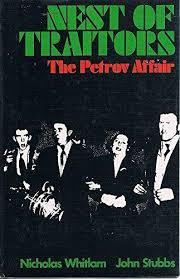
Book Review - Nest of Traitors: the Petrov Affair by Nicholas Whitlam and John Stubbs

Nest of Traitors : the Petrov Affair by Nicholas Whitlam and John Stubbs

Milton, Queensland: The Jacaranda Press, 1974     ISBN 0701607963

The Petrov affair, as it has become known, has - in the twenty-first century - become a footnote of the Cold War; a minor episode in the to-and-fro of the espionage activities of the Eastern Bloc and Western Allies.

At the time it was a major sensation in Australia, which had long been considered a backwater in most aspects of policy and activity in this struggle. Petrov's defection, and the Royal Commission into Espionage initiated by Prime Minister Robert Menzies in its aftermath, changed the political landscape in Australia, led to the toppling of Opposition Leader and head of the Parliamentary Labor Party Doc Evatt, and also led directly to the Labor Split, which consigned that party to opposition for another twenty years.

Therefore the circumstances of Petrov's defection, and of the Royal Commission, have been for many years a source of historical and political angst, not helped by the fact that - given the nature of what occurred - much secrecy surrounds the whole affair.

This book, written by the son of former Prime Minister Gough Whitlam (in fact published while he was running the country) and a journalist, certainly has an agenda to push. That agenda is, that if the defection wasn't actually staged by the Government, it was at least timed by Menzies to help him win the election in which the defection, Royal Commission and the spectre of Communism became major issues. The authors use a classic straw man set up to try and show that many of the documents that Petrov bought with him were manufactured, and that Petrov himself wasn't all that he claimed to be.

While there is little doubt that Menzies used the defection for maximum political advantage, it is also clear that Evatt did much to contribute to his own downfall. By choosing to represent his staffers, who became embroiled in the Commission, he became personally involved himself, and was obsessed with the idea that the documents - the infamous document "J" in particular - were forgeries, and that Petrov, far from being the MVD agent he claimed, was merely a lowly cipher clerk.

Whitlam and Stubbs rely heavily on John Burton and Michael Bialoguski's stories of what happened, and of course on the proceedings of the Commission itself. I find their excoriation of Petrov, based on the Commission's findings, a trifle naive; as even at the time it was clear there was material Petrov had brought with him that was not in the public domain. Many years after this book was written the publication of the Venona decrypts supported Petrov's version and shed light on such additional information that he provided the West. Burton is not an unbiased source, as he was closely allied to Evatt and the Labor Party, and also had strong views about whether Australia should in fact have it's own intelligence and counter-espionage service.

As a guide to the Petrov affair, this book needs to be read with reservations. As a guide to the political storm the defection caused at the time, and was still causing twenty years later, it's a fascinating time capsule.


Cheers for now, from
A View Over the Bell

Wednesday, 4 May 2016

Book Review - Talking to my country by Stan Grant

Talking to my country by Stan Grant

Sydney: HarperCollins, 2016                           ISBN 9781460751978

Stan Grant is a well-known journalist and broadcaster, and he wrote this book as a cri de coeur to his fellow Australians, after the Adam Goodes controversy had taken place on Australian football fields.

As the son of a Wiradjuri man and a Kamilaroi woman, Stan understands only too well the rejection, confusion, and sadness that goes with growing up as an Australian Aboriginal. This book is his attempt to portray what that feels like, and how mainstream views of Aborigines affect his people.

He does this by telling us of his life - a life of constant movement through western New South Wales, his father working hard to keep food on the table, and the welfare away from his children. The way Aboriginal people have been, and still are, treated by their own country burns through these pages. Grant describes how his people, who had lived on their land for tens of thousands of years, are denied not only title to said land, but have had their whole lives taken away from them by white settlement.

This invasion (for that is how it is seen by Aboriginals) has left its mark on the people. Grant clearly shows how confusing it is to be an Aboriginal in Australia, where you are ignored, or vilified, or told to behave like "the rest of us", but when you try to do that you have your colour and heritage thrown back in your face. Grant acknowledges that in many ways he has been lucky, but the fear and confusion remained even as the physical trappings of his personal success increased.

Eventually Grant left Australia, to escape the expectation and degradation he experienced, to places where his Aboriginal heritage was not loaded with personal politics. At first he found it a release, but everything he experienced continued to burn and grow inside him until he broke under the strain.
He returned to Australia, and to his conflicted self. When back in his country, he can breathe deeply, and feel connected again to his people. The position of Aboriginals in society seemed to have changed while he was away, and yet... Grant explains well how, when the national anthem was played at the Sydney Olympics he found it impossible to sing along, as, for Aboriginal people the lyrics are almost a sick joke, and how, given what has happened to Aboriginals in the last 200 years, people like Adam Goodes can't " get over it" when racism yells in their faces at a football match.

This book is not a polemic aimed against white Australia. It is a heart-felt document of what it feels like to be Aboriginal in Australia, and the effect of racism and misguided policies on his people.

At the height of the Goodes controversy, Grant wrote an article that he reprints in this book, and which deserves quoting at length -

" But this is how Australia makes us feel. Estranged in the land of our ancestors, marooned by the tides of history on the fringes of one of the richest and demonstrably most peaceful, secure and cohesive nations on earth.

The 'wealth for toil' we praise in our anthem has remained out of our reach.....'Australians all let us rejoice' can ring hollow to us. Ours is more troubled patriotism. Our allegiance to Australia, our pride in this country undercut by the dark realities of our existence.....

From childhood I often cringed against my race. To be Aboriginal was to be ashamed....

We were ashamed of the bastardised wreckage of a culture that we clung to.....

And as I grew older I pieced together the truth that we didn't choose this. We are the detrius of the brutality of the Australian frontier.... "

I could go on, but it's probably best just to pick up the book and read it yourself. It's well-written, accessible and does not shy away from the hard questions. Grant would like to contribute to the long hard job of true reconciliation in Australia, and Talking to my country is a solid effort. Read and learn.

Cheers for now, from
A View Over the Bell

Tuesday, 15 March 2016

Book Review - The legend of the Nineties by Vance Palmer

The legend of the Nineties by Vance Palmer

Melbourne: Melbourne University Press, 1963

How did Australia as we know it now come to be? It's a question that many ask, and the answers are as varied as the people asking the question. Vance Palmer approached the problem in the late 1950s in this work, looking at what for many seemed as a pivotal decade in the formation of modern Australia, the 1890s. Palmer too sees it as very important, although perhaps not for the reasons others might chose.

Palmer sees distinct eras in early Australian history - convict, pastoralist, gold. Each brought something to Australia - the convict era brought institutionalised cruelty, pastoralism brought feudalism, and gold brought numbers. The sudden influx of people into the country during the gold rush changed more than just the landscape. The nature of gold seeking encouraged an individualist outlook, and the people that came to do the seeking, by and large, were independent characters who saw themselves as equals amongst equals. This influx prompted changes to the law, to land availability, and to the mindset of those who lived in Australia.

It was from this time onwards that ideas of what Australia could become began to coalesce. There was a growing thought that, in this vast "new" land, "new" systems of government could be applied to run the country. By the 1890s the country also began to develop its own literature and folklore (needless to state that the tens of thousands of years of Aboriginal lore was all but ignored by the white settlers), and these changes led to some new developments.

The Bulletin encapsulates the changes that Palmer elaborates, and he see it as a very important part of the growth of an Australian identity, as it captured the zeitgeist of the times, and made it available to all. It was for progress, but had no particular ideological  bent, lending its pages to single taxers, socialists, protectionists and others over the years. Isolationism was one thing that was a constant in the pages of The Bulletin, and beyond.

The other aspect of emerging Australian culture that The Bulletin promoted was writing. While a lot of second-rate material got into the paper, many of Australia's important writers and poets got their start between its covers. Paterson and Lawson were the best known, and their competing visions of life in the bush sets the scene for the final part of Palmer's book.

The old certainties of Australian life, such as they were, came to an end in the 1890s. The end of the gold boom, and the depression that followed, revealed several truths about Australia: the countryside could not support as many people as thought, and a drift to the major cities began that is still going on today. It was also clear Australia couldn't ignore the rest of the world, as that was where the money was coming from. The economic depression concentrated the antagonism between labour and capital that had been developing for the last 20 years, and led to the first big strikes in Australian history, at the docks and by the shearers. Ironically it was the superior industrial organisation by the employers that broke the back of these strikes. The outcome of these ructions - which included William Lane's flawed plan for paradise on earth in Paraguay - could have been almost anything, but ended in accomodation and compromise, and the arbitration system that served Australia well for many decades after Federation.

Palmer sees this accomodation between capital and labour as a lost opportunity: lost through the lack of true political awareness in the majority of workers and their acceptance of near-enough is good enough ("stringy-bark and greenhide methods"), the compliance of the new Labor Party in the system, and growing security fears leading up to World War One. He doesn't have much time for the political class in Australia at the time, seeing them as self-interested and certainly not connected to the majority of Australian people.

However, what he does recognise is that the 1890s was a decade where the idea of being an Australian took root with an increasing number; which developed further after Federation, and moved out into the wider world during the War. ANZAC in some ways set the seal on the previous 30 years of development of Australian culture in all its forms, when so many men and women travelled over the seas and realised that they were a different culture to the other parts of the Empire, and that what they had developed was in many ways better than the society of the Home Country. But that would be the subject of another review.


Cheers for now, from
A View Over the Bell


Monday, 29 June 2015

Book Review - Louisa by Brian Matthews

Louisa by Brian Matthews

Melbourne: McPhee/Gribble, 1988                                             ISBN 0140108645


Other books consulted in the course of writing this review -

The first voice of Australian Feminism : excerpts from Louisa Lawson's The Dawn 188-1895 by Olive Lawson
Sydney: Simon & Schuster Australia, 1990                                  ISBN 0731801377

Henry Lawson by Stephen Murray-Smith [Australian writers and their works, no. 4]
Melbourne : Lansdowne Press, [1962]

The lonely crossing and other poems by Louisa Lawson
Dubbo, NSW : Review Publications, 1986 (facsimile of first edition published 1905)
                                                                                                    ISBN 0909895600


While Henry Lawson is a household name in Australia due to his poems and stories, it is less well-known that his mother Louisa also wrote and published poetry and prose. She may be slightly more well-known as the publisher of the first Australian magazine to be produced entirely by women, The Dawn. She may be even better remembered as one of the founders of the Women's Suffrage movement in New South Wales. She would be almost unknown as the post-mistress of Eurunderee, whilst at the same time holding a selection of land.

Her story is truly an astounding one - like many other rural women in Australia in the mid to late 1800s, she led a life of poverty, sadness and hardship. Unlike any other woman, when she arrived in Sydney she used her boundless energy to involve herself in many causes, and to set up a magazine that became a beacon for women's issues, and was a successful business until she shut it down in 1905.

Unhappily married to a husband who was eternally hot with Gold Fever, her early married life saw her drift from place to place, wherever the "rush" was on. Even when Peter took a selection of land, his wandering didn't stop, so it was up to Louisa to try and make money, hence her move into the post office, and other schemes that did more-or-less well. What she did do during those years on the selection was a lot of thinking about women and their lot in the way Australia was run, and in how Australians lived.

When the selection finally failed (Louisa ended up giving it away in 2 acre lots as an incentive to subscribe to The Dawn), she moved with her children to Sydney, where she first set up as a boarding-house mistress. She had an interest in literature and spiritualism, and quickly began creating networks within those spheres. Louisa, along with some others, began a newspaper called The Republican, which as its name suggests tapped into the upswell of such feeling in the 1880s. It did not last long, but it was important in several ways - it gave Louisa the knowledge of how, and the confidence to, run her own journal; it gave Henry an outlet for some of his early material and gave him some inspiration in and of itself (The Cambaroora Star is surely based on his printing experiences), and finally it taught Louisa how to run successful campaigns in the press (or at least learn from unsuccessful ones).

In fact Louisa had from an early age, despite the discouragement of her parents, been writing poetry, and many of the pages of The Dawn were written by her. Her views were often forthright, and her actions backed her words too - she faced down the NSW typographical union when it tried to close down her paper by declaring women unable to run printeries - she fought against both government and unions at the same time to support women in their struggle for equality.

Her bad fortune continued along with the good - the struggle for the vote was successful, and The Dawn did well, but, after being knocked over by a tram in 1900 and spending almost a year recuperating (her daughter Gertrude ran The Dawn in her absence), the spark seems to have left her life. In her past, often after childbirth, she descended into what today would be called depression, but after the accident it seems her character changed in a more permanent way. In 1905 she decided to close The Dawn, and she spent the rest of her life in Sydney in straitened circumstances, until developing senility saw her into a mental hospital in her last year. By the time she died she was almost forgotten, with the obituary in The Bulletin stating "Mrs Louisa Lawson, the mother of Harry Lawson, died the other day at the ripe old age of seventy-two. Once upon a time Mrs Lawson edited a paper called The Dawn and took a prominent part in the demand for woman suffrage. Since that day twenty years ago, Mrs Lawson has faded from the public eye."

Her children had battles with their own demons - Peter was hospitalised more than once for mania, as was Charlie, and of course Henry's battles with alcohol have been well documented. Matthews, in Louisa, shows the difficult relationships Louisa had with her children, who all struggled in one way or another under her dominating aura.

In fact Matthews' book is - despite its quirks, which are many - a very good biography, as attested to by it winning both a NSW and Victorian Premier's literary award, among other prizes. He manages to expose all the facets of Louisa's life, except perhaps the personal, with an engaging clarity for most of the time, and manages to get across the bustling purposefulness of her character, which makes her later decline all the sadder.

Matthews' quirks though, I am sure, put many readers off. They do get less instrusive as the text gains momentum, and while they might seem radical, actually get in the way of the book on more than one occasion. The book starts with a beginning entitled "notes on an alternative text", where Matthews chronicles his difficulties dealing with the life material of Louisa, of which much cannot be verified to academic standards. As Matthews is an academic, this issue dogs him, and so he comes up with an 'alter ego', Owen Stevens, who will write about and discuss these parts of Louisa's life, while Matthews 'the biographer' sticks to the facts. This little postmodern trick doesn't really do the book any favours - both the biographer and Owen Stevens end up dealing with the same material, and their voices merge, as the distinction between verifiable fact and hearsay merge in the telling of the life. Matthews obviously has an issue with the idea of a writer of biographies interposing him or herself into the life they are writing, but his approach to the book doesn't solve that problem, and in fact doesn't really answer any questions at all. At one stage he disparages non-academic biographers, but I think if he had gone down the path that such a biographer would have taken with this material the book would have been a little less disjointed in its earlier sections. If Matthews felt he couldn't trust himself to interpret the evidence, both hard and "soft", and create the biography using his critical faculties, why, the reader might ask, did he attempt it in the first place?

Thankfully, after a few frankly silly asides from Owen Stevens (a short story and book of a musical), the 'alter ego' calms down and for most of the middle section of the book the reader would be unaware of the shift in authorial voice if it wasn't marked out in the text. Early in the book Matthews states his aversion to biographies that set the "mood of the times" because they don't have enough personal material to work with, and he is successful in placing Louisa in context without expanding too much into general history. The sections of the book that deal with Louisa's time in Sydney are on the whole better than the earlier section, and this could be due to the fact that Matthews has more "facts" he can draw on in this public phase of Louisa's life.

Matthews does in fact seem reluctant to draw many conclusions from anything other than documented fact or prose writing by Louisa herself. Therefore he has little to say about her personal life. She was estranged from her husband for many years before his death in 1888 (when Louisa was 40), and while Matthews often mentions her striking looks his speculation about her engagements with the opposite sex ends with some remarks about some of her poetry.

He devotes a section of the biography to Louisa's poems, and notes that a true woman poet was a rare thing at the time, and Louisa's verse is no worse than, and quite often much better than, a lot of other verse published at the time. Louisa had corresponded with Henry Kendall until he died (she formed a committee that successfully gathered money for a memorial to him), and much of her verse exhibits a connection to him and his style, and that of much of the early Australian verse tradition. Most of her poetry is in simple metre, ballad form or rhyming couplet. The subject matter though is very much of a piece with the rest of Louisa's life

- careworn unhappy women who would welcome death -

In ground that is hallowed let happy folk lie,
But give me a grave in the bush when I die.
For have I not lived, loved, and suffered alone?
Thus making it meet that my grave be unknown
.     .     .     .     .     .     .     .    .    .    .    .    .    .    .
The sound of the stockwhip away on the hill.
Ah God! It is day, and I'm suffering still!
(from Lines written during a night spent in a bush inn)

- Lonely mothers who are the only source of life for their children -

But because thou lovest me,
For thy sake I'll fight us free
From this deadlock of despair,
From this hell, to heav'n, I swear!
(from Light in darkness)

- Reflections on the work for equality -

We lead the way, we lead the way,
We rise alert to meet each day,
...
We turn the sod, we stir the pool,
We point the way to those who rule.
(from The reformers)

- a mother's love for kin (and Louisa's dislike of tobacco) -

Oh, my boy, come in, do,
You are back at last;
Years since last we saw you -
How the time has passed!
...
Felt that you were coming,
So I wrote to Bob;
He says things are humming,
And you'll get a job

Now, dear, don't come near me,
You're all over dust;
Can you smoke? Oh, dear me,
If you really must.
(from Back again)

- the lustfulness and mercilessness of men toward women -

I wooed her in delicate fashion,
Then sullied her soul with my lust;
I poisoned her life with my passion,
And murdered her beautiful trust.
(from To a libertine)

- her hatred of alcohol (Louisa promoted and agreed with the aims of the Temperance movement) -

I take from its kind the brightest mind
And make it with idiots link;
And oft I fly on the gallows high
A grim effigy done by Drink

I curse the lives of innocent wives
Who could never know ought of me;
But what care I for their blighted lives
Nor the terrible wrongs I see?
...
I curse the land, and I curse the sea,
While the poets my praises sing;
And Satan is wrath; he envies me
All the souls of the saints I bring.
(from The song of Bacchus)

- the madness of Gold Fever -

When you have sunk a score of holes,
And drove a hundred more,
And every belssed one has been
Worse than the one before;
(from "Another for the Queen")

- There are some more personal verses too, of love lost perhaps? -

We will part now for every, you and I,
With a frozen smile and a faint good-bye:
...
We will part just here while our new love dies,
...
But tho' you are taking all else away
There is one rare jewel must say you nay -
It is mine, all mine; it is mem'ry's prize.
(from "So many a deed of wrong for right is meant.")

I plucked my love while in its virgin beauty
And memorised it, for I was afraid
That it might warm to lust or chill to duty;
Or change to hate, or suffer blight and fade.
(from Renunciation)

But she to the right turned, and he to the left,
Still keeping the course pride and anger had cleft.
Which led o'er the breakers of passion and pain
Far out o'er teh wide sea of "never again,"
(from Divided)

- and sometimes she was writing a nice lyric -

I love at eve to wander
Alone upon the hills
(from Sunset)

You can see from Louisa's verse where and how Henry developed his verses, and perhaps if the times were different in the late 1800s in Australia it would be Louisa rather than her son that we would be celebrating.

Louisa Lawson is an Australian worth knowing more about - Louisa is a good place to start.


Cheers for now, from
A View Over the Bell


Tuesday, 28 April 2015

Book Review - Confessions of a failed Finance Minister by Peter Walsh

Confessions of a failed Finance Minister by Peter Walsh

Sydney: Random House Australia, 1995                                 ISBN 0091829992


The recent death of Peter Walsh at the age of 80 drew me back to this book, which I read with interest when it first came out. While some parts of the book have dated a little, the strength of the book - Walsh's clear-eyed view of how to best serve the working men and women of Australia - is even stronger now than when it was written.

Walsh's book is not a political memoir in the usual sense, but more a description of how politics can corrupt good policy. Walsh was one of the few clear-eyed members of the Labor government of the 80s and 90s: he, unlike many other politicians, fully understands that for governments to achieve anything, they need to make the best use of the money that they coerce from the public. This involves a rational look at all options, and ensuring that the scarce funding goes to the best place to do the best thing.

As a reader might guess from the title, Walsh feels that the government he was part of - most importantly as Finance Minister - while doing some good things, mostly squibbed their chance.

In some ways the best way to describe the tone of this book is to quote from it - it helps that Walsh is eminently readable. Some examples follow -

"It is easy to understand the politics behind grandfathering [re: instituting means testing of pensions]....but its moral justification is suspect to say the least. It says that existing beneficiaries of anomalies and rorts can continue to receive them, but no new entrants will be permitted. It is certainly discriminatory, but does not attract the attention of 'anti-discrimination' activists and their hangers on."

Regarding the Bureau of Agricultural Economics claim that that a 10 percent sales tax on wine would reduce sales by 14 percent - "Even if retail prices increased by 10 per cent - which they wouldn't - demand elasticities of 1.4 per cent are only found where there is a close substitute. There is no close substitute for cask or flagon wine. At the upper restaurant end of the market, anyone who can afford to eat in a restaurant in the first place will not be deterred from buying a $15 bottle, or a second bottle, because the price had gone up by 75 cents."

Regarding uranium sales, a vexed issue for the Labor party throughout the 80s and 90s - "But because the French tested weapons in the South Pacific and supplied nuclear technology, the ban on sales [of uranium] to France was retained. (They were also primarily responsible for the EEC Common Agricultural Policy, and half of them were on Hitler's side during the War.)"

When dealing with the Department of Foreign Affairs' objection to the Finance Department's proposal to sell surplus land in Tokyo - "The Japanese Government would be deeply offended. The site contained an ancient well, almost a Japanese sacred site. (The answer to that was if the well was so important, and since Japan had the world's biggest current account surplus and we had about the world's biggest deficit, the Japanese Government could buy it.)"

On former education minister Susan Ryan - "Susan carried throughout her political career much of the Whtlam-era baggage, including a naive affinity to China. Following her visit to China in 1976, she told me we could learn a great deal from China, to which I replied 'Cut it out, Susan, if you and I were in China we would both be in concentration camps'." [and Walsh claims to have liked Ryan!]

When the government was declining, and Walsh was getting sick of the slippage he addressed a Labor lawyers conference "that the Budget was being 'oversold' (all Keating's Budgets were), that the new Parliament House was a scandalous waste of money, that the country was still in economic jeopardy, that expectations must be scaled down; and told the bleeding hearts that Labor's child care policies which delivered subsidies of up to $100 a week to some, regardless of how high their household income was, while the vast majority of women with pre-school age kids who plucked chooks at Inghams for less than $300 a week got nothing, were a disgrace."

He continues on in this vein - he describes Hawke as vain and too engrossed in being a statesman, Keating as someone not as smart as he thought he was, and many other ministers as wilfully ignorant or beholden to vested interests to the detriment of good government. Hawke famously said "My friend Peter always was a Cassandra", and Walsh points out that Hawke's ignorance of Greek mythology led him to inadvertently hit the nail on the head - Walsh knew what was going to happen, but nobody believed him (he at least was able to use that line to his own advantage - for many years writing a column named the Cassandra Column for the Australian Financial Review).

Walsh was always focussed on how the government could most effectively assist working people without feathering the beds of the middle classes. He abhorred tariffs, industry assistance and non means-tested handouts.

What is most depressing about reading this book in 2015 is not the grubby politics that occurred during Walsh's time, but that when one looks around the current political arena there are no Walsh's on any side of politics to cut through the spin and ensure that a government does what it should.

I wonder if we'll see his type again.

For anyone interested in Australian political history, and those who want to think about what it is to have good government, this book is well worth reading.


Cheers for now, from
A View Over the Bell

Tuesday, 29 April 2014

Book Review - Midnight in Sicily by Peter Robb

Midnight in Sicily by Peter Robb

Sydney : Duffy & Snellgrove, 1996                                      ISBN 187598920X


Re-reading books can be a fraught business - the impression a book has on a reader can be a combination of the content of the book, the time and place it was read, the state of the reader's mind when reading, how receptive they were to the book's content, and how that content reacts to everything else in the reader's mind. Re-reading a book also takes time away from the possibility of reading something new....

Some books, I think, should not be re-read: they are a book for a certain stage of a reader's life, and revisiting them would produce nothing positive, and in fact might spoil the good memories of that book. On the road would be disappointing for me if re-read, as it just wouldn't seem as ground-breaking to me now as it did when I first opened the covers of my copy. My Father tells me that the worst thing he did was re-read Seven pillars of wisdom in his middle-age, after first reading it in his early twenties; the re-reading destroyed forever the great opinion he had of the work from his first reading (Seven pillars is, despite this, still on my list of books to read again someday).

Other books though, are a re-readers delight - seemingly inexhaustible mines filled with nuggets of literary gold - Midnight in Sicily is such a book. What seems astounding is that a title ostensibly about the Mafia in Sicily, written by an expatriate Australian (who has never lived in Sicily), could be such a book.

Peter Robb did spend about fifteen years living in Naples, so he does have some experience of Italy. He also had the expatriate's eye for the ambiguities and absurdities of life that a local might pass over. In particular, when it comes to organised crime in Italy, he was not involved, so could ask questions and probe in ways that perhaps locals were unable to do.

I wrote that this book is ostensibly about the Mafia - reading this book also gives you a potted history of Italy, of Italian food, Italian Art, Italian Literature and naturally Italian politics. It is also a great travel book. The wide-ranging arc that Robb takes in his book about crime is what makes it such a gem to re-read. Each time it's read the book gives the reader something new, whether it be the influence of the Arabs on the food of Southern Italy, or the outcome of the great Naples earthquake of 1980, or which late-night-cafe is the favourite haunt of the ladies-of-the-night (who are not all ladies).

Robb could have written a serviceable history of the Mafia along the lines of Mafia Republic, but he wanted to do more - he wanted to get under the skin of the Italian psyche and try to explain to people like me just how something like the Mafia can even exist in what seems to be a western liberal democracy, and become so pervasive.

And in fact most of what might seem at first blush to be off-subject in Midnight in Sicily merely serves to show how pervasive the Mafia is in Italian life. A rumination on the history of ice-cream reminds us that the mafia used to control the snow-trade from Mt. Etna, where the original ice-creams came from. A description of the Mattanza leads into stories of Mafia massacres, a discussion of Lampedusa's Il Gattopardo segues into a visit to his old villa to see the (then) current mayor of Palermo, who was struggling to reduce Mafia influence in the city.

With great skill, Robb brings the reader into the world of the Mafia, where what is not said is in many ways more important than what is - that seemingly innocuous things like receiving a telegram from a certain person has much more meaning than what might be conveyed from the message enclosed. Robb shows how the Mafia has corrupted society by exploiting the Italian character, and by being able to quickly move into the "cracks" that appear in the body politic owing to the sclerotic nature of the Italian State.

Midnight in Sicily was written in 1995, and the focal point of the book is the beginning of the trial in Palermo of Giulio Andreotti - Robb weaves his story through-and-through this book and what stands out with this particular re-read is how in Italian politics only the names change - Berlusconi would fit into this book like an arm into a sleeve (he does appear in a cameo at what was then the start of his political career).

Robb's diversions into Italian history, especially recent history, are an elegy for an Italy that had lasted for Millennia, only to be destroyed after the war by the Mafia. There is a fin-de-siecle quality about Midnight in Sicily, and a repressed rage at how men and women of integrity have been thwarted at every turn by those who crave power and money, who have turned the Mafia into an octopus with tentacles that reach into every sector of business and politics.

Robb desperately wants those who are fighting this insidious curse to prevail, but his rational mind requires him to believe that while some victories might be won, defeat of the Mafia will only occur with a change of mindset and culture in Italy, which seems too big a hope to sustain.

All this information is imparted with a wonderfully lucid, limpid writing style, and an artist's gift of deep observation and synthesis, which leaves the reader wiser at the end of the book. And the end of the book will come very soon, as it is one that is read quickly, even if it is digested slowly.

As an insight into the Mafia, this book is invaluable. As an insight into Italy, it's un-put-downable. as a work of literature, it's definitely a minor classic.

Highly Recommended.


Cheers for now, from
A View Over the Bell

Tuesday, 1 April 2014

Book Review - Comrades come rally! by John Sendy

Comrades come rally : recollections of an Australian Communist by John Sendy

Melbourne : Nelson, 1978                                                     ISBN 0170052141


A fascinating and frustrating book. John Sendy was a life-long Communist, joining the Party during the War, and rising through the ranks to be President, before he retired in 1974, disillusioned. As the title suggests, this book is a personal look at a life spent working for the Party, and is about the happenings within the Party - there is not much theoretical material in this book (which is ironic given that Sendy suggests a lack of theoretical muscle in the membership led to many of the problems the Party suffered). In fact Sendy admits he was never much of a theorist, being a person who thought that the aims of Communism seemed right to him, and something worth striving for.

Sendy grew up in Adelaide and environs, and was seen early on as a potential leader in the Party, so was sent to China for three years of training. This experience was very formative in Sendy's thinking, as he drank in the Chinese way of Communism, which led him to begin to question the way Communism was practiced in the USSR. Later on he began to question the Chinese ideology as well, and moved toward the thinking of the Italian and French Communists, who were working through representative democratic forums to effect change, something that to Sendy seemed to make more sense in the Australian situation.  He deplored the inability of the CPA to see that they should support the efforts of the Australian Labor Party, along the lines of Italian support for Centre-Left parties. He notes that the Italian Communists ended up in a Left government in Italy by following such a policy.

This thinking brought him into conflict with some of the other leaders of the Party, who more slavishly followed the Moscow or Peking line. Sendy doesn't explicitly say so, but implies that the lack of intellectual strength within the Party led to this sort of outcome.

The history of the Communist Party of Australia after the war, and especially from the 1960s on, is one of grievances, fights, and splits, mostly over who was more "pure". Like many fundamentalist organisations, members ended up devouring each other. Sendy deplored this situation, continually advocating a more inclusive Party, that allowed it's members to disagree and argue to come up with policy. This was not how much of the other leadership wanted to run the Party - being more authoritarian in approach - with an "if you're not with us you're against us" attitude.

Sendy's fears of the outcome of this kind of thinking came true - the party kept shrinking and became more irrelevant to the Australian polity as time went on. From a high of over 20,000 members in the 1940s, by the time Sendy retired in the mid seventies the party numbered less than 2,000 members. Sendy recounts with sadness the split that led to the formation of the Socialist Party of Australia, something he thought was avoidable, and that unnecessarily diffused the Socialist effort in Australia.

Comrades come rally chronicles the decline, and the internecine backbiting that caused it. It also chronicles many of the characters of the party, and stories of their achievements, both good and bad. Sometimes what's written here comes across as very naive, but Sendy tried at all times to move the Party in a direction so that it could make a difference in politics in Australia. That he failed is not an indictment of his efforts.

An interesting document of the times, this book is neither completely personal reminiscence, nor is it history, nor is it an ideological statement. Falling between these stools, it is not quite as satisfying as it could be, but is interesting nonetheless.

Cheers for now, from
A View Over the Bell

Sunday, 15 September 2013

Book Review - His Excellency's pleasure : a satire by Donald Horne

His Excellency's pleasure : a satire by Donald Horne

Melbourne : Nelson, 1977                               ISBN 0170052109


The Dismissal stands high in the long catalogue of political dramas that have beset the Commonwealth of Australia. It has certainly generated a huge amount of print over the years since 1975, mostly from the left side of Australia's politics.

This little entertainment comes from the period soon after the dismissal of Whitlam - Donald Horne is probably best known for coining the phrase "The Lucky Country", which was the title of a book he wrote in the 60s, bemoaning the inability of Australia to move beyond providing food and minerals for the rest of the World. In His Excellency's pleasure, he has extrapolated the crisis of 1975 by creating a fictional future where Australia is run to the letter of the Constitution, and where a new Governor-General wants to make his mark. The Governor-General's butler is of great assistance in his project, and as he works his way through various sections of the Constitution, the Governor-General gradually takes control of the armed forces, creating legislation, and finally of Parliament itself, all by sticking strictly to the "black ink" of the Constitution.

At first this small tome reads like a grab-bag of all the concerns the Left had at the time with the Dismissal, but Horne is no idealogue, and there are a few twists and turns in the story that leave most of the Australian polity tarred with the same brush. Whilst skewering the Conservatives, Horne also gets stuck into the Union movement as well, especially their propensity to change into "one of them" when power comes their way.

Just when the Governor-General thinks he has the whole thing sewn up, who should pop in for a visit but the English Monarch, who throws a huge spanner in the works (and provides for a slightly pompous and disappinting ending to the book).

This little light-hearted book can be knocked off in an hour or so: if you have an interest in Australian politics, it's not a waste of 60 minutes.

Cheers for now, from
A View Over the Bell